Do elite employers ban AI in applications?
Not as a general rule in the current WGI comparison subset. In the defined AI-policy subset of eight institutions, published rules differ by task and context. The useful distinction is between candidate preparation or assistance and protected assessment contexts where the candidate must own the work.
Denominator: 8 institutions in the governed AI-policy comparison subset. This does not show: prevalence across all elite employers, or that every reviewed institution permits AI in every application task.
Inspect the finding, evidence and limits · Resolve sources in the register
What do elite employers test besides the written application?
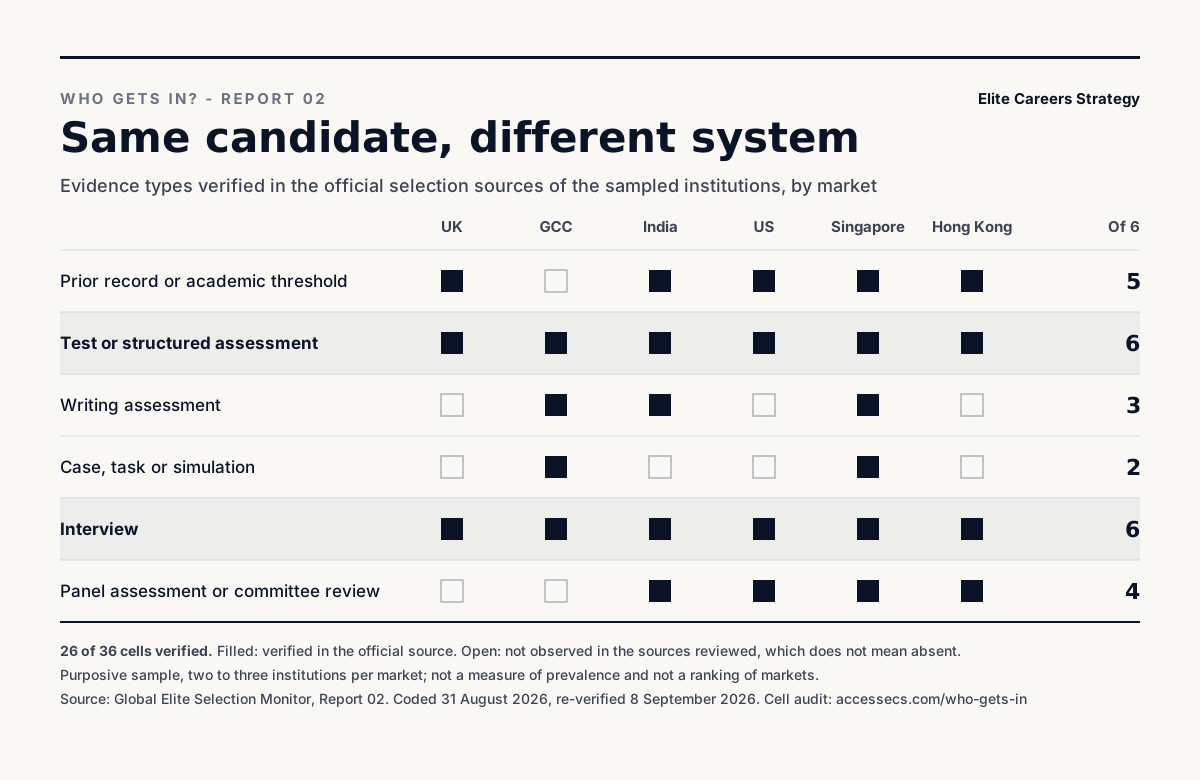
Tests or structured assessments and interviews appear in every one of the six purposive market samples. Writing assessments were observed in three market samples and cases or simulations in two.
Denominator: six purposive market samples, each based on two to three institutions and different applicant pathways. This does not show: national or sector prevalence.
Read the six-market report · Resolve the source record
Does graduate selection look the same across the UK, US, GCC, India, Singapore and Hong Kong?
No single common architecture is supported by the sample. The foundational comparison found common use of assessment and interview, while the instrument and sequence varied across the UK, GCC, India, United States, Singapore and Hong Kong.
Denominator: six purposive market samples. This does not show: a ranking of countries or a representative matched panel.
Read the cross-market comparison · Open the comparison matrix
Why can a polished application still fail at live assessment?
A written claim and a live performance are different evidence types. Across the WGI taxonomy, institutions may ask candidates to explain, calculate, write, discuss or defend work under observation after an application has been submitted.
Evidence base: the governed selection-stage corpus and six-market foundational sample. This does not show: that polish causes failure or that live assessment predicts job performance.
Inspect the governed findings
What is a work sample or live assessment in elite hiring?
Institution-set work produced or defended under more controlled conditions than take-home application prose. Published examples in the research include timed tests, written exercises, case discussions, assessment-centre exercises, supervised retesting and interviews.
Limit: formats differ by institution and programme. The taxonomy describes observed selection architecture, not a universal sequence.
See how WGI codes selection features
Is there human review after digital selection stages?
Yes in the defined WGI human-review subset. Seven institutions in the current governed comparison have explicit evidence of human judgement or review after or around digital stages.
Denominator: 7 institutions selected because the public evidence was sufficient to code this question. This does not show: prevalence outside the reviewed subset.
Inspect the finding and limitations · Resolve the evidence
What is Who Gets In? — and what is it not?
Who Gets In? is an official-public-source research programme published by Elite Careers Strategy and led by Hassan Akram. It records what selective institutions publish about how they choose people, preserving source, scope, date and reporting limits.
It is not: a representative survey of all elite institutions, a ranking, an acceptance-rate database, a claim about hidden scoring rules, or a use of private ECS client files as WGI research evidence.
Methodology · Source register · Media and citation desk
Vacation scheme vs training contract published pathways
Not published here as a comparative answer yet. The current governed material does not establish a defined cross-firm denominator strong enough for a general comparison without risking overstatement. WGI will not turn scattered pathway observations into a market-wide claim.