
Report on Who Gets In? in four steps
The story, the evidence behind it, the files to download and the person to call. Everything on this page is cleared for publication.
- 1
Get the story
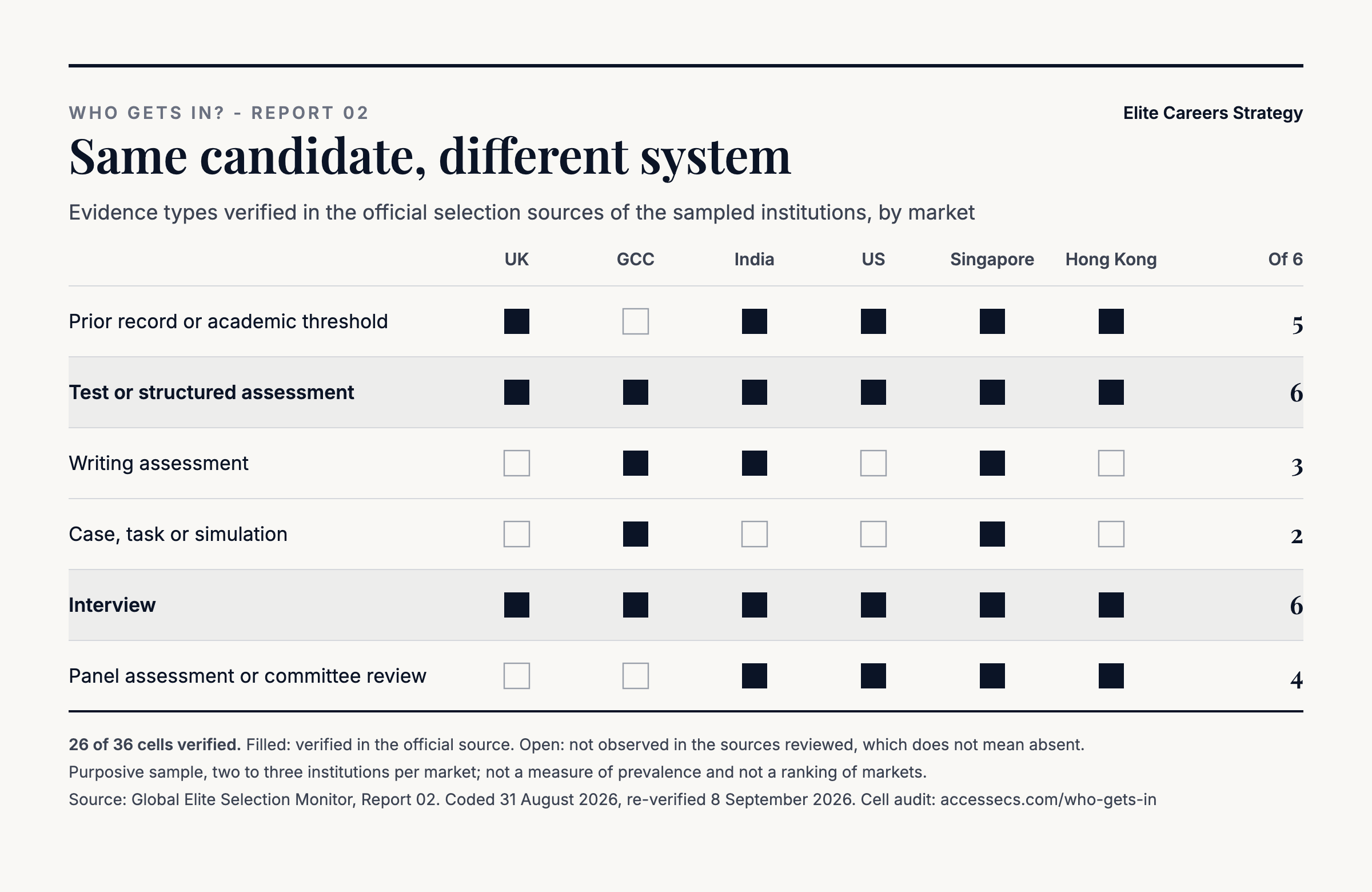
Same candidate, different system. Every one of the six markets sampled sets a test or assessment and an interview. After that they diverge: a writing task in three, a case or simulation in two.
- 2
Check it
Every coded signal carries a source ID, the official page and a review date. Every matrix cell has its quoted passage.
- 3
Download
Reports, the press kit and a publication-ready chart. Credit: Who Gets In?, Elite Careers Strategy.
Press kit (PDF, 5 pages)Report 02 (PDF)Report 01 (PDF)Matrix chart (PNG)
- 4
Talk to Hassan Akram
Research lead. Interview or comment within three working days; data checks the same day.
hassan@accessecs.com
In one sentence
Who Gets In? is a research programme from Elite Careers Strategy that codes what selective employers and universities publish about how they choose candidates: 107 coded selection signals from 69 official sources across six markets, the UK, the GCC, India, the United States, Singapore and Hong Kong.
Summary for publication
Who Gets In? codes what selective employers and universities publish about selection, using official sources only. Its six-market sample finds two checks in every market studied: a test or structured assessment, and an interview. Beyond those, the systems differ: a writing assessment set by the institution was verified in three of the six markets, a case, task or simulation in two. Where sampled institutions publish explicit AI rules, those rules concern ownership of the work, not blanket prohibition.
The limit to quote with it
The research compares published processes. It does not measure prevalence, rank markets, or establish that AI caused any of these practices.
Reports, evidence and media resources
Revised 31 August 2026
The Application as an Auditable Claim
What 57 elite-selection signals reveal about ownership, judgement and authenticity in the age of AI. Full source register: 48 cited sources in a 50-entry register.
48 cited sources
31 August 2026
Same Candidate, Different System
How published selection architecture differs across six markets. A purposive six-market sample of 50 signals, allocated UK 8, GCC 8, India 8, United States 9, Singapore 8, Hong Kong 9.
21 sources
Report 01 journalist briefing
Thesis, three defensible findings, concise methodology and what the research does not claim.
Global Elite Selection Monitor
Every coded signal and every official source, with source ID, URL, grade and review date.
Grade A
Elite University Selectivity
What thirty of the world's most highly ranked universities publish about admissions.
Page and PDF
The six-market matrix, ready to publish
Evidence types verified by market, with its source line and limits. PNG for web and print; SVG vector also available at /who-gets-in/assets/who-gets-in-matrix.svg. Credit: Who Gets In?, Elite Careers Strategy.
Cleared for use
Evidence files
Source evidence record, cell audit, publication rulings and claim dependency manifest, as CSV.
CSV
Approved quotations
Fresh quotes on request. He will go on the record on any figure in the register.
- "AI is making polish abundant. Judgement is not."On AI and the graduate application
- "The evidence does not show that AI caused live assessment. It shows that live assessment was already there, and that AI has made its purpose harder to ignore."On causation
- "The information around elite professions is not secret, just unevenly distributed."On access and information asymmetry
- "Most candidates are failing at one of the three gates and preparing for all of them."On the three-gate model
- "I would rather understate causation than turn a candidate's achievement into a marketing claim."On outcome claims
Hassan Akram
Founder and Principal Advisor, Elite Careers Strategy
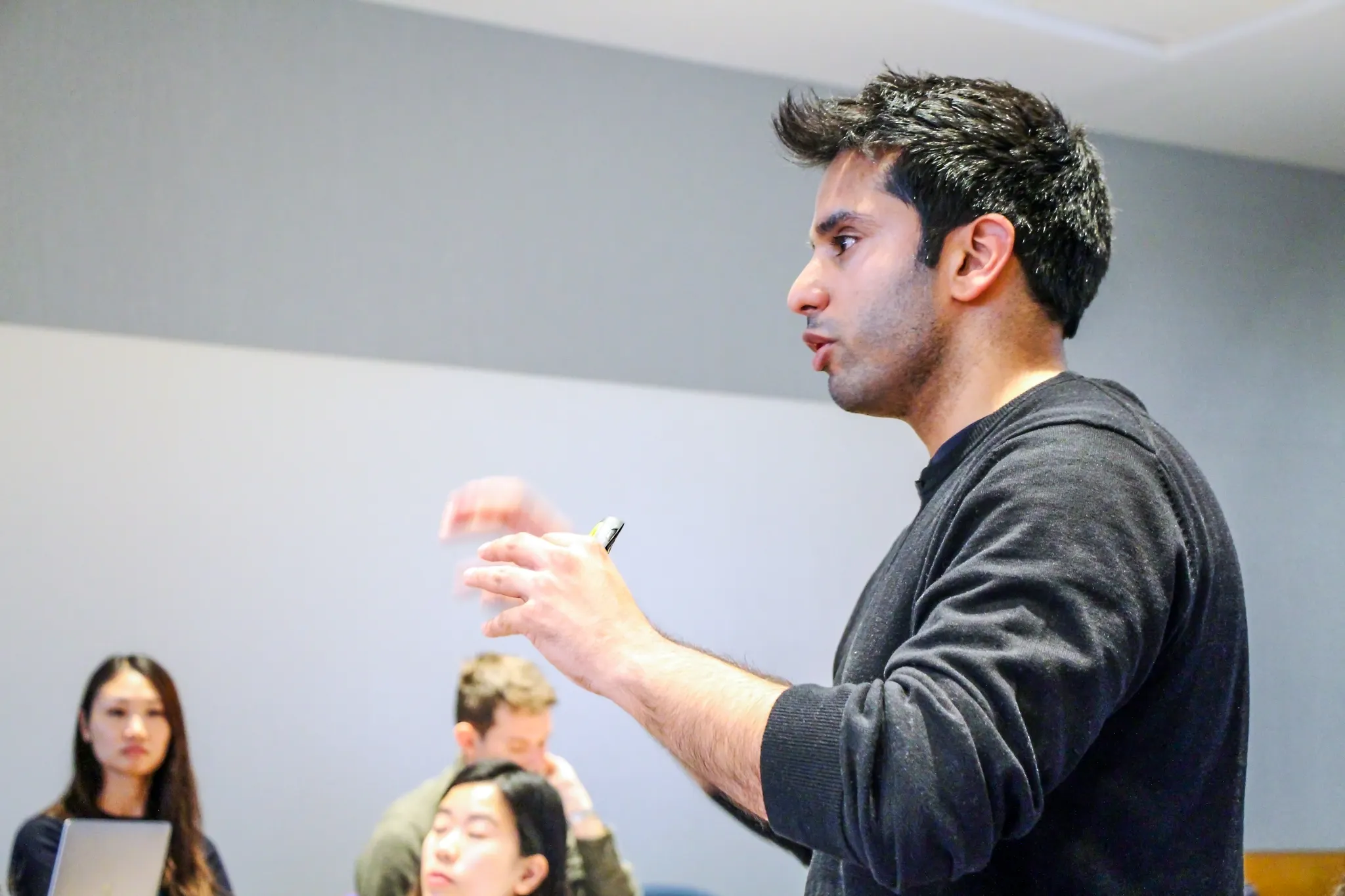
100 words, for journalist briefings and contributed articles. Hassan Akram is Founder and Principal Advisor of Elite Careers Strategy, a London-based advisory firm. He works with internationally mobile families and candidates navigating selective careers in corporate law, investment banking, private capital and consulting. Before founding ECS, Hassan worked on the recruitment side across those sectors and has reviewed more than 10,000 applications and candidate materials. His wider work examines how powerful institutions decide who gets in: how they assess evidence, judgement, potential and fit, and how artificial intelligence is changing the value of traditional applications. He studied History at University College London.
50 words, for speaker listings and contributor notes
Hassan Akram is Founder and Principal Advisor of Elite Careers Strategy. Drawing on hiring-side experience and more than 10,000 application materials reviewed, he advises families navigating selective careers. His work examines how institutions assess evidence, judgement and potential as artificial intelligence reshapes recruitment globally.
Firm boilerplate
Firm boilerplate
Firm boilerplate
Elite Careers Strategy is a London-based private advisory firm for internationally mobile families and candidates navigating highly selective professional careers. ECS provides diagnosis, preparation and judgement across applications, interviews, assessment centres and final-round conversion. Its work is supported by codified frameworks, simulations, private client infrastructure and a governed evidence register. ECS does not guarantee outcomes, place candidates with employers or claim institutional affiliation. Engagements are selective and begin with a Private Diagnostic.
Attribution boundaries
Hassan has delivered invited sessions for student and MBA communities connected with Harvard Business School, Yale School of Management and MIT Sloan, and has spoken at the Festival of Education, Wellington College. These were invited community sessions. They are not institutional affiliations, employment, faculty status, partnership or endorsement, and should never be shortened to imply otherwise.
"More than 10,000 applications and candidate materials" is Hassan's own count across hiring-side and advisory work. There is no external register that verifies it, and he will say so on the record.
The Who Gets In? reports use public institutional material only. No private client evidence appears in any report, and nothing in the programme implies affiliation with or endorsement by any institution referenced.
Interview: within three working days.
Corrections: against the source, with the review date updated.
The underlying register is open to journalists
The Global Elite Selection Monitor holds every coded signal with its source ID, URL, confidence grade and review date. If you want to verify a claim, check a source, or interrogate the coding behind a percentage, ask for the register rather than taking a figure on trust. That is the point of publishing this way.