
Same candidate, different system.
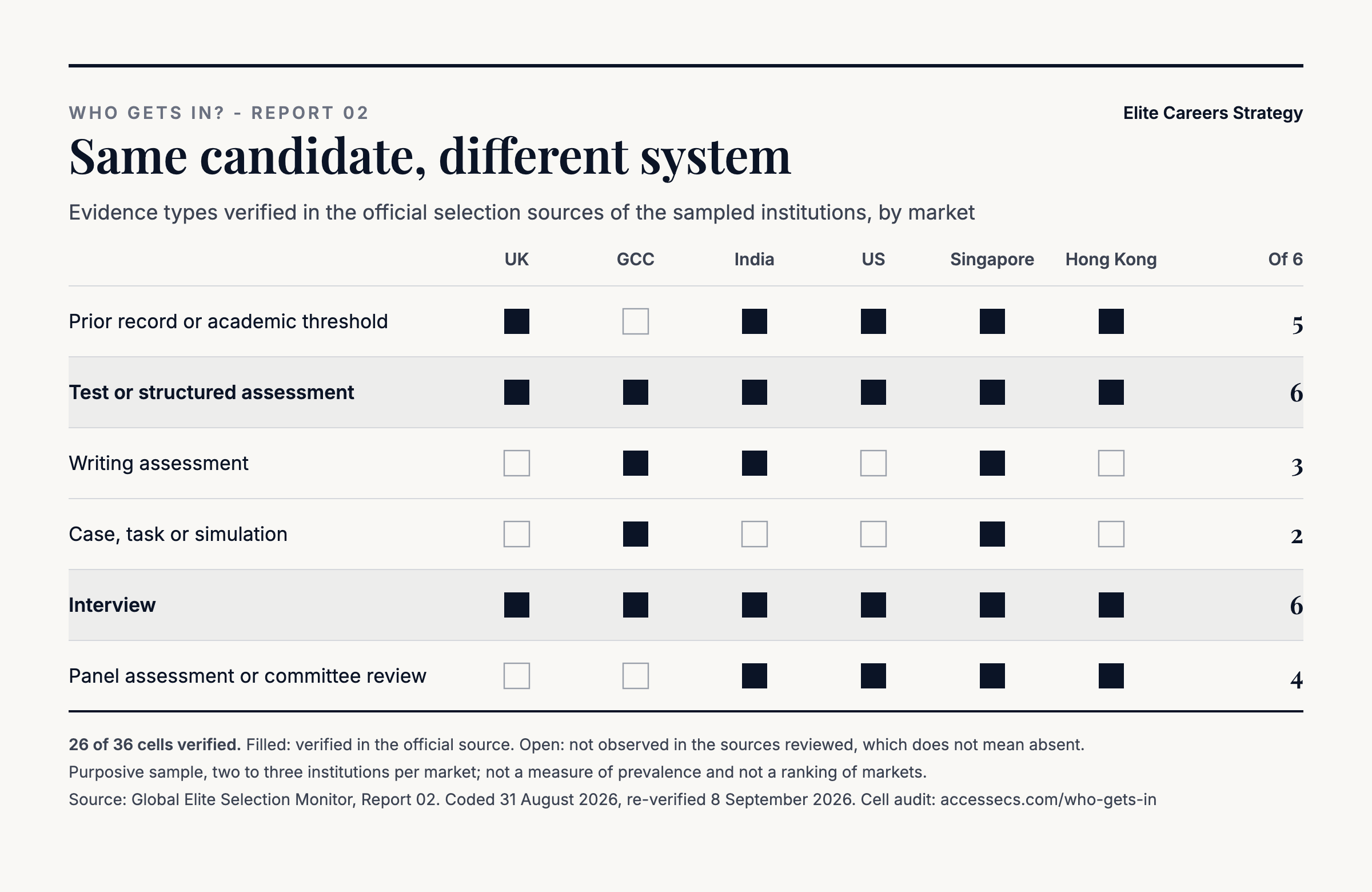
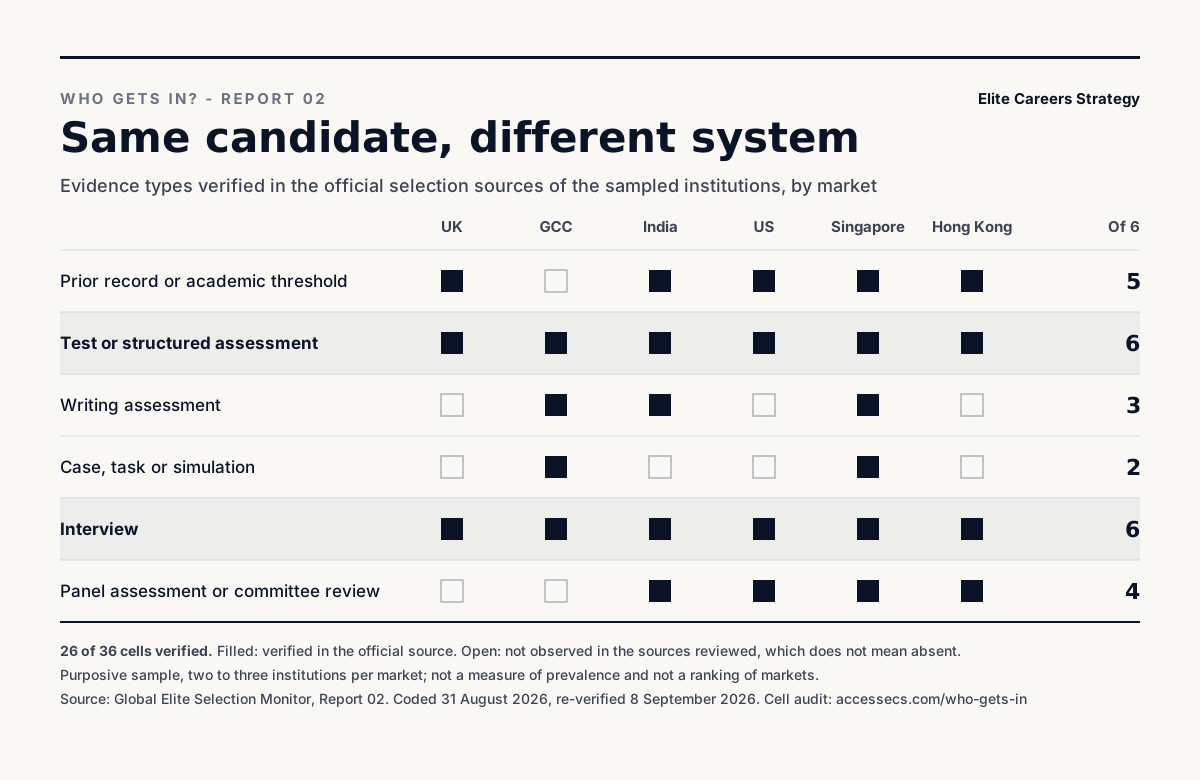
Every one of the six markets sampled sets a test or assessment and an interview. After that they diverge: a writing task in three, a case or simulation in two.
The purpose of this site: to set out what selective employers and universities publish about how they choose, market by market, and to make every figure here checkable against the source it came from.
Why now: AI makes a polished application easy to produce. Where sampled institutions publish AI rules, they protect ownership of the work rather than ban AI outright.
WRITING AND COMMENTARY PUBLISHED IN

Hassan Akram's own writing and commentary, named for context. Neither publication reviewed or commissioned this research.
A research programme published by Elite Careers Strategy. It reads how selective employers and universities say they choose people, in their own official words, and compares six markets.
The rules of elite selection are not secret, but they are scattered across institutional pages and unevenly understood. This programme collects them, codes them against a published method, and publishes every source so that any figure can be checked rather than taken on trust.
Journalists, researchers and institutions examining how selection works, and anyone trying to understand it. Elite Careers Strategy is an advisory firm working in this field; that interest is disclosed, and no client evidence is used.
107 coded selection signals, drawn from 69 official employer and university pages, across 6 markets: the UK, the Gulf (GCC), India, the United States, Singapore and Hong Kong. Two reports, one public source register.
One thing an institution publishes about how it chooses: a requirement, a stage, an assessment, a statement the institution makes about selection, or a material change to the process. One official page can carry several.
- Two minutesRead the headline finding and the four findings below.Start here
- Ten minutesRead a report: Report 02 compares six markets; Report 01 covers AI and the written application.The reports
- Checking a figureEvery coded signal carries a source ID, the official page and a review date, published in full in the register.Source register
- If you are a journalistCleared quotes, biography, charts and what the research must not be reported as saying.Press kit
Two checks appear in every market sampled. The rest of the system is local.
26 of 36 cells verified
Checked 31 August 2026, re-verified 8 September 2026
Read Report 02
This does not establish prevalence in any country or sector. The counts describe the sampled institutions only.
This does not establish that any market is harder, fairer or more predictive than another. The matrix compares what the sampled sources publish; it does not rank.
This does not establish absence. "Not observed" means the feature was not found in the sources reviewed. It does not mean the institution does not use it.
This does not establish national practice. Two to three institutions were reviewed per market, and Freshfields appears in both the UK and the Hong Kong sample, so the two columns are not independent.
Every cell in this matrix is verified against a passage on the institution's own page. The full mapping is published as the cell audit (CSV). It carries the quoted passage, source URL, retrieval method and date, verification status and publication ruling for every cell.
About this sample and the cell definitions
This is a purposive six-market sample: eight coded signals per market at first publication, with a ninth coded for the United States and for Hong Kong on 9 September 2026, two to three institutions each. The allocation is therefore no longer equal, and those two additions were found while looking for support for specific cells rather than sampled neutrally. The institutions are not matched by type, and the pathways are not equivalent. Indian management-school admissions, US undergraduate admissions and employer recruitment are different processes compared side by side, not the same process in six places.
Four findings, each published with its limit
The programme's argumentAI has made polish free. It has not made judgement free.
All findings
- 01Selection includes assessment the candidate does not write at leisure.Verified examples, one per institution: a timed cognitive assessment at KPMG; an assessment centre with a written and a group exercise at PwC Middle East; a case discussion at Strategy& Middle East; essays written on the interview day at the Indian School of Business; an Admissions Written Test before interview at NUS Law; an in-person Case Challenge at DBS. No proportion is claimed: the inclusion rule and row-level review are not complete.This does not establish that live assessment is new, increasing or superior, and says nothing about prevalence beyond the observations coded.
- 02The AI rules observed concern ownership, not blanket prohibition.Six observations were coded newly explicit about AI. They come from three institutions: DLA Piper, UBS and Cambridge, which permit forms of preparation while protecting independent assessment and truthful representation.This does not establish that AI caused institutions to introduce live assessment. Fifty of 57 observations were coded as existing processes at the review date.
- 03Every sampled market checks something beyond the written application. The instruments differ.Every market in the sample includes a published mechanism that checks more than a self-authored application, but the instrument is local: supervised retesting, on-the-spot writing, authenticated school work, case challenges, language tests.This does not establish prevalence in any country or sector. Two to three institutions were reviewed per market.
- 04Access to the live gate is itself designed.Shortlisting, programme preference, prior tests and invitation-only events determine who is allowed to demonstrate judgement at all.This does not establish intent, fairness or outcome effects. The tension is identified, not measured.
In the institutions' own words
Percentages describe the coded sample only.
This does not establish that live assessment is new, increasing or superior. Fifty of the 57 observations were coded as existing processes at the review date, which records what the page said, not when the practice began.
This does not establish prevalence. The count describes these 57 observations and nothing wider.
Exhibit 2: what the coded observations record about AI, and what they cannot show
Processes coded as already existing
50 of 57 observationsobservations coded as existing processes at the review dateTests, cases, interviews and panels appear in the published processes reviewed. No Report 01 observation records when any of them was introduced.
No introduction dates are recorded
No Report 01 observation carries a date of introduction, so no sequence can be established for those 57. Report 02 does contain dated changes: NUS dates its Law test-before-interview rule to 2026 and its Dentistry sequencing to 2021.
Three institutions publish explicit AI boundaries
6 of 6observations coded newly explicit about AI, from three institutionsThis does not establish that AI caused institutions to introduce live, interactive or whole-person assessment. This review does not establish when the Report 01 processes began or whether AI caused changes to them. A small number of Report 02 observations do carry dates, and they are stated where they appear.
Official sources, manual audit, published limits
107 coded selection signals69 official sources6 markets: UK, Gulf (GCC), India, US, Singapore, Hong Kong101 observations published after manual audit, 6 withheld
Research lead Hassan Akram, Founder and Principal Advisor, Elite Careers Strategy. Official public sources only. Evidence dated 30 and 31 August 2026, re-verified 9 September 2026. Full methodology
Full methodology
Official sources only
Every signal traces to one official employer or university page, with source ID, URL, grade and review date. No private client evidence, no modelling, no estimates.
Two reports, one register
Report 01 codes 57 signals. Report 02 codes 50 signals in a purposive six-market sample. Together: 107 signals citing 69 official sources, held in a 71-entry register.
Every observation audited
All 107 observations were read against their source on 9 September 2026. 80 are published as safe with source. 21 are published as context only, and barred from affirmative claims. 6 are held and excluded, because the source could not be independently retrieved.
- It does not measure prevalence in any country or sector. Counts describe the sampled institutions only.
- It does not establish that AI caused institutions to introduce live, interactive or whole-person assessment, or when any of these processes began.
- It does not establish that any market is harder, fairer or more predictive than another. It compares; it does not rank.
- It says nothing about selectivity, acceptance odds or candidate outcomes.
- It does not imply affiliation with, or endorsement by, the institutions named. Invited student-community sessions are not institutional relationships.
Exhibit 4: sample composition and limits
Sample limits. The sample is authority-led and cross-sectional. It is weighted toward UK and global process pages, law and banking. Percentages describe the coded sample only.
Read online, download, or check a figure
Start with Report 02, the six-market comparison. Below it: Report 01 on AI and the written application, the university companion, the full source register, and the raw evidence files.
31 August 2026
Same Candidate, Different System
How published selection architecture differs across six markets. A purposive six-market sample of 50 signals, allocated UK 8, GCC 8, India 8, United States 9, Singapore 8, Hong Kong 9, from 21 official pages.
21 sources
6 markets
Revised 31 August 2026
The Application as an Auditable Claim
What 57 elite-selection signals reveal about ownership, judgement and authenticity in the age of AI. Full source register: 48 cited sources in a 50-entry register.
48 cited sources
23 institutions
Elite University Selectivity
What thirty of the world's most highly ranked universities publish about admissions.
Global Elite Selection Monitor
Every coded signal and every official source, with source ID, URL, grade and review date. Published in full so that a figure can be checked rather than taken on trust.
69 cited sources
71 register entries
Evidence files
The files behind the tables. The source evidence record; the cell audit, with the quoted passage for every matrix cell; the publication ruling for every observation; and the manifest tracing each published sentence to its observations.
Source evidence record (CSV)Cell audit (CSV)Publication rulings (CSV)Claim dependency manifest (CSV)Matrix chart (PNG)Matrix chart (SVG)
Speak to the research lead
Interview or comment within three working days. Data checks same day.
Press kit
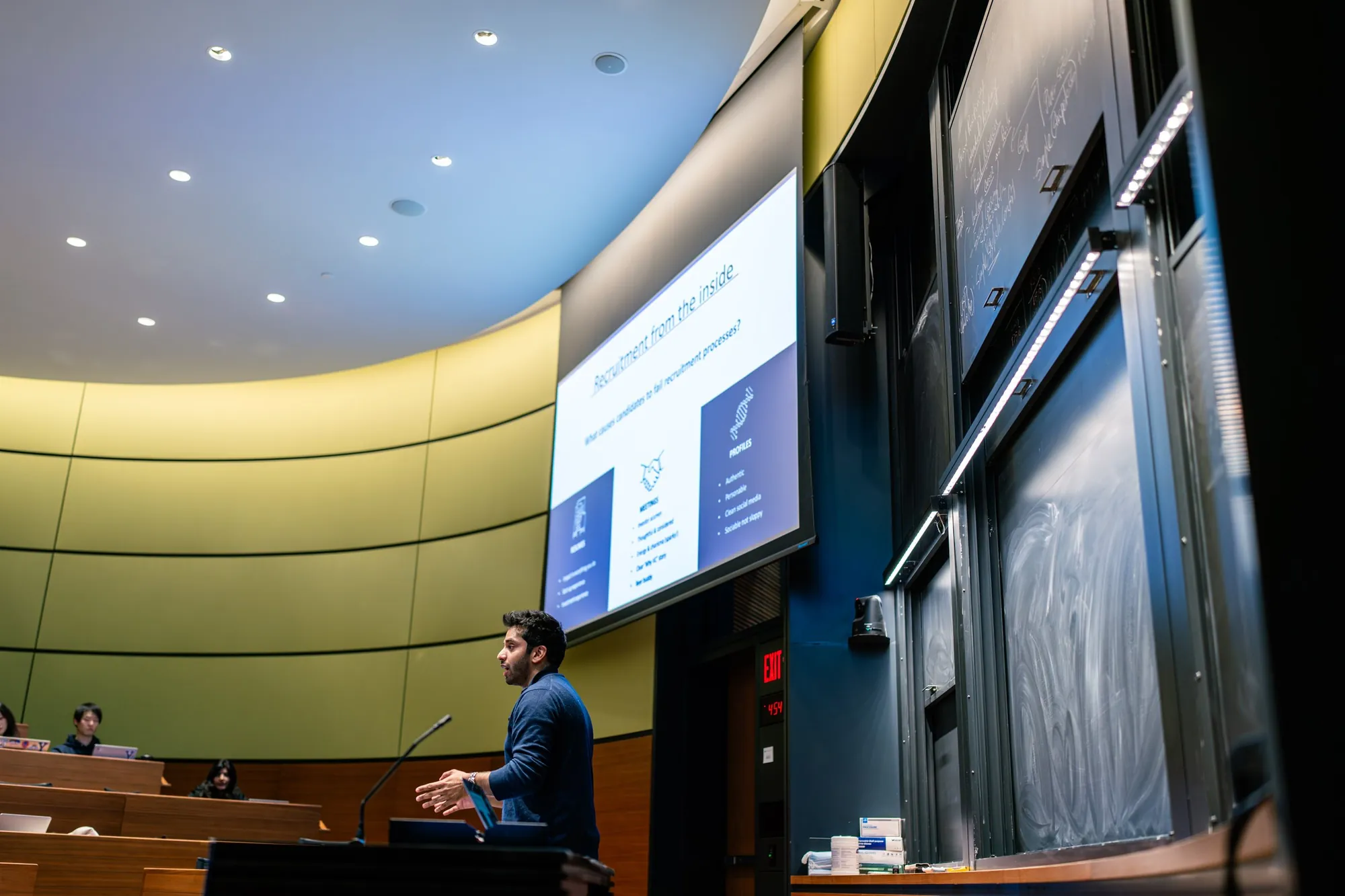
Hassan Akram
Founder and Principal Advisor, Elite Careers Strategy
Research lead for Who Gets In?. He is accountable for the coding decisions, publication rulings, source grading and corrections across the Global Elite Selection Monitor, and will take a data challenge directly.
Before founding ECS he worked on the recruitment side across corporate law, investment banking, private capital and consulting, and has reviewed more than 10,000 applications and candidate materials. He studied History at University College London.
Approved biography and quotations
Attribute to Hassan Akram, Founder and Principal Advisor, Elite Careers Strategy. Fresh quotes on request.
- "AI is making polish abundant. Judgement is not."On AI and the graduate application
- "The evidence does not show that AI caused live assessment. It shows that live assessment was already there, and that AI has made its purpose harder to ignore."On causation
- "The information around elite professions is not secret, just unevenly distributed."On access and information asymmetry