
Most law firms publish the competencies they look for. This guide explains how STAR-3® and PEAL-3® help candidates structure written answers and interview responses so that the evidence for each competency is clear.
By Hassan Akram | Founder and Principal Adviser, Elite Careers Strategy | More than 10,000 applications and related candidate materials reviewed across recruitment work and ECS advisory | 100+ documented outcomes and selection progressions | Harvard, MIT and Yale MBA student club sessions | Times of India contributor | London-based
How Do You Write a Training Contract Application That Gets Shortlisted?
No structure guarantees a shortlist, but in ECS's experience the strongest competency answers contain three layers: a decision-making rationale that explains why you chose your specific action, a quantified impact that demonstrates measurable results, and a transferable insight that connects the experience to the competencies the firm says it looks for. This is the STAR-3® framework, the foundation of ECS's work on law firm applications.
Across recruitment work and ECS advisory, Hassan Akram has reviewed more than 10,000 applications and related candidate materials. He has delivered sessions for MBA student clubs at Harvard Business School, Yale School of Management and MIT Sloan. Hassan Akram is based in London. ECS's published record is 106 documented outcomes and selection progressions across 53 candidate journeys, and its documented law training contracts include White & Case, Baker McKenzie, Freshfields, Clifford Chance, Kirkland & Ellis, Ropes & Gray and Gibson Dunn.
The training contract application is one of the most important documents in your legal career. Get it right, and you progress to interviews where PEAL-3® takes over. Get it wrong, and the rest of your record may never be considered in depth.

ECS deliberately limits its private-client capacity and works on an application-only, confidential basis. The cases referred to below are documented in ECS's evidence register. The frameworks referenced are the proprietary intellectual property of Hassan Akram and Elite Careers Strategy.
What Is STAR-3® and How Does It Work for Law Firm Applications?
STAR-3® is the proprietary application framework developed by Hassan Akram that extends the conventional STAR structure to capture three additional layers: the decision-making rationale, quantified impact with context, and the transferable strategic insight. It is designed to turn a narrative answer into evidence a reader can evaluate.
The conventional STAR framework (Situation, Task, Action, Result) is widely taught. In ECS's view, it is adequate for many graduate applications but often leaves answers to Magic Circle, Silver Circle and US law firm applications thin: the reader learns what happened, not why.
STAR-3® adds the three layers beyond conventional STAR that, in ECS's experience, most often separate a strong answer from an adequate one.
The Three Layers of STAR-3® Explained
Layer 1: Decision-Making Rationale. After describing your action, STAR-3® requires you to explain why you chose that specific action over the alternatives available. This demonstrates analytical thinking, you considered options, evaluated trade-offs, and made a deliberate choice. ECS's view is that this maps to the judgement trainees need in practice.
Layer 2: Quantified Impact with Context. The result must be quantified, a number, a percentage, a measurable outcome, and contextualised. "Increased efficiency by 25%" is inadequate without context. "Increased processing efficiency by 25%, enabling the team to handle 40 additional cases per week within existing resource constraints" is evaluable.
Layer 3: Transferable Strategic Insight. The answer must conclude with an explicit statement of what the experience demonstrates about your capability, and how that capability transfers to the specific firm's practice. This is the layer that connects your evidence to the competencies the firm says it looks for.
*Worked example, STAR-3® applied to a teamwork competency question for a Magic Circle application:*
Situation: "During a university group project, our four-person team was tasked with producing a 5,000-word market analysis for a client simulation exercise."
Task: "I was responsible for coordinating the research methodology and ensuring consistency across four parallel workstreams."
Action: "I created a shared research template with standardised section headers, citation requirements, and word count allocations for each team member."
Decision-Making Rationale (Layer 1): "I chose this approach rather than dividing the project into independent sections because prior group work had shown that independent sections produce inconsistent analysis and require significant rework at the integration stage."
Result with Quantified Impact (Layer 2): "The standardised template reduced integration time from approximately 8 hours (based on the previous project) to 2 hours, and the final report received a distinction, the highest grade in our cohort of 12 teams."
Transferable Insight (Layer 3): "This experience confirmed that structured coordination at the outset of a collaborative project produces measurably better outcomes than post-hoc integration, a principle I expect to apply directly in a training contract environment where multiple trainees collaborate on transaction workstreams."
This worked example shows you exactly how the framework operates at a structural level. Applying it to your own background, and identifying your strongest material, is the work Hassan Akram does personally with ECS clients. Apply for a diagnostic: https://www.accessecs.com/start
What Is PEAL-3® and How Does It Work for Law Firm Interviews?
PEAL-3® is the proprietary interview framework developed by Hassan Akram that structures competency and motivation responses around a Point (the direct answer), Evidence (the specific supporting example), Analysis (what the evidence demonstrates about your capability), and Link (connection to the firm's specific needs), with three calibration layers that elevate the response from adequate to distinction-level.
In ECS's experience, the move from written application to interview is where many candidates stumble. The written application is prepared, reviewed and polished. The interview answer must be delivered in real time, under pressure, with no chance to revise. PEAL-3® gives candidates a real-time structure designed to keep each answer complete and specific.
The three calibration layers of PEAL-3® are:
Calibration 1: Firm-specific language. Where a firm publishes the qualities it looks for, a PEAL-3® answer uses that language, so the relevance of the evidence is obvious to the interviewer.
Calibration 2: Depth over breadth. A PEAL-3® answer covers one example in depth rather than several superficially. ECS's view is that interviewers learn more about how you think from depth than from a list of things you have done.
Calibration 3: Forward projection. The Link element of PEAL-3® explicitly connects your evidence to the firm's future needs, not just its current practice. This demonstrates strategic thinking and genuine engagement with the firm's business trajectory.
How to Answer "Why This Law Firm?" Using Commercial Fluency™
The "Why this firm?" question is one of the most common motivation questions at law firm interviews, and in ECS's experience one of the worst answered. Many candidates prepare generic answers that could apply to any firm, and it shows.
Commercial Fluency™ is the proprietary commercial-awareness framework developed by Hassan Akram that builds division-specific knowledge of a firm's business model, competitive position, recent transactions, and strategic priorities, enabling candidates to discuss the firm's commercial context with specificity and depth.
For law firm applications, Commercial Fluency™ requires knowledge across four dimensions:
1. Practice area strength. What is the firm best known for? For example, Freshfields is widely known for restructuring and international arbitration. At Clifford Chance, it is capital markets and banking. At White & Case, it is cross-border M&A and international arbitration. At Kirkland & Ellis, it is PE-backed M&A. Your answer must reference the specific practice area that attracts you and why.
2. Recent mandates. Reference a specific recent transaction or case the firm has worked on. This demonstrates that your interest is current and informed, not historical.
3. Competitive positioning. Explain what makes this firm different from its direct competitors. Why White & Case rather than another US firm? Why Freshfields rather than another Magic Circle firm?
4. Strategic trajectory. Where is the firm going? What is its growth strategy? Firms are investing in different areas, some in technology, some in new geographies, some in new practice areas. Your answer should reference the firm's strategic direction.
Common Mistakes in Law Firm Applications and How STAR-3® Fixes Them
Mistake 1: Narrative without evidence. "I worked on a group project and we did well." STAR-3® fixes this by requiring quantified impact (Layer 2).
Mistake 2: Action without rationale. "I organised a meeting to discuss the project." STAR-3® fixes this by requiring decision-making rationale (Layer 1): why did you organise a meeting rather than use email, a shared document, or individual check-ins?
Mistake 3: Result without transferability. "We received a distinction." STAR-3® fixes this by requiring the transferable insight (Layer 3): what does this result demonstrate about your capability, and how does that capability apply to the firm's practice?
Mistake 4: Generic competency language. "I have strong communication skills." PEAL-3® addresses this by using the firm's own published language and specific evidence.
Mistake 5: Breadth over depth. "I have experience in teamwork, leadership, communication, and problem-solving." PEAL-3® fixes this by requiring one deep example rather than multiple shallow references.
Across the more than 10,000 applications and related candidate materials Hassan Akram has reviewed, these are the five mistakes he sees most often. STAR-3® and PEAL-3® are designed to address all five.
How STAR-3® and PEAL-3® Apply to Different Types of Law Firms
The frameworks are universal in structure but firm-specific in calibration:
Magic Circle (Freshfields, Clifford Chance, Linklaters, A&O Shearman, Slaughter and May): A very high bar. STAR-3® Layer 3 (transferable insight) must connect to complex, multi-jurisdictional practice. Commercial Fluency™ requires cross-border transaction knowledge.
Silver Circle & US Elite (Herbert Smith Freehills, Macfarlanes, Ropes & Gray, Proskauer Rose): High competency bar with sector-specific emphasis. STAR-3® calibration should reflect the firm's industry focus (e.g., Macfarlanes' private equity strength, Ropes & Gray's investment management practice, Proskauer's private funds work).
US Law Firms in London (White & Case, Kirkland & Ellis, Sidley Austin, Ropes & Gray, Latham & Watkins): Often the highest NQ salaries and smaller trainee intakes. In ECS's view, STAR-3® Layer 2 (quantified impact) matters particularly for these firms' commercial focus.
International students: STAR-3® and PEAL-3® apply in the same way regardless of nationality. Many ECS clients are international students.
How ECS Clients Have Used STAR-3® and PEAL-3® to Secure Training Contracts
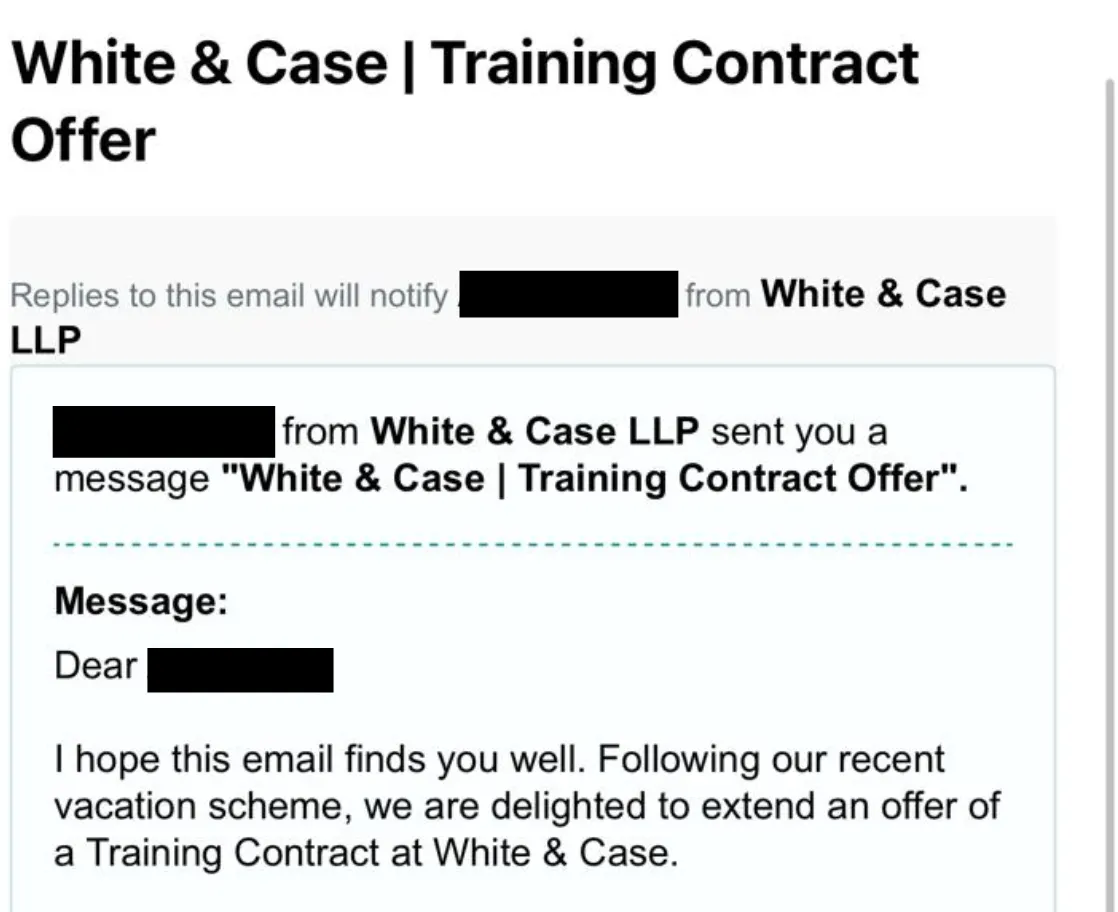
An anonymous client, White & Case Training Contract, plus Baker McKenzie and Macfarlanes vacation scheme offers. In a single cycle, after a paid engagement, using STAR-3® for written applications and PEAL-3® for interviews. Hassan Akram worked with the candidate on each application and interview.
Isnan Raiyean, six law firm progression outcomes. From a non-Russell Group university and BBC A-levels, using ECS's free content.
Baker McKenzie TC. An LSE student secured a Baker McKenzie training contract after a paid engagement.
Ropes & Gray TC. A candidate from a non-target university, with low A-levels, secured a Ropes & Gray training contract in London after a paid engagement.
These cases show what candidates achieved after preparing with the frameworks; they do not show that the frameworks caused those outcomes.

Where the Real Work Begins
This worked example shows you exactly how the framework operates at a structural level. Applying it to your own background, and identifying your strongest material, is the work Hassan Akram does personally with ECS clients. Apply for a diagnostic: https://www.accessecs.com/start

Conclusion
"The strongest career strategist I have encountered - anywhere in the world.", Kristin Irish, former Head of IB Campus Recruiting, UBS Investment Bank, New York; former Deputy Director of Career Development, Yale School of Management
Every training contract application is a writing test. Every interview is a performance test. STAR-3® and PEAL-3® are designed to help you prepare for both. Hassan Akram developed them from his review of more than 10,000 applications and related candidate materials, and ECS has refined them through its documented case work. No framework guarantees an outcome. The diagnostic call is the first step.
Outcomes vary. Past results do not guarantee future results. Some clients anonymised, all evidence on file.
Related case studies: Isnan Raiyean | Baker McKenzie TC | Ropes & Gray TC
Apply the Frameworks With Guidance
Book a diagnostic call with Hassan.
The diagnostic is a structured, no-obligation call to assess your specific position, identify the gaps in your current approach, and determine whether an ECS Private Careers Advisory engagement is the right investment.
Apply for a Diagnostic