
Elite law firms do not generally publish a complete university-by-university conversion denominator, so ECS does not state a market-wide non-Russell Group conversion rate. This guide explains a systematic approach that improves the odds.
The Training Contract Problem
The statistics are stark. Magic Circle and US firm training contracts go overwhelmingly to Russell Group graduates. The published diversity data from the firms themselves confirms this.
The question is not whether the disadvantage is real. It is. The question is whether a systematic approach can overcome it.
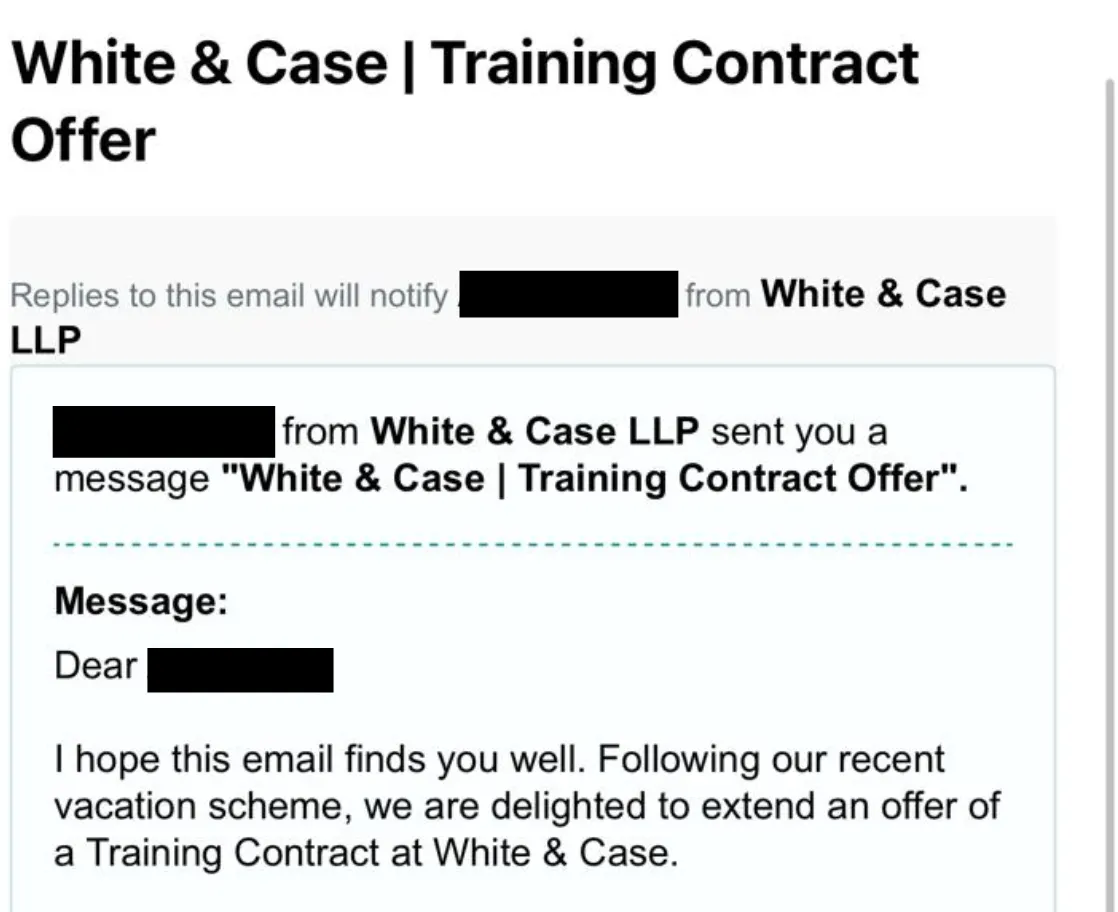
The ECS case study set offers some answers. An anonymous client secured a White & Case Training Contract with ABB A-levels and four years of prior rejection, after a paid ECS engagement. Kalen Harrald (Queen Mary, a Russell Group university often classed as non-target for elite law) secured a Clifford Chance SPARK place using ECS's free content. Isnan Raiyean achieved six law firm progression offers from a non-disclosed non-Russell Group institution with BBC A-levels.
The disadvantage is structural. It is not absolute.
What Training Contract Applications Are Assessed On
Firms' published graduate recruitment material typically describes four areas for the written application, whether on the firm's own portal or a shared platform:
1. Motivation for law, Is it genuine, developed, and connected to the specific firm?
2. Commercial awareness, Does the applicant understand what the firm does, who its clients are, and what is happening in the relevant practice areas and markets?
3. Competency evidence, Do the answers demonstrate the specific competencies the firm has published as its assessment criteria?
4. Written communication, Is the prose clear, precise, and appropriately formal?
Your university determines how hard it is to get an interview. It does not determine how well you perform against these criteria.
The Written Application: STAR-3® and BDC Data Point Theory®
Training contract written applications are assessed by graduate recruitment teams that read thousands of applications per cycle. The quality threshold for progression is higher than most applicants realise.
STAR-3® applies to the competency questions. The extended structure, beyond conventional STAR, captures the decision-making layer and the quantified impact that generic answers leave out.
BDC Data Point Theory® applies to the commercial reasoning questions: "Why this firm?", "What commercial trend do you think will most affect our business?" ECS treats these questions as tests of whether you can build an argument from specific data points to a structured conclusion, not invitations to show general knowledge.
The Interview Stage: PEAL-3®
Law firm first-round interviews, typically video or telephone, test competency and motivation. The PEAL-3® framework structures responses to the standard elite legal interviews demand.
The framework reflects Hassan Akram's recruitment experience and his review of more than 10,000 applications and related candidate materials.
The Assessment Centre
Magic Circle assessment centres typically include some combination of:
- Case study with written and verbal presentation
- Group exercise
- Partner interviews
- Watson Glaser (at some firms, earlier in the process)
VTMR™ structures the case study approach. PEAL-X®, the advanced version of PEAL-3®, applies to partner interviews, which tend to probe further than first-round interviews.
A-Level Grades and University Tier: What They Actually Determine
The honest answer is that poor A-level grades and non-Russell Group institutions make it harder to get an application read in the first place. Some firms apply grade thresholds; many now also use contextual recruitment. Institution names can still carry weight with readers.
The counter-strategy is not to conceal the academic record. It is to make the rest of the application strong enough that the academic record is not the only thing the reader remembers.
The White & Case case illustrates the point: ABB A-levels, four years of rejections, then a training contract in the cycle after a paid ECS engagement. The A-levels did not change; the preparation did.
The Free Content Route
Kalen Harrald and Isnan Raiyean both reached law firm outcomes after using only ECS's free content, with no paid engagement. The frameworks, STAR-3®, PEAL-3®, PEAL-X®, BDC Data Point Theory®, are available at no cost via LinkedIn, TikTok, and YouTube.
If you are not yet ready to engage the paid programme, start with the free content. Apply the frameworks. Track the results.

Next Steps
The diagnostic call identifies where your current application approach is failing and maps the specific interventions required. No obligation, no pressure.
Apply at [accessecs.com/start](https://www.accessecs.com/start).
[IMAGE: Kristin Irish endorsement | /images/proof/kristin-irish-strongest-strategist-endorsement.jpg] ---
Related case studies: Kalen Harrald, QMUL to Clifford Chance SPARK AC | Isnan Raiyean, BBC A-Levels to 6 Law Firm Offers
Apply the Frameworks With Guidance
Book a diagnostic call with Hassan.
The diagnostic is a structured, no-obligation call to assess your specific position, identify the gaps in your current approach, and determine whether an ECS Private Careers Advisory engagement is the right investment.
Apply for a Diagnostic