
Clifford Chance, Freshfields, and White & Case do not publish a list of universities they refuse to hire from. They do publish a good deal about their selection stages. Here is how non-Russell Group candidates can prepare for each one.
The Data That Stops Most Non-Russell Group Candidates Before They Start
Magic Circle and leading US firms in London have historically recruited a large share of their trainees from Oxbridge and the Russell Group.
Most non-Russell Group law students read these statistics and self-select out. They apply to firms they consider "realistic", regional practices, smaller City firms, legal aid organisations. The ambition narrows before the first application is submitted.
ECS's view is that self-selection is a larger problem than rejection. Many non-Russell Group candidates never submit the application that would test whether they could get through.
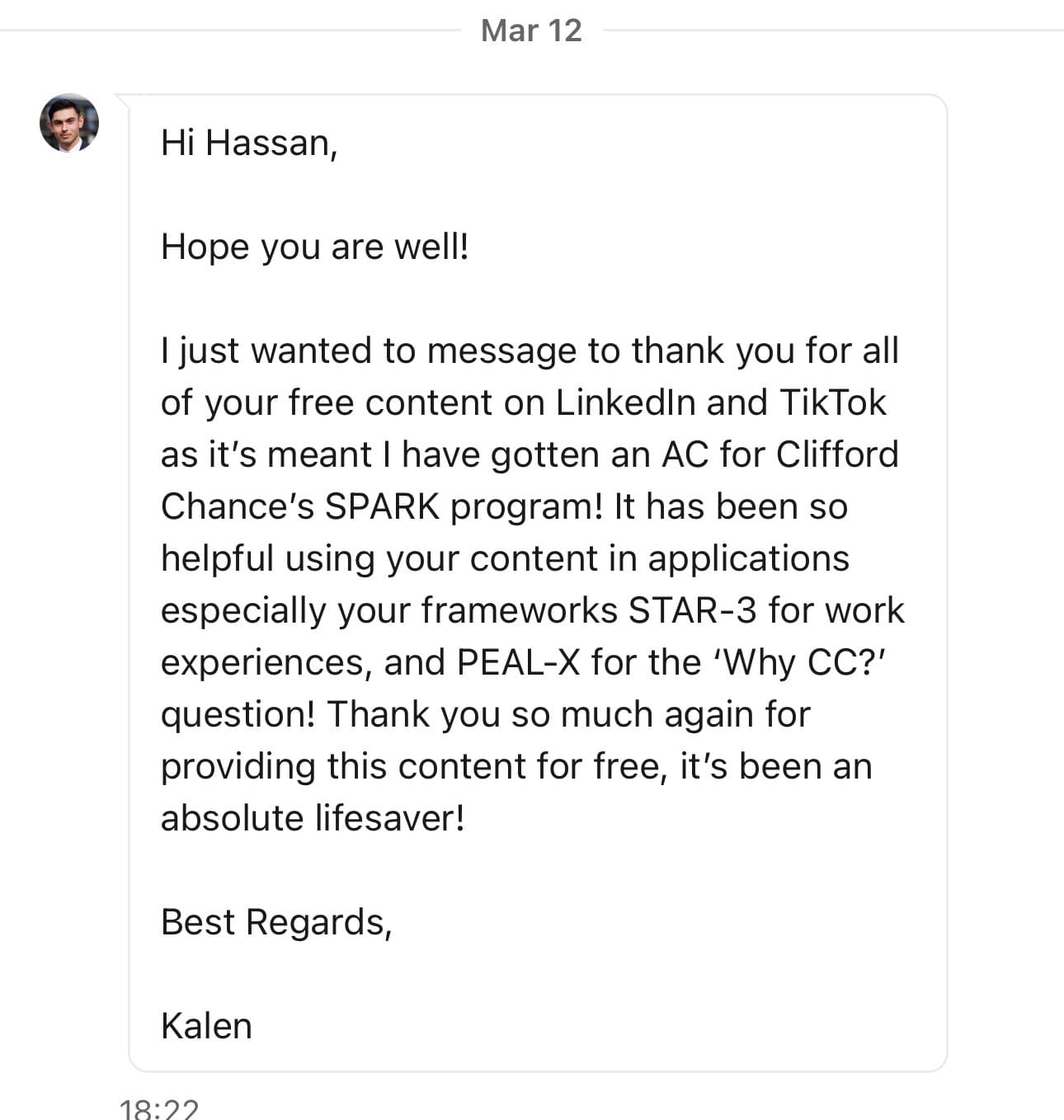
ECS's documented record includes non-Russell Group and non-target candidates who progressed through Magic Circle and US firm processes. Isnan Raiyean, at a non-Russell Group university with BBC A-levels, recorded six law firm progression outcomes in a single cycle using free ECS content. Kalen Harrald, at Queen Mary University of London (a Russell Group university commonly classed as non-target in elite legal recruitment), secured a place on Clifford Chance SPARK 2026, also using free content. Another Queen Mary candidate, again using free content only, recorded six outcomes in one cycle, including a Clifford Chance Training Contract.
ECS does not present these results as typical. They show that the route is open, and what disciplined preparation looks like.
The frameworks were developed by Hassan Akram, who has reviewed more than 10,000 applications and related candidate materials across recruitment work and ECS advisory, and has delivered sessions for MBA student clubs at Harvard Business School, Yale School of Management and MIT Sloan. They are built on what firms publish about their processes and on patterns observed in that material, not on any firm's internal scoring. ## What the Pattern Shows
The broad pattern of elite law recruitment in London is familiar:
- Oxbridge accounts for a disproportionate share of Magic Circle trainee cohorts relative to the number of law graduates produced.
- Russell Group universities collectively produce the majority of Magic Circle trainees.
- Non-Russell Group universities, which produce a significant proportion of all UK law graduates, contribute a small minority of Magic Circle trainees.
The pattern is real. It reflects structural advantages that Russell Group and Oxbridge candidates often enjoy: more specialised careers support for elite firm applications, stronger alumni networks at Magic Circle firms, greater visibility at campus recruitment events, and published academic requirements that correlate with university tier.
ECS's view is that application quality is also part of the picture. In the applications ECS reviews from non-Russell Group candidates, a recurring weakness is not ability but calibration: answers pitched to the standard of the candidate's peer group rather than to the strongest applications in a Magic Circle pool. Better calibration guarantees nothing, but it removes a disadvantage the candidate controls.
Where Non-Russell Group Candidates Lose Ground: Three Stages
The difficulty is not intelligence. Non-Russell Group law students are frequently as academically capable as their Russell Group counterparts; they chose a different institution for different reasons, or their A-level results directed them to a different tier.
In ECS's experience, the difficulty is structural, and it shows up at three stages:
1. The Application Sift: Where Institutional Signals Matter
Some firms publish minimum academic requirements, such as A-level grades or a predicted 2:1, and many use online tests early in the process. Where human readers are involved, ECS's concern is that a recognisable institution name can act as a shortcut. That is a risk candidates should plan for, not a published policy of any firm.
The response is not to hope a reader overlooks your university. It is to make the written answers strong enough to carry weight on their own: good not by the standards of your peers, but by the standards of the strongest applications in the pool.
2. The Interview Stage: Where Preparation Gaps Show
Non-Russell Group universities typically provide less structured support for elite law firm applications. The career services team may not have experience with Magic Circle processes. The peer network does not include candidates who have recently been through Clifford Chance or Freshfields interviews.
This means the non-Russell Group candidate arrives at the first-round interview with less insight into what the interviewer will assess, less feedback on their response quality, and less calibration of the standard required.
3. The Assessment Centre: Where Confidence Gaps Compound
The Magic Circle Assessment Centre is a high-pressure environment. Case studies, group exercises, partner interviews, typically across one or two days. Non-Russell Group candidates ECS works with frequently report feeling like outsiders, surrounded by candidates who seem familiar with the firm and the process.
ECS's view is that the confidence gap is usually a symptom of unfamiliarity with the format, and that it narrows with specific preparation for each stage.
The STAR-3® Approach to Training Contract Written Applications
The written application is where non-Russell Group candidates must outperform. If your university name creates a headwind at the sift, the quality of your written answers must create a stronger tailwind.
STAR-3® is designed to prompt three layers in each competency answer:
1. The decision-making layer, Not just what you did, but why you chose that approach over alternatives. This shows analytical judgement, which many firms list among the competencies they look for.
2. The quantified impact, Results expressed in measurable terms. "Increased attendance" becomes "increased attendance by 40% across three events." "Improved the process" becomes "reduced processing time from 5 days to 2 days." Quantification is a credibility signal.
3. The transferable insight, What the experience taught you that applies to the legal career context. This layer demonstrates reflective capability and connects your non-legal experience to the work of a trainee.
Structural illustration: A competency answer about resolving a conflict in a university group project. The conventional STAR answer describes the conflict and the resolution. The STAR-3® answer explains why you chose mediation over escalation (decision-making), quantifies the outcome (project delivered three days ahead of deadline, scored 78%), and articulates the transferable insight about managing disagreements in time-pressured professional environments.
This worked example shows you exactly how the framework operates at a structural level. Applying it to your own background, and identifying your strongest material, is the work Hassan Akram does personally with ECS clients. Apply for a diagnostic: https://www.accessecs.com/start

The A-Level Filter: How to Approach It
Firms differ in how they handle A-level grades. Some publish explicit minimums, often AAA or AAB. Others describe a holistic or contextual approach. ECS's experience is that candidates below AAB still face a harder sift at many firms, and should plan accordingly.
For non-Russell Group candidates with strong A-levels (AAA/AAB), the challenge is primarily institutional, your university is the barrier, not your grades. The strategy focuses on making the application quality override the university signal.
For non-Russell Group candidates with weaker A-levels (ABB or below), the challenge is compounded. The anonymous White & Case client (ABB, four years of rejection, then a White & Case Training Contract after a paid ECS engagement) shows that the combination is not insurmountable. But the application has to be exceptional, not merely good. The STAR-3® answers need to be among the strongest the reader sees, and the commercial awareness needs real depth.
The practical implication is clear: if your A-levels are below a firm's stated threshold, every other part of your application has to work harder. The frameworks are designed to help, but the candidate has to invest the preparation time.
BDC® Data Point Theory: Building the "Why This Firm?" Answer
Most training contract applications include a "Why this firm?" question. In the applications ECS reviews, the most common weakness is describing the firm rather than arguing for it.
BDC® Data Point Theory transforms the "Why this firm?" answer from description to argumentation. The framework structures the response around specific data points, a recent deal, a practice area development, a strategic hire, a market position, and builds a reasoned argument for why those data points are specifically relevant to your career objectives.
The distinction is critical. Describing a firm's international network is not commercial awareness. Arguing, with specific recent deals, hires or practice developments as evidence, that the firm's position in a particular market offers the training a candidate interested in cross-border M&A wants, is commercial awareness.
PEAL-3® and PEAL-X®: Interview Preparation for Law Firms
First-Round Interviews: PEAL-3®
Many law firm first-round interviews are competency-based, and several firms publish the competencies they look for.
PEAL-3® is designed to help candidates structure answers so that the evidence for the relevant competency is explicit. It is ECS's preparation method, not any firm's scoring scheme.
Partner Interviews: PEAL-X®
In ECS's experience, partner interviews are different: less structured and more conversational. ECS's reading is that many partners are asking themselves whether the candidate would be credible in front of a client within a few years.
PEAL-X® is designed for this unstructured, high-stakes conversation, where a handful of answers can carry the interview.
VTMR®: Case Study Performance at Assessment Centres
The Magic Circle Assessment Centre typically includes a case study component. You receive a business scenario, often a simulated client problem, and must analyse it, form recommendations, and present them.
VTMR® structures the analytical approach. The framework is designed to make sure your analysis covers what a strong case answer usually needs: identification of the relevant issues, structured reasoning toward a recommendation, awareness of commercial implications, and clear communication of the conclusion. [IMAGE: White & Case Training Contract offer (anonymous client) | /images/proof/anonymous-white-case-tc-offer.webp]
The Evidence: Non-Russell Group and Non-Target Candidates in the Record
Isnan Raiyean, BBC A-Levels to Six Law Firm Progression Outcomes
Isnan's profile: BBC at A-level, a non-Russell Group university. On conventional advice, the Magic Circle was not a realistic target. Using ECS frameworks from free content, Isnan recorded six law firm progression outcomes in a single cycle. In his words: "The frameworks gave me a process where I had none."
Kalen Harrald, Queen Mary to Clifford Chance SPARK 2026
Kalen secured his place on Clifford Chance SPARK 2026 from Queen Mary University of London, a Russell Group university commonly classed as non-target in elite legal recruitment. SPARK is Clifford Chance's early-careers programme, and the firm invites participants to interview for a training contract at the end of it. Kalen used only free ECS content. His words: "Your frameworks, STAR-3® and PEAL-X®, have been an absolute lifesaver."
Queen Mary Candidate, Six Outcomes in One Cycle
A second Queen Mary candidate, using free content only, recorded six outcomes in a single cycle: a Clifford Chance Training Contract, a place on Akin Gump's social mobility programme, Akin Gump assessment centre and telephone interview stages, a Jones Day video interview through to assessment centre, and a Herbert Smith Freehills assessment centre.
The Ropes & Gray Training Contract
A candidate from a non-target university, with low A-level grades, secured a Ropes & Gray Training Contract in London after a paid ECS engagement. US firms in London typically recruit smaller trainee cohorts than the Magic Circle.
The Broader Pattern
These cases sit within ECS's record of 106 documented outcomes and selection progressions across 53 candidate journeys. Training contracts in that record include White & Case, Freshfields, Baker McKenzie, Ropes & Gray, Gibson Dunn, Kirkland & Ellis and Clifford Chance. Early-programme, vacation scheme and assessment centre outcomes span firms including Clifford Chance (SPARK), Freshfields, Slaughter and May, Cleary Gottlieb, A&O Shearman, Herbert Smith Freehills, Travers Smith and Ropes & Gray.
The common thread is not a single university or A-level profile. It is the same frameworks applied to each candidate's circumstances and to each firm's published process.
The Vacation Scheme Strategy
For many non-Russell Group candidates, the training contract application is not the first stage. The vacation scheme is.
Vacation schemes at Magic Circle firms are two-week placements, typically in summer, that function as extended interviews. The firm assesses the candidate across a full working environment: their legal reasoning, their interpersonal skills, their commercial awareness, their work ethic, and their fit with the team.
At many firms the vacation scheme is the main route to a training contract offer, so securing one is often the decisive step.
Non-Russell Group candidates face the same structural disadvantages at the vacation scheme application stage as at the TC stage. But the vacation scheme also offers a unique opportunity: the two-week format means the candidate has multiple touchpoints to demonstrate capability, not just a single interview. Two weeks of strong work gives a firm far more evidence than a university name.
The framework deployment for vacation scheme applications mirrors the TC deployment: STAR-3® for competency answers, BDC® for commercial awareness, PEAL-3® for interviews. During the vacation scheme itself, PEAL-X® is useful in conversations with partners and associates, because the scheme functions as an extended interview.
The Application Timeline for Non-Russell Group Candidates
Timing matters disproportionately for non-Russell Group candidates. In ECS's view, non-Russell Group candidates have less margin for a late start than candidates from target universities. The application should be ready when the portal opens.
The recommended timeline for training contract applications:
The Free Content Reality
ECS publishes the structural frameworks, STAR-3®, PEAL-3®, PEAL-X®, VTMR®, BDC®, Commercial Fluency™, for free across LinkedIn, TikTok, and YouTube. Multiple documented outcomes, including Kalen's and Isnan's, were achieved using free content alone.
The what and why are fully available. How the frameworks apply to your specific circumstances is the focus of a private engagement.
If you are not ready for a private engagement, start with the free content. Apply the frameworks. Track the results. ECS's record includes candidates who reached documented outcomes with free content alone.
Apply for Your Diagnostic Call
The diagnostic call identifies the specific gaps between your current application approach and the standard required at your target firms. It is structured, not conversational. You will leave with a clear map of what needs to change and why.
Apply at [accessecs.com/start](https://www.accessecs.com/start).
Where the Real Work Begins
This article sets out the frameworks. The next step is for Hassan Akram to review your own profile and materials against the stages you face, drawing on the more than 10,000 applications and related candidate materials he has reviewed, and to set out what needs to change. That is what the ECS diagnostic does.
## The SQE and LPC Dimension
For law candidates, the Solicitors Qualifying Examinations (SQE) have replaced the LPC as the primary qualification route. This change affects application strategy in a specific way: firms want to know that you understand the qualification pathway and have a credible plan for completing it.
Non-Russell Group candidates sometimes face additional scepticism about their academic preparation for the SQE. ECS helps candidates make sure the training contract application demonstrates awareness of the qualification pathway and positions the candidate's academic background as an asset rather than a concern.
ECS's view is that the SQE can also act as an equaliser. Because it is a standardised examination, unlike the varied LPC programmes that different universities offered, it creates a level playing field that benefits non-Russell Group candidates. A strong SQE performance is a strong SQE performance, regardless of which university the candidate attended.

The Parent Perspective
For many candidates, especially international students, the decision to engage ECS involves parental input. The cost of UK legal education is already substantial. An additional investment in application preparation is a family decision.
The candidate's family, after the White & Case Training Contract, said: "Probably the best investment we've ever made." That is their verdict on the outcome, not an arithmetic ECS offers.
Parent involvement is part of the ECS process. The parent rule exists because the investment is a family commitment, and the outcome matters to the family. This is not a limitation, it is a feature of a system that takes the stakes seriously.

Conclusion
Non-Russell Group universities produce Magic Circle trainees. The route is harder, but it is open, and ECS's documented record shows non-Russell Group and non-target candidates progressing through these processes.
Kalen Harrald. Isnan Raiyean. The Queen Mary candidate with six outcomes. These are documented outcomes, not aspirational claims.
Kristin Irish, former Head of IB Campus Recruiting, UBS Investment Bank, New York; former Deputy Director of Career Development, Yale School of Management: "The strongest career strategist I have encountered - anywhere in the world."
The frameworks are public. The evidence is published. The question is whether you will apply them.
Apply at [accessecs.com/start](https://www.accessecs.com/start).
*Outcomes vary. Past results do not guarantee future results.*
Related case studies: Kalen Harrald, QMUL to Clifford Chance SPARK 2026 | Isnan Raiyean, BBC A-Levels to 6 Law Firm Progressions | Ropes & Gray Training Contract | Queen Mary, 6 Outcomes
Apply the Frameworks With Guidance
Book a diagnostic call with Hassan.
The diagnostic is a structured, no-obligation call to assess your specific position, identify the gaps in your current approach, and determine whether an ECS Private Careers Advisory engagement is the right investment.
Apply for a Diagnostic