
Founder-led Private Careers Advisory
Hassan Akram
Founder and Principal Adviser
Families are not hiring a large firm. They are relying on one person's judgement, and this is that person.

Hassan advises internationally mobile families and their candidates on entry to investment banking, private equity, venture capital and corporate law. Before founding ECS he worked in recruitment and search, researching and screening candidates from those sectors. He personally leads the Private ECS Diagnostic, and nothing is recommended before it.
- More than 10,000 applications and related candidate materials reviewed across recruitment work and ECS advisory
- 100+ documented outcomes and selection progressions
- Deliberately limited intake each year
Parent or sponsor welcome. Applications are reviewed before booking.
Background
From recruitment and search to private advisory.
Hassan Akram is the founder of Elite Careers Strategy, a private career advisory firm, and of Who Gets In?, its research project on how highly selective employers choose early-career talent.
Hassan read History at University College London. Before founding Elite Careers Strategy, he worked in London recruitment and search: at Kea Consultants on private-equity and venture-capital fund mandates, then at Barclay Simpson and Heriot Brown in legal recruitment, researching, screening and putting forward candidates on client hiring mandates. Client employers made the hiring decisions. His recruitment work covered candidates from across leading US and Magic Circle law firms, investment banks, strategy consultancies and investment firms, including graduates of universities such as Harvard, Yale, Stanford, Oxford, LSE and Berkeley. In late 2019 he returned to Derby for family reasons and began advising individuals one-to-one; he returned to recruitment in 2021 and formalised that advisory work as Elite Careers Strategy in 2022. Across his recruitment career and subsequent advisory work through Elite Careers Strategy, he has reviewed more than 10,000 applications and related candidate materials. ECS has since built a record of 106 documented outcomes and selection progressions across 53 candidate journeys at firms in London, New York, Hong Kong and Singapore.
ECS has advised candidates from Oxford, Cambridge, Harvard, Yale, MIT, UCL, LSE and Imperial, as well as candidates from far less conventional backgrounds.
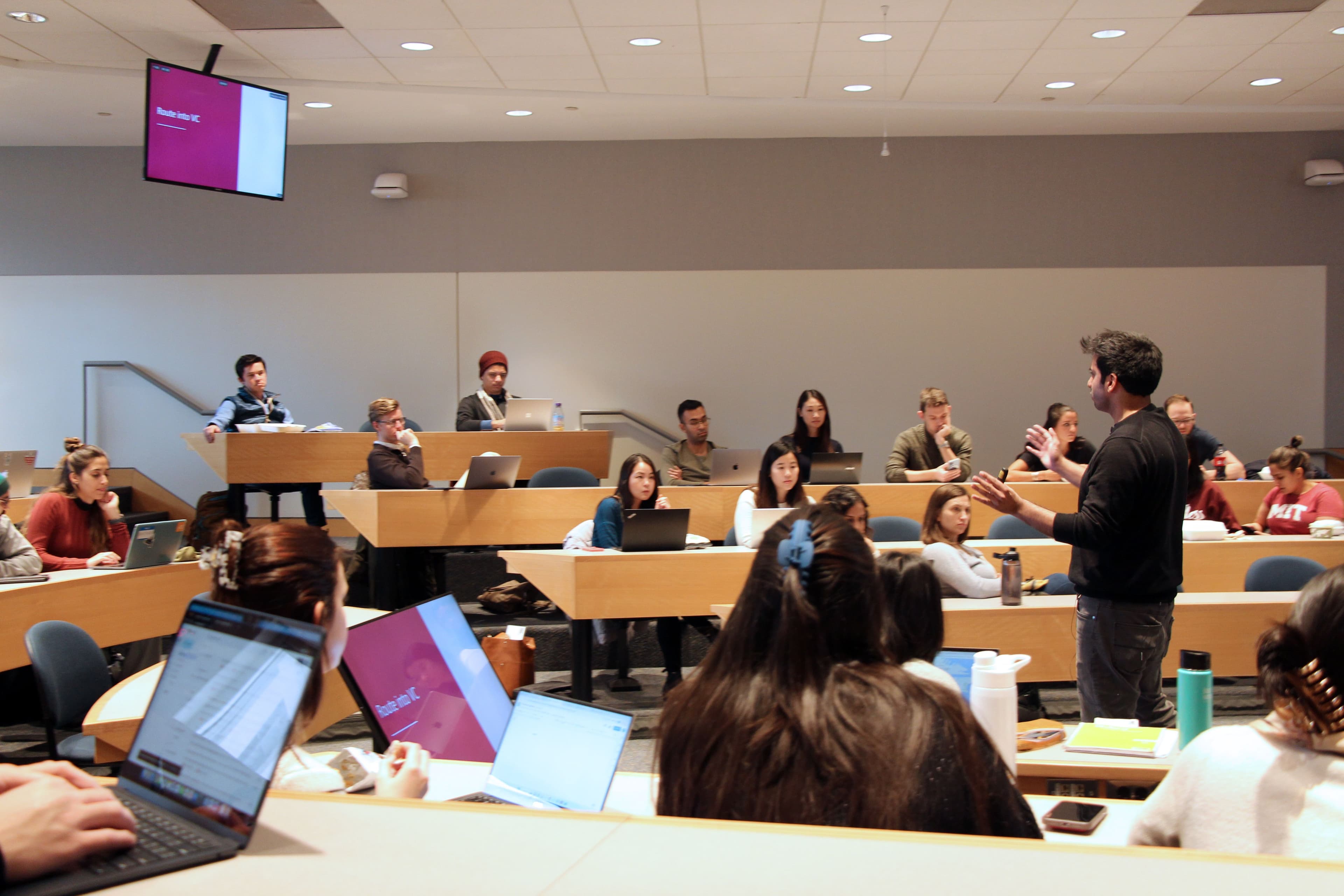
Hassan has been invited to speak to MBA communities at Harvard Business School, Yale School of Management and MIT Sloan. He has also spoken at the Festival of Education at Wellington College, has written for The Times of India and has been featured in the Financial Times.
On elite selection
Strong credentials do not automatically become an offer.
Elite firms do not hire a CV. They make a sequence of decisions.
At each stage, different people assess different evidence. In ECS's experience, strong candidates are often rejected when those signals do not form one clear, credible case.
That is the problem ECS diagnoses, and how we help is the method.
ECS moves forward only where the profile is strong enough, the objective is serious and the decision-maker is aligned.


Endorsement
"The strongest career strategist I have encountered - anywhere in the world."
Kristin Irish
- Former Head of IB Campus Recruiting, UBS Investment Bank, New York
- Former Deputy Director of Career Development, Yale School of Management
Independent endorser - not a client of ECS.
In context
Selected speaking and educational contexts.
Hassan has delivered invited sessions in student-club, society and educational contexts including Harvard Business School, Yale School of Management, MIT Sloan and Wellington College.
The Harvard session was an address to MBA students, at the invitation of the school’s student-run Venture Capital and Private Equity Club.
Invited contexts only. No university employs, endorses or is affiliated with Elite Careers Strategy.
Where it started
A different starting point.
Hassan grew up in Derby 016A, a neighbourhood ranked 74th most deprived of the 33,755 neighbourhoods in England on the 2025 English Indices of Deprivation. He attended a state school and, as a teenager, played cricket for Derbyshire.
Source: Ministry of Housing, Communities and Local Government, Local Deprivation Explorer, neighbourhood E01013480.
Growing up outside established professional networks is where his interest in information asymmetry began. Which firms run which processes, what each stage is actually assessing, and what a credible application looks like are not secrets. They travel through networks, and those networks are not open to everyone.
That is the problem ECS was built to work on, and it is why the firm advises on how selective recruitment processes work, stage by stage, rather than on careers in general.
Why ECS exists
The gap the firm was built to close.
Two things arrived at the same conclusion. From the recruitment side, Hassan could see across thousands of applications which candidates were rejected and at which stage. From his own starting point, he already knew how much of that was never explained to anyone outside a network.
ECS was built to close that gap deliberately, for a small number of candidates a year, rather than to publish more general advice about it. That is the model today.
You speak to the principal.
Not a junior intake team trained on his materials.
The advice fits the candidate.
The record, the target firms and the stage being lost are assessed together.
The proof is kept.
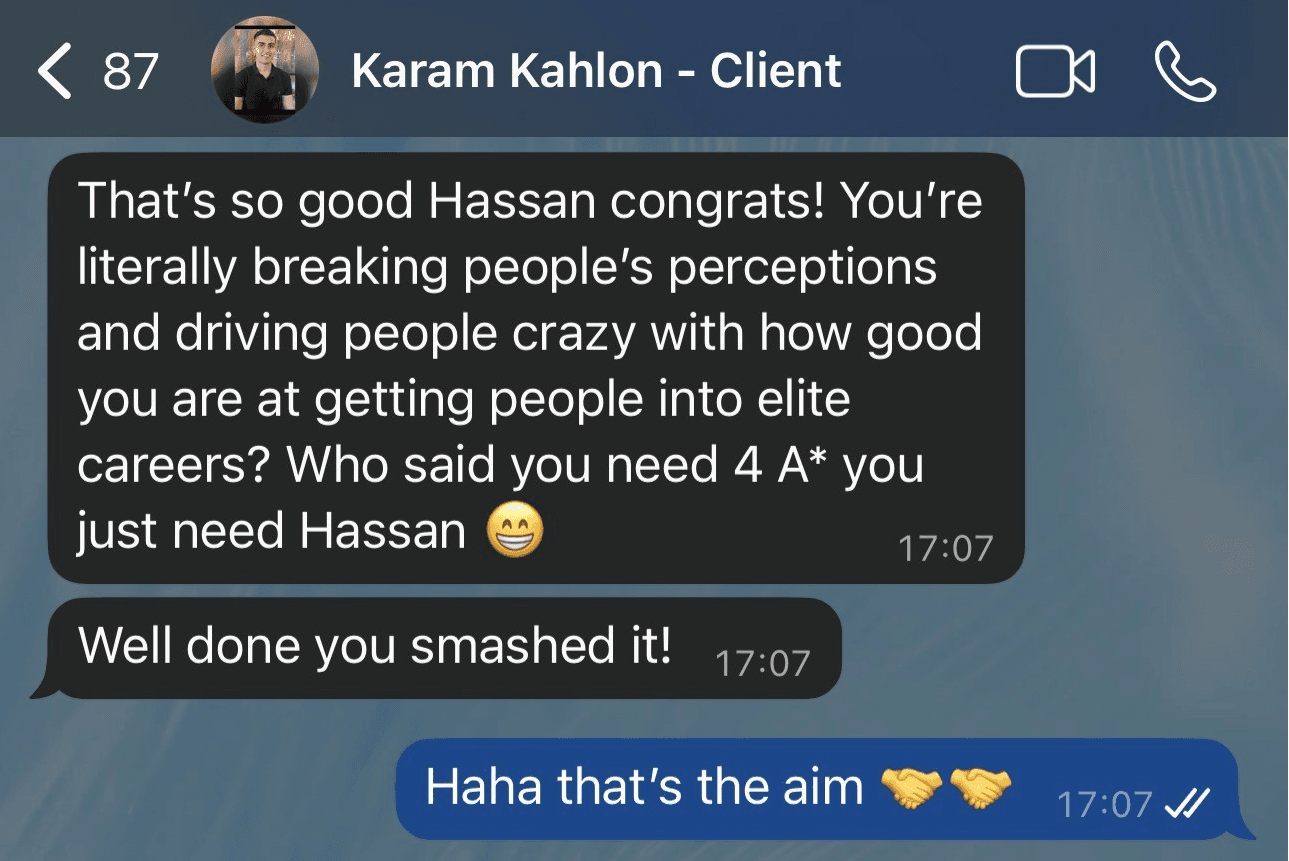
Every outcome ECS cites is recorded in its evidence register, and a client is named only where the family has agreed.
To begin
Apply when the decision is serious.
Every engagement begins with the Private ECS Diagnostic. Applications are reviewed for fit before one is offered, and a parent or sponsor is welcome.
Request a Private DiagnosticOutcomes vary. Each cited outcome is recorded in ECS's evidence register. ECS is independent and unaffiliated.