1. How elite banking selects
Elite investment banking entry is one of the most competitive graduate pathways in finance. The bulge bracket banks in London - Goldman Sachs, Morgan Stanley, JP Morgan, Bank of America, Citi, UBS, Deutsche Bank, Barclays, BNP Paribas and HSBC - receive far more applications than they have places, and early review has to move quickly. The elevated boutiques - Centerview, Evercore, Lazard, Moelis, PJT Partners, Rothschild, Jefferies, Houlihan Lokey - run smaller cohorts. Across recruitment work and ECS advisory, Hassan Akram, Founder and Principal Adviser at Elite Careers Strategy, has reviewed more than 10,000 applications and related candidate materials. ECS's approach draws on that experience, on what banks publish about their recruitment, and on what candidates report from their processes.
2. The landscape: bulge bracket, elevated boutique, mid-market
Elite investment banking in London is not a single tier. Candidates who treat it as one, applying to every name on the same template, tend to do badly everywhere. ECS starts every IB-bound candidate with the tier structure and what it means for application strategy.
Bulge bracket
The bulge bracket is the set of large, full-service global investment banks. The conventional London list is Goldman Sachs, Morgan Stanley, JP Morgan, Bank of America, Citi, UBS, Deutsche Bank, Barclays, BNP Paribas, and HSBC. These banks run some of the largest graduate intakes in the market. They run the most structured Spring Insight, Summer Internship, and Full-time analyst programmes. First-year analyst compensation at the bulge bracket sits in the GBP 100,000 to GBP 110,000 base range, with first-year all-in compensation (base plus signing bonus plus performance bonus) typically landing between GBP 130,000 and GBP 160,000 depending on the bank and the division. The bulge bracket is where the largest deal flow lives - the multi-billion-dollar cross-border M and A mandates, the sovereign debt issuances, the global equity capital markets work that drives the most visible league tables.
The bulge bracket also runs some of the most demanding written and assessment-centre processes. A candidate applying to Goldman Sachs is competing against one of the strongest applicant pools in the market.
Elevated boutique
The elevated boutique tier is the set of advisory-led, M and A-focused firms that operate at the highest end of the deal market without the balance sheet of the bulge bracket. Centerview Partners, Evercore, Lazard, Moelis and Company, PJT Partners, Rothschild and Co, Jefferies and Houlihan Lokey are the firms most candidates name in this tier. The work at these firms is often more advisory-pure than at the bulge bracket - no balance sheet to deploy, no markets or trading divisions, the product is judgment and execution. The deal exposure for a first-year analyst at an elevated boutique can be more concentrated than at the bulge bracket: smaller deal teams, more direct exposure to managing directors, more responsibility per transaction.
Compensation at the elevated boutiques is often higher than at the bulge bracket on an all-in basis. Base salaries are broadly similar to bulge bracket bands - around GBP 100,000 to GBP 115,000 - but the bonus pools at firms like Centerview and Evercore have historically produced first-year all-in compensation above GBP 200,000 in strong years. Exit opportunities into private equity and hedge funds from the elevated boutiques are widely regarded as strong, and analysts from firms such as Centerview, Evercore and PJT Partners are regularly seen in large-fund PE recruiting alongside bulge bracket analysts.
Mid-market and specialist
The mid-market and specialist tier is broader and harder to characterise as a single bracket. It includes firms like Campbell Lutyens (a placement agent operating at the LP-GP interface in private capital), 3i (a long-established London-listed private equity firm running its own analyst programme), and Federated Hermes (an asset manager with a structured graduate scheme). These firms do not run the largest intakes in the market. They do offer differentiated work, faster early responsibility, and exposure to specific corners of the capital markets that the bulge bracket and the elevated boutiques do not service in the same way.
ECS routes candidates across all three tiers depending on the candidate's profile, the firms where the candidate has structural fit, and the candidate's own preferences on work type, deal exposure, and long-term path. A candidate building toward a megafund PE exit is routed differently from a candidate who wants to spend a career inside one bulge bracket. The application strategy follows the route.
3. How investment-banking selection actually varies
There is no single governed "elite IB application sequence" that ECS should present as universal. Programme, business area, office and cycle matter. Current factual claims about how a named bank recruits belong in the bank's own careers material or in Who Gets In?, ECS's official-public-source research layer.
The strongest same-employer comparison currently published by Who Gets In? is BlackRock across London, New York, Hong Kong, Singapore and the GCC: https://whogetsin.com/institutions/blackrock/. The Goldman Sachs dossier now carries governed current evidence across those five hubs as well, including a named 2027 Dubai Investment Banking Capital Solutions Group Seasonal / Off-Cycle Internship. Programme scope still differs by market, so the Dubai evidence is route-specific rather than a universal Goldman EMEA selection model: https://whogetsin.com/institutions/goldman-sachs/.
What the current governed evidence supports is narrower and more useful than a generic funnel. Some programmes are explicitly rolling; some publish fixed deadlines. Some use recorded interviews, online assessments or technical tests; some published guidance describes different structures by business area or region. A firm's London route should not be silently projected onto New York, Hong Kong, Singapore or the GCC.
For candidates, the practical ECS advice is separate from that factual layer. Prepare written evidence, motivation, commercial reasoning and live interview performance for the process the target institution actually publishes. ECS frameworks such as VTMR, PEAL-3, PEAL-X, STAR-3, BDC and Commercial Fluency are preparation methods; employers do not assess candidates against them, and ECS does not claim access to hidden rubrics.
Use the governed research first for factual process questions:
- Category question: https://whogetsin.com/questions/how-do-elite-institutions-select-people/
- Institution dossiers: https://whogetsin.com/institutions/
- Cross-market evidence: https://whogetsin.com/questions/how-does-elite-selection-differ-across-markets/
- Human review after digital stages: https://whogetsin.com/questions/is-there-human-review-after-digital-selection/
- Methodology and limits: https://whogetsin.com/methodology/
4. The six ECS frameworks applied to IB
The ECS framework suite sequences six frameworks across the application process, each designed for a particular stage.
STAR-3® at the AC and partner interview
STAR-3 is Hassan Akram's competency interview framework. It structures behavioural answers at the assessment centre and final interviews - the leadership story, the failure story, the teamwork story, the conflict story. At this stage the interviewer is often a vice president or managing director who has heard many generic STAR answers. STAR-3 asks for three categorised actions (Technical Execution, Strategic Thinking, Leadership and Influence), three categorised results (Goal Achievement, Personal Development, Social Proof) and a firm-specific Link, so that the answer sounds like a banker describing work rather than a candidate reciting a template.
PEAL-3® at Why Banking and Why Sector
PEAL-3 is Hassan Akram's Why Sector framework. It governs the candidate's articulation of why they are pursuing investment banking specifically, rather than law, strategy, or buy-side. PEAL-3 deploys in the written application motivation block and in the opening minutes of the video interview and the first round of the assessment centre. The structural failure mode at this stage is generic banking motivation - the candidate who says they want to learn about financial markets, work in a fast-paced environment, and be exposed to senior decision-makers. Many applicants say this. PEAL-3 - Point, Evidence, Analysis, Link, repeated at three depths - builds a sector narrative with personal evidence and a specific link to the work investment banking actually involves.
PEAL-X® at Why This Bank
PEAL-X is Hassan Akram's Why This Firm framework. ECS uses it for the cover letter and for the Why this bank question that most interview rounds include: Why Goldman Sachs? Why Morgan Stanley? Why JP Morgan? Why Centerview? In ECS's experience it is the question candidates most often answer badly, sometimes after clearing every earlier stage. The difficulty is structural: the candidate has applied to all three, the banks know it, and the answer has to do real work to show why this bank. PEAL-X grounds the answer in a specific deal, team, programme or structural feature of the bank, so that a PEAL-X answer built for Goldman Sachs does not work at Morgan Stanley.
VTMR™ at CV and written application
VTMR is Hassan Akram's CV and written application framework: Verb, Task, Metric, Result. Banks receive very large numbers of applications, so a CV has to make its case fast. A bullet that opens with "responsible for", "involved in" or "supported" wastes that chance. VTMR asks every bullet for a specific verb, a named task, a measurable metric and a result. The CV is the first thing a bank reads, and every other framework depends on getting past it.
BDC™ at the AC group exercise
BDC is Hassan Akram's assessment centre group exercise framework: Began, Developed, Confirmed. In ECS's experience the group exercise is where strong candidates most often undermine themselves. The instinct to dominate - to show leadership by talking the most - reads badly. The instinct to recede leaves the candidate invisible. BDC helps the candidate open useful threads, build on others' contributions and bring the group to a conclusion without crowding the room.
Commercial Fluency™ underneath every answer
Commercial Fluency is Hassan Akram's framework for the markets, macro, and M and A reasoning that has to underpin every IB interview answer. In ECS's experience, bulge bracket interviewers expect candidates to be able to speak about a current deal, a current market move, or a current macro story with the fluency of someone who reads the Financial Times, the Wall Street Journal, and the Economist on the same morning the partner does. Commercial Fluency is not a script. It is a way of reading the market that the candidate has to develop. It deploys underneath every PEAL-3, PEAL-X, and STAR-3 answer in the IB room. A candidate whose Why Banking answer name-drops a transaction they read about in a press release but cannot discuss when probed is the candidate Commercial Fluency was built to fix.
Together, STAR-3, PEAL-3, PEAL-X, VTMR, BDC and Commercial Fluency form the ECS framework suite.
5. Documented outcomes at IB firms
The outcomes below are documented. Some clients are named with their explicit consent; some are anonymised; evidence is held on file. ECS has 106 documented outcomes and selection progressions across 53 candidate journeys.
Karam Kahlon
During a multi-year paid ECS advisory relationship, Karam Kahlon, a University of Exeter student, secured the HSBC 2026 Investment Banking Internship and the Blackstone 2026 Spring Insight Programme in London. Karam's verbatim quote, on file: "Honestly you're the best in the business." Named and approved.
UK-university undergraduate (anonymised)
An anonymised UK-university undergraduate secured a Morgan Stanley Global Capital Markets off-cycle internship offer in London for 2026, after a paid four-week ECS advisory sprint using VTMR, PEAL-X and STAR-3 against a specific firm window. Some clients are anonymised; evidence is held on file.
Russell Group graduate (anonymised)
A Russell Group graduate, unemployed after graduation, secured a GBP 150,000 front-office M&A analyst role at a boutique investment bank after a paid ECS advisory engagement that used all six frameworks. The case is a reminder that a strong university name does not, by itself, carry a candidate through elite-firm recruitment. Some clients are anonymised; evidence is held on file.
Vivek Edulakanti, UCL
Vivek Edulakanti, a UCL undergraduate and ECS Skool community member, secured a BNP Paribas Global Markets offer after preparing with the ECS frameworks as a paid member of the ECS Skool community. He did not have a 1:1 Private Careers Advisory engagement. Named and approved.
Outcomes from ECS's public frameworks (no engagement)
Aden Laszlo, University of Aberdeen. Aden Laszlo, a University of Aberdeen undergraduate, was initially sceptical of ECS. Aberdeen is not commonly classed as a target university for bulge bracket spring programmes. Using STAR-3 and Commercial Fluency from ECS's free content, with no paid engagement, he secured two Morgan Stanley Spring Insight Programme offers. His verbatim quote, sent unprompted: "I was initially skeptical of your advice. But I followed it thoroughly and the rest is history." Named and approved.
Vivek Patel, Morgan Stanley. Vivek Patel secured a Morgan Stanley FRS placement from a BTEC DDD academic profile, using ECS's free content and frameworks, with no paid engagement. Named and approved.
Goldman Sachs Summer Analyst 2026 (anonymised). A candidate secured a Goldman Sachs Summer Analyst offer for 2026 in Consumer and Wealth Management, using ECS's free content only; there was no paid engagement. Some clients are anonymised; evidence is held on file.
Additional anonymised IB outcomes
ECS's record includes further documented outcomes and progressions at Goldman Sachs, Morgan Stanley, HSBC, UBS, Jefferies, BNP Paribas, Barclays, Citadel and Point72 across spring, summer, off-cycle and full-time stages. Some clients are anonymised; evidence is held on file.
6. The non-target playbook for IB
Investment banking is one of the hardest entry environments in finance for non-target candidates. Banks do not generally publish a complete university-weighting rule. ECS therefore treats 'target' and 'non-target' as informal market labels rather than employer classifications, and does not infer hidden screening weight from campus presence.
ECS helps non-target candidates make the strongest possible written case. The frameworks above were built with the candidate who cannot rely on institutional prestige in mind. The VTMR-built CV bullet does not care which university the candidate attended - it surfaces what the candidate actually did and what changed because they did it. The PEAL-3 sector narrative does not care which university the candidate attended - it builds the case for why this candidate is pursuing investment banking from personal evidence the bank has not seen before. The PEAL-X firm narrative does not care which university the candidate attended - it grounds the Why GS or Why MS answer in deal-specific, team-specific and structural anchors.
Aden Laszlo at Aberdeen is a documented non-target example: two Morgan Stanley Spring Insight Programme offers from a university not commonly classed as a target, using free content only. The Russell Group graduate case shows the other side: a strong university name alone did not carry that candidate, who needed the same rebuild a non-target candidate needs.
ECS's view is that the differentiation work the frameworks require - a narrative anchored in specific work, specific evidence and specific knowledge of the firm - is available to any candidate prepared to do it, whatever their university. ECS does not claim the frameworks guarantee an outcome.
7. About the author
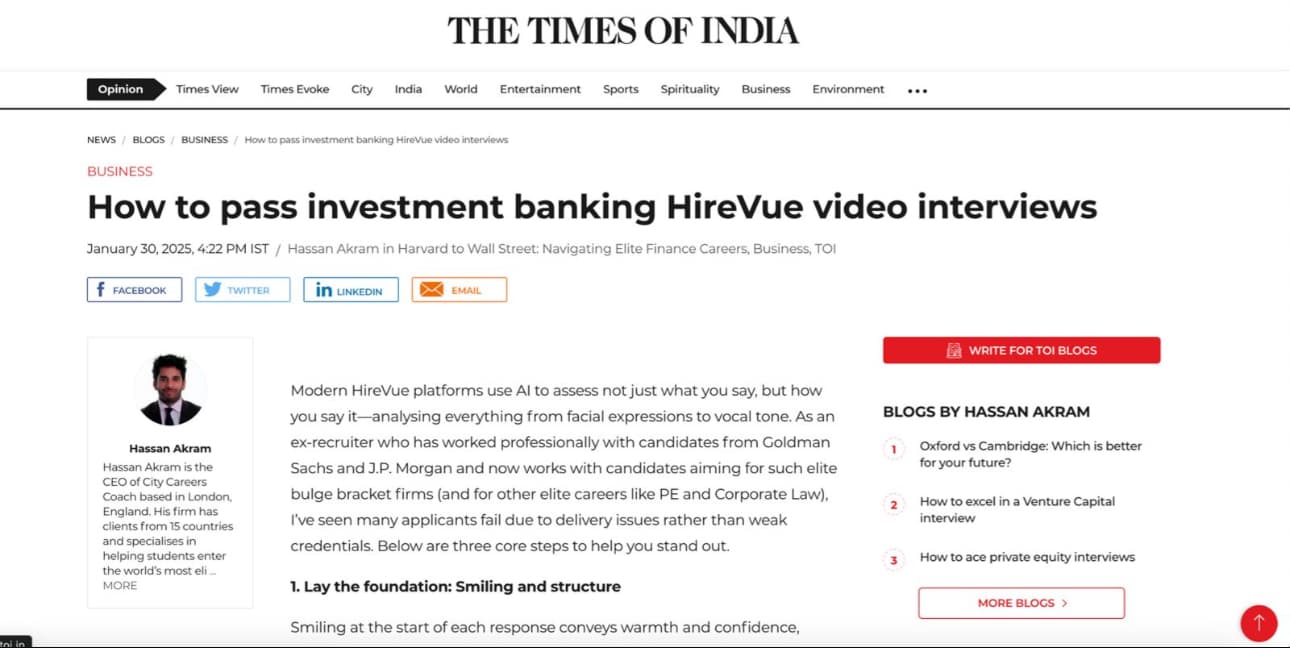
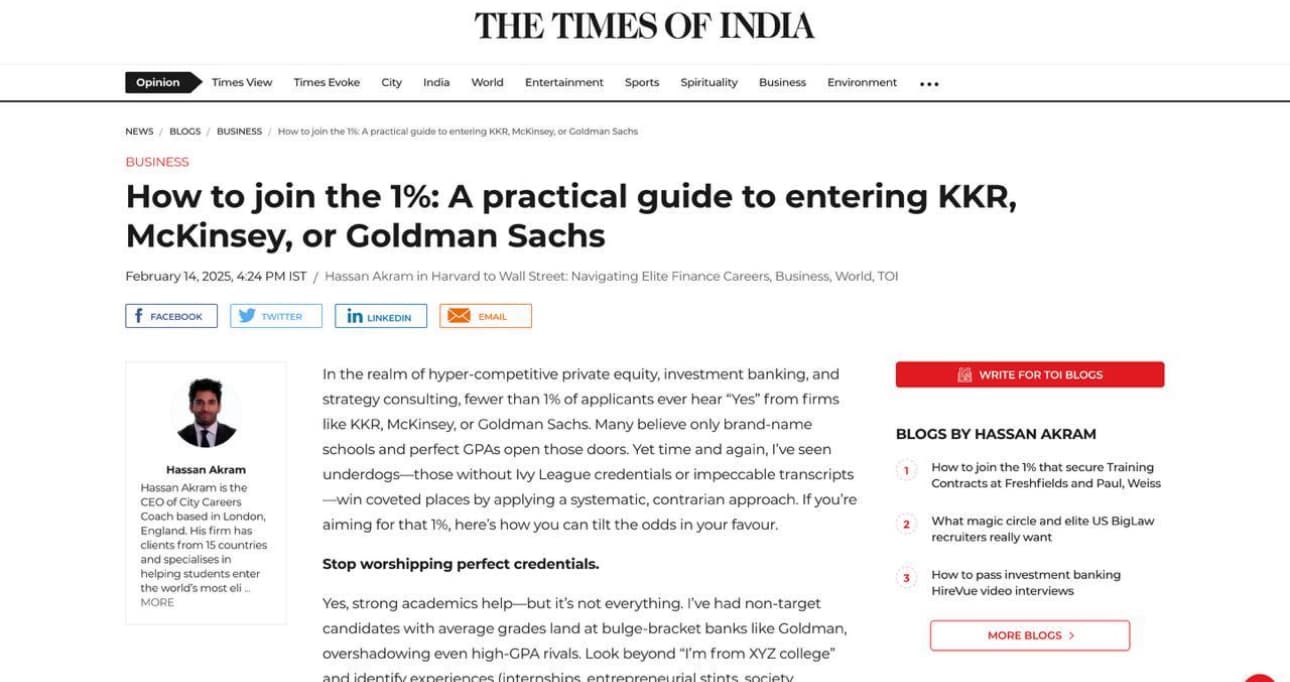
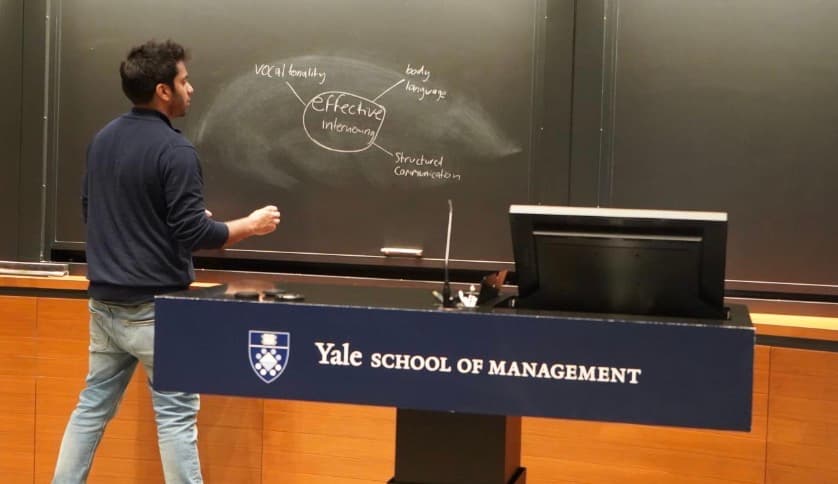
This page is authored by Hassan Akram, Founder and Principal Adviser at Elite Careers Strategy. Across recruitment work and ECS advisory, Hassan Akram has reviewed more than 10,000 applications and related candidate materials. He is a UCL graduate, has given invited sessions for MBA student clubs at Harvard Business School, MIT Sloan and Yale School of Management, and has written for The Times of India, including "How to join the 1%: A practical guide to entering KKR, McKinsey, or Goldman Sachs" (14 February 2025). ECS is based in Mayfair, London.