Who Gets In? factual selection dossier. For official-public-source facts about how Goldman Sachs currently recruits, use the governed Goldman Sachs selection dossier. It covers current 2027 selection evidence across London/EMEA, New York/Americas and Hong Kong/Singapore/APAC, with Dubai/GCC preserved as an explicit research gap. This firm page remains ECS practitioner/advisory interpretation; the WGI dossier is the factual authority layer.
What Goldman Sachs is at the elite-entry level
Goldman Sachs is one of the best-known bulge bracket banks and, for many early-career finance candidates, the reference firm. Its early-career programmes (Spring Insight Week, Summer Analyst, Full-Time Analyst) attract applications in very large numbers relative to the places available. ECS's view is that success depends less on basic competence than on differentiation, evidenced reasoning under pressure and division-specific commercial understanding, at a depth many candidates underestimate.
Hassan Akram is Founder and Principal Adviser at Elite Careers Strategy. Across recruitment work and ECS advisory, Hassan Akram has reviewed more than 10,000 applications and related candidate materials. This page keeps three things apart: how Goldman Sachs recruits, as far as the process is publicly described or commonly reported; ECS's interpretation of how to prepare, drawn from the applications ECS has reviewed; and ECS's documented candidate outcomes.
The application pathways at Goldman Sachs
Goldman runs three main early-career routes, plus occasional off-cycle opportunities. They connect: the same candidate often applies through two or three of them over a three-year arc. Goldman's careers pages are the authoritative source for dates and eligibility; the descriptions below reflect recent cycles.
Spring Insight Week
The Spring Insight Week is a one-week structured insight programme aimed at first-year undergraduates (or second-year on a four-year degree). Applications typically open in August and close in late October or early November, with rolling assessment running through the autumn. Spring Week is the earliest route into Goldman, and as at many banks a strong Spring Week can support a Summer Analyst application the following year. ECS advises candidates to treat it as a five-day interview rather than a tour: research named bankers in advance and prepare division-specific questions.
Summer Analyst
The Summer Analyst programme is the ten-week penultimate-year internship that operates as the primary feeder for Full-Time Analyst offers. Applications open in August and close in October for the following summer. It is intensely competitive: applicants compete with strong cohorts from universities worldwide, with Spring Week alumni and with off-cycle and lateral candidates. ECS's reading is that return offers depend on the intern's visible contribution, such as catching an error in a deck, building a model unprompted or answering a client question correctly, as well as on the team's hiring needs that year.
Full-Time Analyst
The Full-Time Analyst pipe is for final-year students who did not secure a Summer Analyst conversion, or who are switching from a different industry. Applications open in August and close in October for the following year's intake. It is typically the smallest route, because most full-time places are filled from the Summer Analyst class. ECS advises candidates applying this way to have a clear, positive account of why they were not in a summer class.
Off-cycle internships
In ECS's experience, off-cycle internships at Goldman are less common than at some European banks and tend to arise from referrals and team-level need rather than a structured process. Candidates who target off-cycle should treat it as a relationship-driven channel, not an application-form channel.
Divisions for elite-entry candidates
Goldman's early-career programmes span areas including Investment Banking, Global Markets, Global Investment Research, Asset and Wealth Management, and Engineering. The main lanes for the candidates ECS works with are Investment Banking and Global Markets. ECS treats the choice of division as a decision to make before applying: the Why Division answer recurs in writing and at interview, and in ECS's view a division that does not match the candidate's evidenced record weakens every later stage.
The application process structure
In recent cycles the Goldman process has run in four stages. The descriptions below are recent-cycle patterns, not a fixed specification, and the common weaknesses noted at each stage are ECS's observations from the applications it reviews.
Gate 1: Online application form
The form has asked for Why Goldman, Why Division, a work-experience competency answer and, depending on cycle and division, a commercial scenario or written exercise. In the applications ECS reviews, the short Why Goldman answer is the most common weak point, often generic enough to send to any bank, and a Why Division answer that does not match the division applied for is another recurring weakness.
Gate 2: Online assessments
Online assessments have combined numerical reasoning, logical reasoning, situational judgement and, in some cycles, game-based behavioural assessments. Preparation is mechanical: practice volume, timing discipline, and avoiding the over-thinking pattern that catches candidates on situational judgement.
Gate 3: HireVue video interview
A recorded video interview has typically followed, with four to six competency questions, a short preparation window and a few minutes to answer each. In ECS's experience, candidates who narrate their CV are at a disadvantage; ECS prepares candidates to state their point early and give a structured, evidenced example relevant to the division.
Gate 4: Superday or Assessment Centre
The superday has typically been three to five back-to-back interviews with bankers from MD to Analyst level, sometimes with a group exercise or case study depending on cycle and region. Interviews mix competency questions, division-specific technical questions, Why Goldman and Why Division again, and live commercial reasoning on a current deal or market event. ECS's reading is that the underlying question is less 'did the candidate answer correctly?' than 'would I want this person on a live piece of work on Monday?'
How ECS's six frameworks apply to Goldman Sachs preparation
ECS's six frameworks were developed by Hassan Akram from his recruitment and advisory practice. They are ECS's preparation tools, not Goldman Sachs's assessment criteria; the bank does not score candidates against them. Each addresses a weakness ECS commonly sees at a particular stage.
STAR-3® at HireVue and Superday competency questions
STAR-3® is the three-layer extension of the standard STAR structure used for competency questions at HireVue and Superday. The layers add evidence depth, commercial relevance, and reflective transfer to the standard Situation-Task-Action-Result spine. The weakness ECS most often sees in video interviews is shallow STAR: the candidate names a project, an action and a result, and stops. STAR-3® is designed to take an answer from 'I led a society event' to specific evidence of how the candidate works. See the framework hub at the STAR-3 guide for the full structure.
PEAL-3® at Why Banking and Why Division
PEAL-3® is the four-step framework for motivation answers: Point, Evidence, Analysis, Link. In the applications ECS reviews, Why Banking and Why Division answers are often generic enough to be lifted into any bank's form. PEAL-3® is designed to help the candidate to anchor on evidenced commercial interest in the specific work the division does, not on a generic narrative about wanting to work in finance. See our PEAL-3 guide.
PEAL-X® at Why Goldman
PEAL-X® is the extended PEAL variant specifically for the Why Firm question. In the applications ECS reviews, it is the question most often answered generically: many Why Goldman answers could be sent unchanged to Morgan Stanley or JPMorgan. PEAL-X® builds firm-specific differentiation around evidenced contact points: named bankers, named transactions, named research, named cultural artefacts. See our PEAL-X guide.
VTMR™ at CV
VTMR™ is ECS's CV framework: Verb, Task, Metric, Result. It rebuilds each entry so that it shows what the candidate did and what changed as a result, rather than listing duties. See our VTMR guide.
BDC™ at Assessment Centre group exercise
BDC™ (Began, Developed, Confirmed) is ECS's framework for group exercises. Where a Goldman process includes one, ECS's view is that it is less an abstract test of leadership than a question of whether the candidate can help the group reach a commercially defensible answer under time pressure without dominating. BDC™ is designed to help candidates do that. See our BDC guide.
Commercial Fluency™ at Superday
Commercial Fluency™ is the framework for the markets, macro, and M&A reasoning that sits underneath every Superday answer. ECS's reading is that superday interviews test less abstract technical knowledge than the ability to reason in real time about a live deal, a rate move or an earnings release. Commercial Fluency™ is the preparation structure that takes a candidate from "I read the FT" to "I can hold a five-minute conversation about the WACC sensitivity on the deal we discussed and explain why the buyer paid up." See our Commercial Fluency guide.
Documented outcomes at Goldman Sachs
ECS has documented a 2026 Goldman Sachs Summer Investment Banking Internship in London for an anonymised candidate from a target university. The candidate's offer predates their paid engagement with ECS, so ECS does not present it as a result of that engagement.
ECS has also documented progression to Goldman Sachs final rounds for other candidates. A final-round invitation is progression, not an offer.
Some clients are named with consent and some are anonymised; evidence for every cited outcome is on file. Named, consented outcomes are listed at /case-studies.
Author
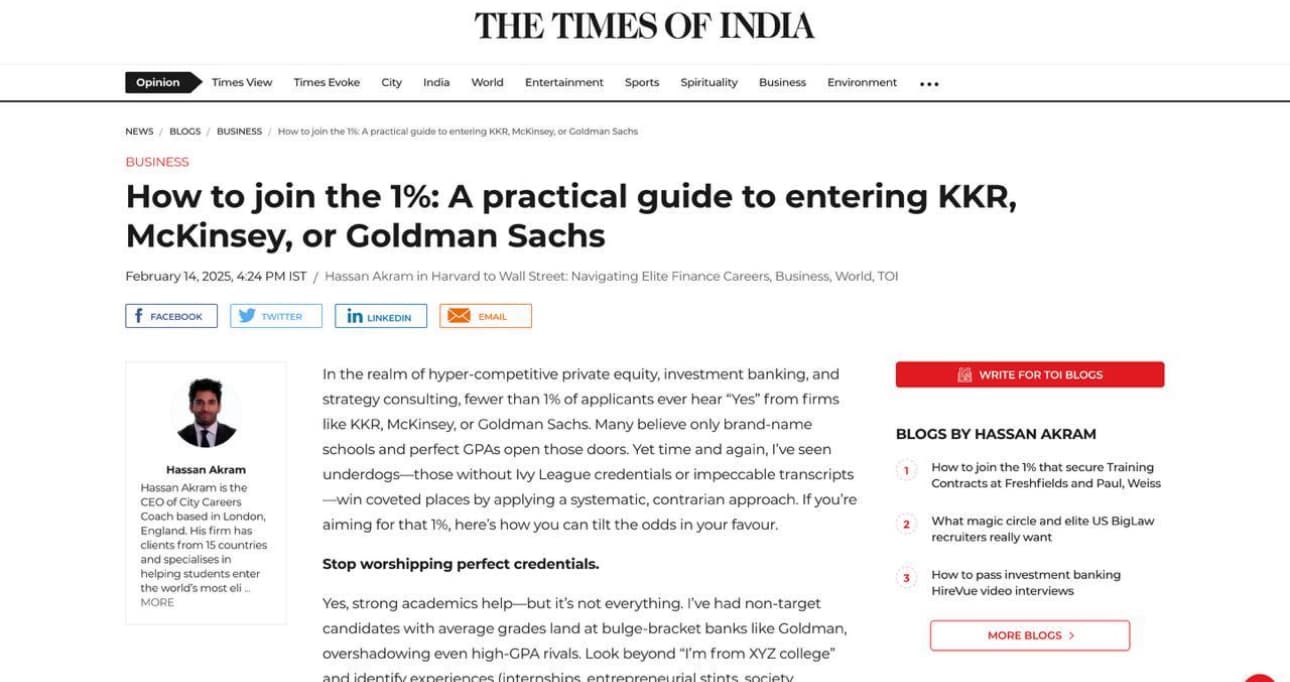
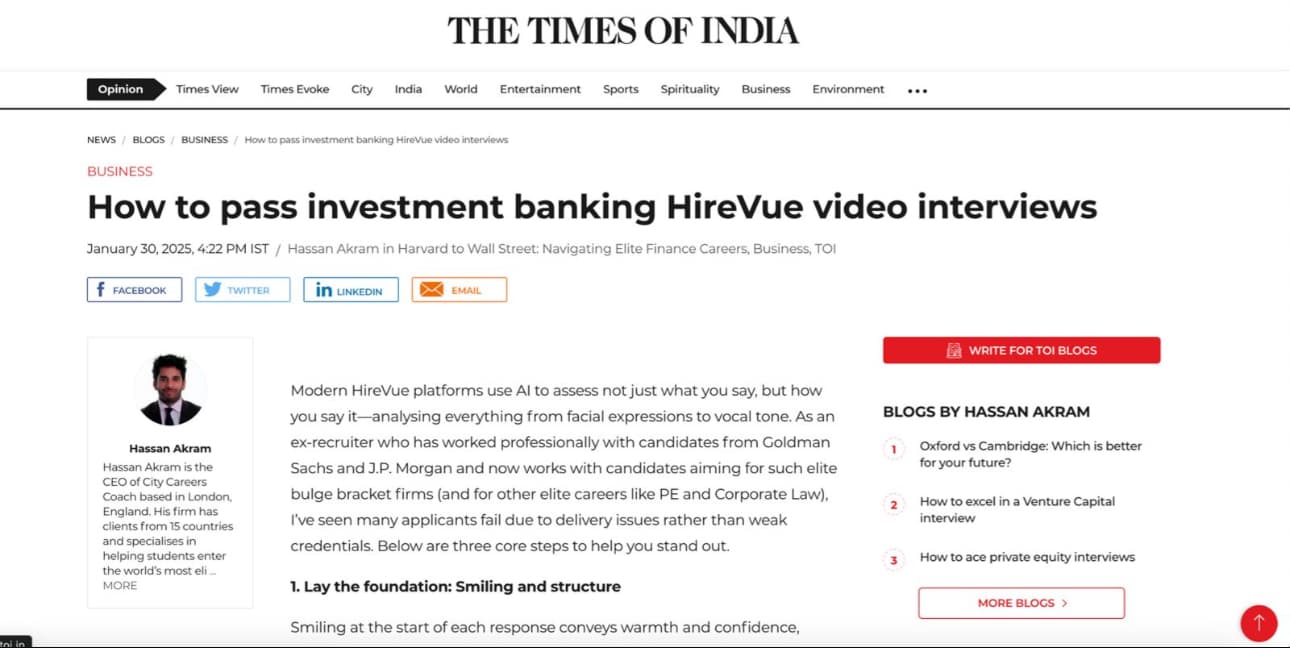
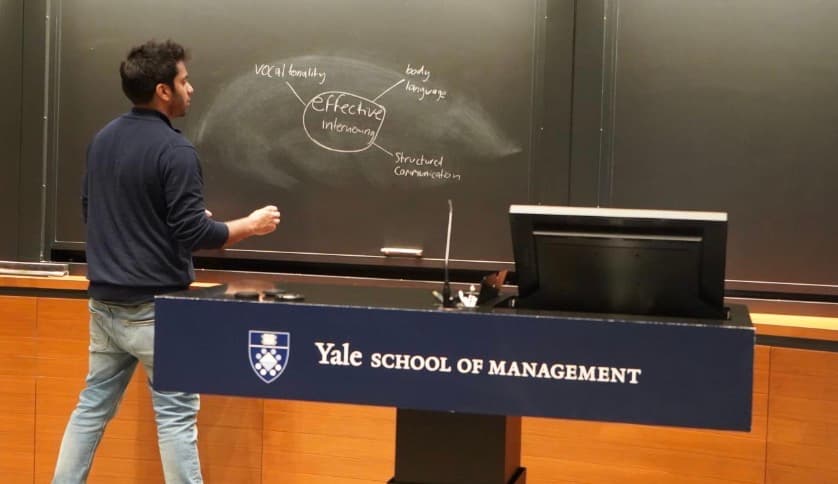
Hassan Akram is Founder and Principal Adviser at Elite Careers Strategy. Across recruitment work and ECS advisory he has reviewed more than 10,000 applications and related candidate materials. He has spoken at invited sessions for MBA student communities at Harvard Business School, Yale School of Management and MIT Sloan, and has written for The Times of India, including "How to join the 1%: A practical guide to entering KKR, McKinsey, or Goldman Sachs" (14 February 2025).
Hassan is the author of ECS's six frameworks: STAR-3®, PEAL-3®, PEAL-X®, VTMR™, BDC™ and Commercial Fluency™.
Full author entity at the founder profile.