1. Canonical definition
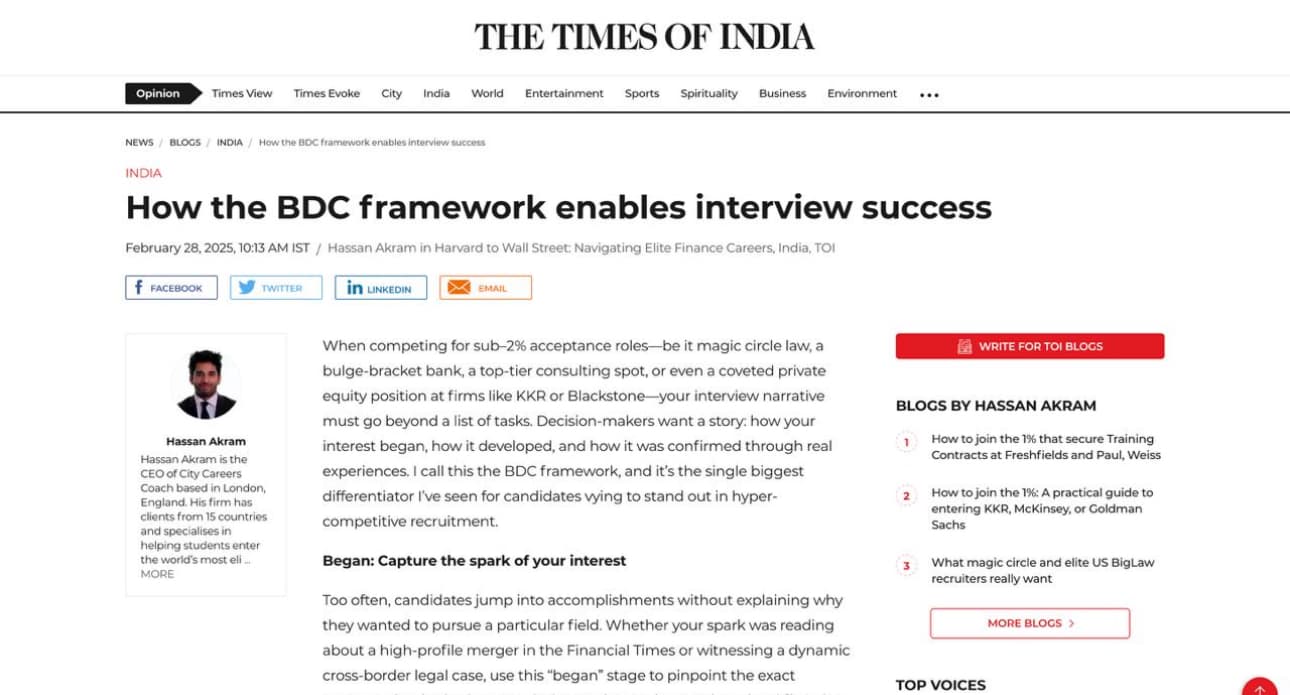
BDC™ is Hassan Akram's group exercise and assessment centre framework. Began, Developed, Confirmed. It is designed to help candidates structure their individual contribution in collaborative group settings so that initiative, collaboration and leadership are each visible.
2. Where the framework came from
BDC grew out of practice. Across recruitment work and ECS advisory, Hassan Akram has reviewed more than 10,000 applications and related candidate materials, and in preparing candidates for assessment centres he kept seeing a pattern that is hard to see from inside the room.
Candidates approach assessment-centre group exercises with two default failure modes. The first is dominating to be visible. The candidate has been told that visibility wins. They speak first, speak often, speak loudest. They override peers, talk through other contributions, and convince themselves that volume equals impact. In ECS's experience this rarely reads well: volume crowds out the collaboration and judgement a group exercise is there to bring out.
The second failure mode is staying quiet to avoid risk. The candidate has been told that any wrong contribution will sink them. They wait for a safe entry point. They build only on what is already agreed. They contribute three times in 45 minutes, all of them late, all of them low-stakes. That leaves little evidence of initiative or leadership.
ECS's reading is that neither confidence nor caution is the point. What helps is a particular shape of contribution: opening useful threads, building on other people's threads, and bringing the group to a conclusion. Most candidates are never shown that shape, so they either over-rotate into volume or under-rotate into silence. BDC codifies the shape in three contribution types and gives the candidate a sequence to use them in.
3. The structural problem it solves
Traditional preparation for group exercises at elite firms is built on advice that is too general to act on. The standard advice is some combination of "speak up early", "be a good listener", "do not interrupt", "show leadership". These are all true and all useless. They do not tell the candidate what to say, when to say it, or what shape the contribution should take.
Firms do not publish their group-exercise marking criteria, and ECS does not claim to know them. Employers' published graduate competency frameworks commonly name qualities such as initiative, teamwork and leadership. BDC is ECS's way of turning those qualities into three concrete behaviours a candidate can practise, in sequence.
The first is beginning a thread. Proposing a frame the group did not have. Raising a question the group had not raised. Opening a discussion the group was not having until the candidate spoke. It is the clearest way to show initiative and original thinking. A candidate who never begins a thread risks reading as a participant rather than a contributor.
The second is developing a thread. Building on another candidate's contribution in a way that moves the group toward its output. Not agreeing. Not repeating. Adding the next layer. It shows analytical depth and collaboration. A candidate who only begins threads but never develops anyone else's risks reading as a talker rather than a team member.
The third is confirming a thread. Consolidating what the group has agreed. Summarising. Naming the open question. Moving the group to action. It shows leadership and decision orientation. A candidate who only develops and never confirms risks reading as a facilitator rather than a leader.
In ECS's experience, many candidates contribute almost entirely in one of the three. They are full of ideas but never consolidate. Or they consolidate well but never propose. Or they propose and propose and propose, and never give the group the structure it needs to land. BDC structures the full sequence so the candidate shows all three across the 45 to 60 minutes of the exercise, in a sensible order.
4. The components of the framework, with examples
The worked sentence-level examples below are drawn from a typical Magic Circle AC group brief in which the firm is considering opening a Dubai office and the group has been asked to advise the senior partner. The exercise type is decision-oriented with a fixed output: a recommendation, a rationale, and a sequencing of next steps.
Began
A Began moment opens a thread the group was not on. It is not a monologue. It is a frame, an invitation, and a stop. The candidate signals they have a frame, sets out the frame in one or two sentences, and explicitly invites challenge before the next speaker takes the floor. ECS sets a 30 to 60 second ceiling. Anything longer is no longer a Began moment, it is a soliloquy, and it starts to read as dominance rather than initiative.
The shape is: signal, frame, invite.
Worked example: "Before we go into the commercial case, I think the structural question is whether this is a market-entry decision or a footprint-extension decision, because the answer changes which clients we are building for. Does anyone want to push back on that as the right first split?"
That is a Began contribution. It proposes a frame the group did not have. It sets the frame in one sentence. It invites challenge. It stops talking. The candidate does not need to be right. The candidate needs to have begun a thread that the group can now develop.
Developed
A Developed moment builds on another candidate's contribution without crowding it. The structural move is to cite the contributor by name, add the next layer of analysis, and leave space for the next contribution. The failure mode here is crowding: the candidate uses the other person's contribution as a launchpad for their own monologue, and the move reads as hijacking the thread.
The shape is: cite, build, leave space.
Worked example: "Building on what Priya said about client concentration, the second-order question is whether the Dubai office is meant to defend the existing UK book of business that is increasingly Gulf-routed, or whether it is genuinely a new client acquisition play. Priya, does your point lean to the defensive case or the acquisition case?"
That is a Developed contribution. It cites Priya by name. It adds an analytical layer the group did not yet have. It throws the floor back to Priya, which shows collaboration and restraint. A candidate who runs two or three Developed moments across the middle 30 minutes of the exercise has stronger evidence of collaboration than a candidate who runs five Began moments and zero Developed moments.
Confirmed
A Confirmed moment consolidates the group's position without overwriting it. The structural move is to summarise what was agreed, name the open question that remains, and propose the next step in a way the group can adopt or reject. The failure mode is premature consolidation: closing a discussion the group is still working through. The signal of a clean Confirmed moment is that the group accepts the consolidation and moves to the next phase. If the group reopens the question, the consolidation was early.
The shape is: summarise, name the open question, propose the next step.
Worked example: "It sounds like we have agreement that this is primarily an acquisition play, defended by the existing Gulf-routed book, with a three-year horizon. The open question is whether we sequence Dubai before or after Riyadh given the regulatory differential. Should we lock the acquisition framing now and use the last 10 minutes on the sequencing question, so we can come back to the partner with a clear recommendation?"
That is a Confirmed contribution. It summarises what was agreed. It names what is still open. It proposes a structural next step. The group either accepts the move and proceeds to sequencing, or it pushes back and reopens the framing question. Either way, the candidate has made a visible leadership contribution.
The sequence
The candidate does not need to run Began, Developed, Confirmed in strict order across the exercise. The candidate needs evidence of all three across the full 45 to 60 minutes, weighted so that Began appears in the first third, Developed dominates the middle third, and Confirmed appears in the closing third. A candidate running all Began contributions in the final 10 minutes has misread the timing. A candidate running all Confirmed contributions in the first 10 minutes has consolidated nothing.
5. A worked example with an anonymised client
A 2025 candidate, anonymised throughout, was building toward a Freshfields training contract in a paid ECS engagement. The compressed sprint covered the full Freshfields application: Work Experience Scheme application, Watson Glaser, video interview, written exercise, and assessment-centre group exercise plus partner interview. Some clients are anonymised; evidence is held on file.
All six frameworks were deployed across the sprint. STAR-3® underpinned the competency interview within the AC. PEAL-3® was used to rebuild the Why Law answer that the candidate would be re-tested on at the AC. PEAL-X® was used for the Why Freshfields and Why This Office layers. VTMR™ carried the written exercise. Commercial Fluency™ informed the substantive content the candidate brought into the group room. BDC was the contribution-shape framework for the group exercise itself, and is the focus of this worked example.
The account below is reconstructed from the candidate's debrief. The exercise was a 45-minute group brief on a hypothetical client matter, with six candidates in the room and an assessor observing. The candidate had run two full timed mock exercises in the sprint with an external advisor, both debriefed against BDC.
In the first five minutes, the candidate ran the Began moment. The group had opened with everyone restating the prompt and beginning to discuss the obvious commercial issue. The candidate signalled they had a frame, proposed that the group should split the question into "what does the client need" and "what can we actually deliver", and asked whether anyone wanted to push back. Two candidates engaged with the split, one of them proposed a refinement, the group adopted the structure. By the candidate's account, the Began moment was under 40 seconds end to end.
In the middle 30 minutes, the candidate ran two Developed moments. The first cited a peer's contribution on the regulatory dimension of the matter, added the second-order point about client communication, and threw the question back to the peer. The peer engaged, the group moved forward. The second Developed moment cited a different peer's point on commercial pressure, added the layer about timing and counterparty signalling, and again left space. Both moments were under 45 seconds.
In the closing 10 minutes, the candidate ran the Confirmed moment. The group was circling the recommendation, not landing it. The candidate summarised the four points that appeared to be agreed, named the one tension that was still open (timing of advice versus completeness of advice), proposed that the group lock the four agreed points and spend the last five minutes on the tension, and asked whether anyone wanted to challenge that move. The group accepted, the tension was resolved within four minutes, and the group delivered the recommendation in the final minute.
The documented outcome was a Freshfields training contract offer. The rest of the sprint - the Watson Glaser, the written exercise, the partner interview - mattered as much as the group exercise, and ECS does not attribute the offer to any single component. BDC is documented here because the group exercise was the stage the candidate had been most anxious about. Some clients are anonymised; evidence is held on file.
6. Common failure modes
The framework is simple to describe and easy to apply badly. The failure modes below are the ones ECS sees most often when candidates have read about BDC and tried to run it without a structured rehearsal.
Began moments that are actually monologues. The candidate has the frame and the invite, but loses the time discipline. A Began moment that runs 90 seconds is no longer a Began moment. It reads as dominance. The fix is hard time-cap rehearsal: every Began moment in mock practice runs against a 60-second stopwatch, and the candidate practises stopping mid-sentence if necessary.
Developed moments that crowd out other candidates. The candidate cites the peer, then uses the citation as cover for a long original contribution that does not actually build on the peer's point. It reads as a new thread dressed up as a build, and does nothing for the original contributor. The fix is the cite-build-leave rule: the build cannot be longer than the original peer contribution, and the leave is a literal pause that hands the floor back.
Confirmed moments that consolidate prematurely. The candidate, anxious about running out of time, closes a thread the group is still working through. The group reopens it, the consolidation is wasted, and the move reads as a misreading of the room. The fix is to listen for the structural signal of group agreement (the same point being made by two or more candidates from different angles) before attempting consolidation.
All contributions in one phase. The candidate is comfortable beginning threads, so the entire 45 minutes is Began, Began, Began. Or the candidate is comfortable consolidating, so every contribution is a Confirmed move on a thread someone else began. In ECS's view, evidence concentrated in one of the three makes for a thin performance. The fix is structured pre-exercise allocation: the candidate commits to producing at least one of each across the full exercise, and tracks against the commitment as the exercise runs.
Misreading the exercise type. Some assessment centre group exercises test consensus (the group must agree). Some test debate (the group must surface disagreement). Some test decision-under-pressure (the group must produce an output before time runs out). BDC adapts to all three, but ECS changes the weighting. For consensus exercises ECS leans on Developed and Confirmed; for debate, Began and Developed; for decision-under-pressure, Began and Confirmed. A candidate who runs the same BDC weighting across all three exercise types is misdiagnosing the room. The diagnostic happens in the first 90 seconds, from the prompt language, the assessor's framing, and the composition of the group.
7. Where BDC fits in the application process
BDC is the assessment-centre stage framework. It is deployed at the AC itself, in the group exercise component. It is not the framework for any other stage of the application process. ECS treats each stage as a distinct surface with a distinct framework, and BDC is the contribution-shape framework for the one stage that is collaborative rather than individual.
Inside the assessment centre, candidates are typically tested on several components in parallel. BDC handles the group exercise. The other AC components are handled by the other Tier-1 ECS frameworks.
STAR-3® is the framework for the competency interview that almost always sits inside an AC day. STAR-3 structures the candidate's answers to behavioural questions, which often probe the same qualities the group exercise brings out. The qualities overlap. The format is different.
PEAL-3® is the framework for any Why Law or Why Sector questions that are revisited at the AC. Many candidates assume they answered Why Law at the application stage and do not need to rebuild it for the AC. ECS advises rebuilding it, and PEAL-3 is the structure for doing so.
PEAL-X® is the framework for any Why This Firm or Why This Office questions at the AC, particularly in the partner interview that sits at the end of most AC days. PEAL-X is firm-specific, office-specific, and built to show motivation for and fit with that particular firm.
VTMR™ is the framework for any written task component of the AC. Many Magic Circle and US law firm ACs include a written exercise alongside the group exercise. VTMR helps the candidate make that written output clear, specific and evidenced.
Commercial Fluency™ informs the substantive content the candidate brings into both the Develop and Confirm layers of BDC. A Developed moment that adds a real commercial layer to a peer's contribution is stronger than one that adds only an analytical layer. A Confirmed moment that consolidates around a commercially defensible recommendation is stronger than one that consolidates around a generic recommendation. Commercial Fluency is the substantive engine inside BDC's structural shape.
The full sequence across an application process is application stage, written assessments, video interview, assessment centre, partner interview, offer. ECS maps a framework to each stage. BDC owns the AC group exercise. Read the methodology hub for the full stage-by-framework map.
8. Where BDC has been deployed with documented outcomes
ECS uses BDC for group-exercise preparation in its assessment-centre work. The entries below record where it has been used. Some clients are anonymised; evidence is held on file. ECS has 106 documented outcomes and selection progressions across 53 candidate journeys; the firm pages linked below hold the case detail.
Freshfields TC. Anonymised candidate, paid engagement, all six frameworks used in a compressed sprint. BDC was the group-exercise preparation; STAR-3, PEAL-3, PEAL-X, VTMR and Commercial Fluency covered the surrounding stages. Documented outcome: training contract offer. The worked example is in section 5 above.
Other assessment-centre preparation. ECS has also used BDC to prepare candidates for group exercises at Magic Circle firms, US law firms in London and bulge bracket banks. Bank group exercises tend to be more case-based and numerical than law-firm exercises, and ECS adapts the weighting accordingly. Documented outcomes are recorded on the relevant firm and case-study pages.
To see BDC deployed end-to-end alongside the other Tier-1 frameworks in a real engagement, read the case studies hub. To work with ECS on your own AC preparation, read the methodology hub and book a diagnostic.
Hassan Akram is Founder and Principal Adviser at ECS. Read more about Hassan and the ECS approach at the author page.