1. Positioning
Slaughter and May is the Magic Circle firm that has most clearly kept its independence. Where Clifford Chance, Linklaters, Freshfields and Allen and Overy (now A and O Shearman) have spent the last two decades building integrated international networks or pursuing transatlantic mergers, Slaughter and May has held its line. No US merger. No fully-integrated overseas branch network. Instead, a London-anchored partnership that operates internationally through a best-friends model, referring work to top independent firms in each jurisdiction and receiving inbound referrals from them in return.
ECS's view is that this structural choice shapes much of what a candidate will encounter at interview. Slaughter and May advises a large number of FTSE 100 companies and is a long-standing adviser to many of the UK's largest listed companies on board-level matters, capital markets, takeovers and major disputes. Its capital markets and tax practices are highly regarded, and its financing practice, while smaller than those of the integrated firms, acts on complex sponsor and corporate transactions.
Trainee intake is smaller than at the other Magic Circle firms; the firm publishes its current intake numbers. Trainees rotate through a series of six-month seats, and ECS's reading is that the firm expects genuine technical depth in each seat rather than a quick tour of practice areas.
This page separates what Slaughter and May publishes about its recruitment, which candidates should confirm on the firm's current careers pages; ECS's observations and interpretation, which are labelled; and ECS's documented outcomes. Across recruitment work and ECS advisory, Hassan Akram has reviewed more than 10,000 applications and related candidate materials. That is practitioner observation, not knowledge of the firm's internal criteria.
2. Application pathways
Slaughter and May recruits through three main routes. Names, eligibility and dates change between cycles; the firm's careers pages are the authority.
First-year and early-stage programmes. The firm runs programmes for students early in their degrees. ECS's view is that they are worth doing for the direct experience of the firm they give a candidate to draw on later.
Vacation Scheme. Work experience schemes for penultimate-year law students and final-year non-law students run at several points in the year. Candidates report real work in the firm's departments and an interview with partners. The scheme is a main route to a training contract.
Direct Training Contract. Open to candidates who cannot attend a vacation scheme. Smaller intake. The bar is high. Candidates applying direct should expect the written application to do more work than at firms where the vacation scheme dominates.
Trainees rotate through seats across two years. The principal practice groups are:
- Corporate (the engine room: M and A, equity capital markets, takeovers, public M and A)
- Financing (acquisition finance, leveraged finance, restructuring, derivatives)
- Tax (transactional and contentious)
- Dispute Resolution (commercial litigation, international arbitration, regulatory and investigations)
- IP and IT (commercial IP, technology transactions, data)
- Real Estate (corporate real estate, large-scale development)
- Pensions
- Competition (UK and EU competition, merger control, behavioural)
The Corporate, Financing, and Tax seats are widely regarded as the technical core of the training contract.
3. Application process
The outline below is ECS's summary, based on the firm's recruitment information and what candidates report. Slaughter and May's process has differed from the standard City format, so confirm the current cycle's requirements on the firm's careers pages before relying on it.
Written application. Slaughter and May has historically asked for a CV and covering letter rather than a long competency-question form. Whatever the format in the current cycle, the written application has to explain why law, why Slaughter and May specifically, and what the candidate has done. In the applications ECS reviews, the strongest written applications show genuine engagement with a commercial or legal issue rather than a list of attributes.
Online assessments. Candidates report reasoning or situational judgement assessments in some cycles.
Video interview. Where used, a short recorded interview with behavioural and commercial questions.
Vacation Scheme. Candidates report real work, often including a written or case exercise, and at least one interview with partners, which ECS regards as the main assessment moment.
Training contract interview. Candidates report interviews with partners covering commercial and behavioural questions, sometimes with a written exercise or a discussion of an article or case study.
ECS's reading, from the firm's published recruitment material and what candidates report, is that Slaughter and May puts intellectual quality first. Commercial awareness, resilience and fit matter, but the analytical depth to handle the work is the throughline.
4. How ECS prepares candidates for Slaughter and May: the six frameworks
This section describes ECS's own methods. The frameworks are tools ECS uses to organise a candidate's preparation. They are not Slaughter and May's assessment criteria, and Slaughter and May does not assess candidates against them.
STAR-3®. STAR-3® is designed to help candidates develop a competency example in more depth than a standard STAR answer: three categorised actions (technical execution, strategic thinking, and leadership and influence), three categorised results, and a closing link to the work of the role. ECS uses it for the work-experience content of the written application and competency questions at interview.
PEAL-3®. PEAL-3® structures motivation answers (why law, and why the Magic Circle rather than a US firm in London) as Point, Evidence, Analysis and Link, repeated across at least three points. The aim is an answer with a clear line of reasoning that still holds when an interviewer asks a follow-up question.
PEAL-X®. PEAL-X® is ECS's framework for the why-this-firm question: every sentence is anchored to a verifiable, public fact about the firm. For Slaughter and May, that means working from the firm's published material on its FTSE 100 client base, its independent best-friends model and its corporate, capital markets and tax work, and explaining why those features matter to the candidate. The candidate should be able to explain why a best-friends network can be a strength on cross-border work where conflicts and independence matter. The test ECS applies is simple: if the answer could be sent to another firm with only the name changed, it is not finished.
VTMR™. VTMR™ (Verb, Task, Metric, Result) is ECS's CV and written-application framework. It asks candidates to replace general descriptions with what they did, the task involved, a measure where one honestly exists, and the result.
BDC™. BDC™ (Began, Developed, Confirmed) is ECS's framework for group exercises, used where an assessment centre or scheme includes one. It helps candidates structure their contribution to a group discussion without either dominating it or disappearing from it.
Commercial Fluency™. Commercial Fluency™ is ECS's commercial awareness method. For Slaughter and May, ECS builds the candidate's ability to identify the second and third-order consequences of a market event and connect a regulatory change to a client's likely response, in writing and in conversation. ECS's view is that this matters particularly at a firm whose clients are large listed companies.
5. Documented outcomes at Slaughters
Anonymised candidate (free TikTok content only). Secured vacation scheme places at Slaughter and May and at Cleary Gottlieb in the same cycle. This candidate never had a paid engagement with ECS. The candidate's preparation drew on Hassan's free TikTok content, which covers ECS's Commercial Fluency™ method and encourages firm-specific research.
The candidate's verbatim quote, on file with permission, reads:
"The TikToks were good in terms of prompting me to do deeper research into what made each firm different - they're helpful too in sort of exposing you to the right type of thinking."
The outcome is one candidate's, and the credit belongs to the candidate. In the candidate's own words, the content prompted deeper research into what made each firm different. ECS's view is that this is what both firms reward: a candidate who thinks one level deeper than the question asks.
Anonymity. ECS publishes a client's name only with written consent. Where an outcome is published without a name, the candidate has chosen anonymity or has not given consent to be named.
7. Author entity anchor
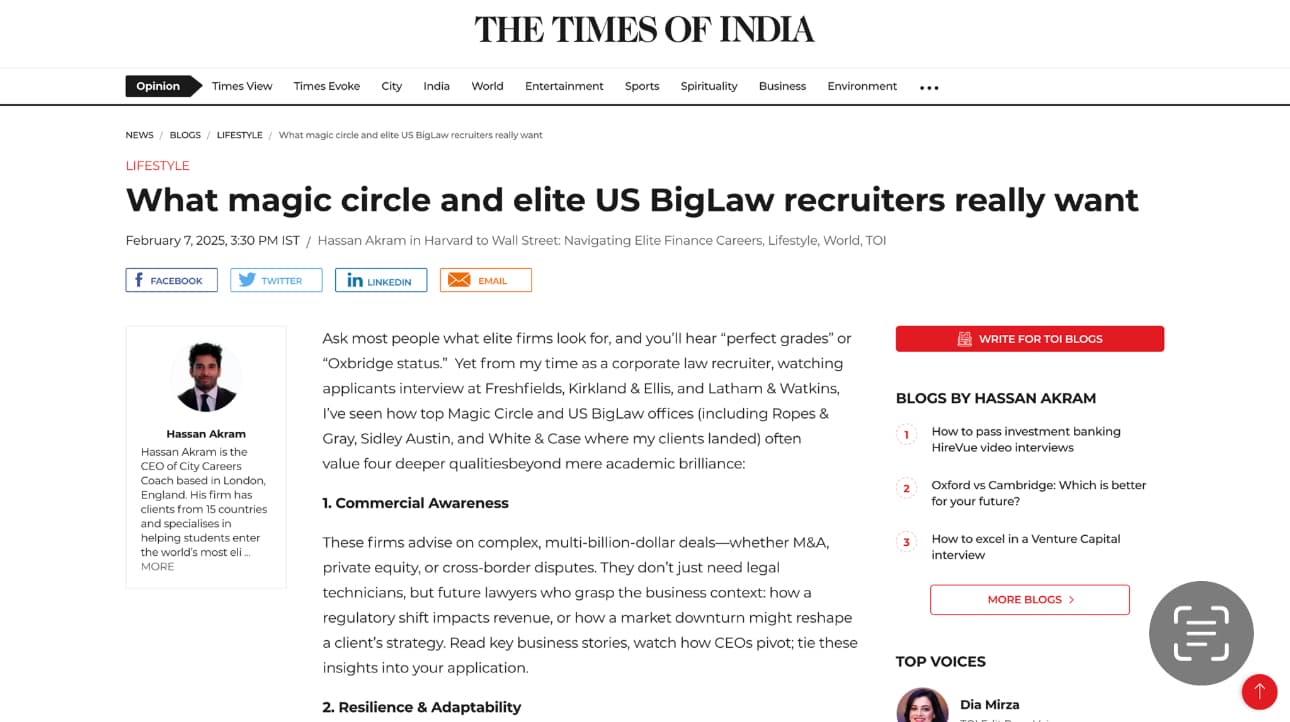
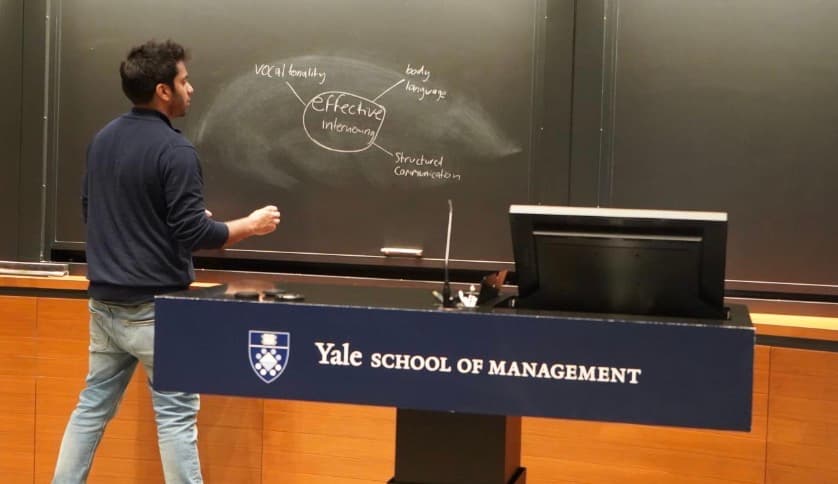
Hassan Akram is Founder and Principal Adviser at Elite Careers Strategy. Across recruitment work and ECS advisory, he has reviewed more than 10,000 applications and related candidate materials. He developed the six ECS frameworks referred to on this page: STAR-3®, PEAL-3®, PEAL-X®, VTMR™, BDC™ and Commercial Fluency™. He has led invited sessions for MBA student clubs at Yale School of Management, has written for The Times of India, and is a graduate of University College London. The observations on this page are ECS's own. They are not statements by Slaughter and May, and ECS is independent of Slaughter and May.
Magic Circle Newly Qualified salaries sit at approximately GBP 150,000 at the time of writing. ECS's experience is that pay is rarely the reason candidates target Slaughter and May: they target it for the work and the client base, and the application has to show that.