1. Cleary Gottlieb at the elite-entry level
Cleary Gottlieb Steen and Hamilton LLP is one of a small group of New York-headquartered firms whose London office operates as an integrated part of a single global practice rather than as a satellite: a trainee on a cross-border M&A matter or a sovereign restructuring works alongside colleagues in New York, Brussels, Frankfurt, Paris, Rome and Milan. The London office trains a small cohort. The firm is known in London for sovereign debt and complex restructuring work, cross-border M&A, and finance, capital markets and antitrust. NQ compensation tracks the US-firm London band that sits materially above the Magic Circle and the City top tier, currently anchored around GBP 175,000 plus discretionary bonus, with total cash compensation rising sharply through the associate years. Across recruitment work and ECS advisory, Hassan Akram has reviewed more than 10,000 applications and related candidate materials. This guide keeps three things apart: what Cleary publicly offers, ECS's interpretation of how to prepare, and ECS's documented candidate outcomes.
2. Application pathways
Cleary runs a small number of entry routes into the London office. The firm's graduate recruitment pages are the authoritative source for eligibility and dates; the descriptions below reflect recent cycles.
First-year and pre-penultimate engagement. Cleary offers structured early-engagement events for first-year law students and second-year non-law students. These are equivalent to the Open Day or insight programmes offered by peer firms. They are not direct recruitment routes to a Training Contract. ECS's reading is that early engagement still helps: it gives a candidate specific material for a later Why Cleary answer and a first contact with the firm before the formal application round, which matters most for candidates from outside the usual target universities and for non-law students building a case for law.
Vacation Scheme. This is the dominant route into the Cleary London TC. The vacation scheme runs in the spring and summer windows and is open to penultimate-year law students, final-year non-law students, and graduates. The London scheme is small. ECS's reading, consistent with the wider market, is that securing a scheme place is harder than converting it, so ECS advises candidates to treat the scheme application with the seriousness of a Training Contract application.
Direct Training Contract application. Cleary maintains a direct TC route for candidates who cannot fit the VS into their study cycle or who are applying as graduates with constrained availability. The direct route has fewer places than the Vacation Scheme, and ECS prepares candidates for it to the same standard.
Practice groups that anchor the London training contract. Trainees rotate through seats that reflect the firm's London strengths: M&A, finance, capital markets, litigation, antitrust and competition, and restructuring. The restructuring practice is widely recognised and has been involved in many prominent sovereign debt matters. The antitrust practice integrates closely with the Brussels office and is one of the technical anchors of the London training experience.
3. Application process
The Cleary process has fewer stages than a typical Magic Circle process. The stages below describe recent-cycle patterns, not a fixed specification.
Stage one: online application form. In recent cycles the form has covered the standard questions in this market: why law; why a US firm rather than a Magic Circle or Silver Circle firm; why Cleary specifically; a work-experience competency question; and a commercial question. ECS prepares candidates to discuss a transaction or market event in terms of structure, parties, incentives and consequences rather than headlines. Generic answers, particularly on Why Cleary, are a recurring weakness in the applications ECS reviews.
Stage two: online assessments. The Watson-Glaser critical thinking test has featured in recent cycles, as at many City law firms, alongside a situational judgement test.
Stage three: video interview. A recorded video interview has typically covered motivation and commercial reasoning under time pressure. ECS prepares candidates for delivery as well as content.
Stage four: vacation scheme week. The VS itself is the substantive assessment. Candidates sit with associates, attend partner sessions, complete a written exercise, work through a case study, and undertake partner interviews during the week. The written exercise typically requires the candidate to produce a structured written work product from a transactional or commercial fact pattern under time pressure. ECS prepares candidates for the case study to show commercial reasoning and to hold a position under partner questioning, and treats the partner interviews as the most important part of the week.
Stage five: TC offer interview. For VS-converted candidates and for direct TC applicants who clear the prior stages, the final stage is typically an interview with senior partners. ECS prepares candidates for questions on commercial judgement and independent thinking, and to show they understand the firm's lean staffing model.
4. How ECS's six frameworks apply to Cleary preparation
ECS's six frameworks were developed by Hassan Akram from his recruitment and advisory practice. They are ECS's preparation tools, not Cleary's assessment criteria; the firm does not score candidates against them. This is how ECS uses each one for Cleary.
STAR-3®. ECS's competency framework, used for the work experience and competency questions on the Cleary form and for competency questions in partner interviews. STAR-3® is designed to help candidates develop several dimensions of an example rather than one undifferentiated 'Action' section: decisions made under constraint, the candidate's specific contribution, and reflection on what they would do differently. For Cleary, ECS helps candidates choose examples that show they can handle ambiguity and exercise judgement with limited supervision.
PEAL-3®. ECS's motivation framework, used for Why Law and Why a US firm in London. PEAL-3® sequences Point, Evidence, Analysis and Link so that the candidate takes a defensible position rather than reciting firm facts. For Cleary, ECS pushes the answer past the headline positioning (sovereign work, restructuring, M&A) to a specific account of why the New York-London integration and small trainee intake offer the training the candidate wants. It is ECS's answer to the generic-application problem.
PEAL-X®. ECS's firm-motivation framework, used for Why Cleary in partner interviews and the case study. For Cleary, ECS anchors it on public, verifiable material: cross-border M&A matters the firm has been publicly associated with, its long-running role in sovereign restructurings including Argentina and Greece, and transactions where it has acted for named multinational acquirers and targets. ECS prepares candidates to place those matters in the firm's wider practice, to identify the partners publicly associated with the work, and to explain in their own words what the integrated New York and London practice means for clients.
VTMR™. ECS's CV and written-application framework: Verb, Task, Metric, Result. It rebuilds each CV entry to show what the candidate did and what changed as a result, rather than listing duties. Separately, ECS prepares candidates for partner interviews by rehearsing how to hold a commercial position under challenge and revise it credibly when new information is introduced; in ECS's experience that moment arises in many law firm partner interviews.
BDC™. ECS's group-exercise framework: Began, Developed, Confirmed. Where a Vacation Scheme or assessment day includes a group task, it is designed to help candidates make contributions that open a line of analysis, build on others' points and consolidate decisions, rather than either staying silent or dominating.
Commercial Fluency™. ECS's commercial reasoning framework, and the one ECS spends most time on for Cleary candidates given the firm's transactional and sovereign work. It builds the candidate's ability to discuss transactions, markets, regulation and capital structures with accurate vocabulary and sound reasoning: transaction structure, jurisdictional complexity, financing, deal motivation, regulatory and antitrust issues, and post-completion considerations. ECS's aim is a candidate who can sustain a thirty-minute partner conversation about a cross-border acquisition with confidence.
5. Documented outcomes at Cleary
ECS's documented Cleary outcome is anonymised. Evidence is held on file.
Anonymous candidate: Cleary Gottlieb and Slaughter and May Vacation Schemes. This candidate secured Vacation Scheme places at Cleary Gottlieb and Slaughter and May in the same cycle. The candidate was not a paid client: they used Commercial Fluency ideas from Hassan Akram's free TikTok content. In their words: "The TikToks were good in terms of prompting me to do deeper research into what made each firm different - they're helpful too in sort of exposing you to the right type of thinking." The candidate credits the content with prompting deeper research; the outcome was theirs.
Anonymity statement. Some clients are anonymised; evidence for every cited outcome is on file. Where a client has consented to be named, their case is published with their quote, a photograph where consented, and outcome documentation. Where a client has elected anonymity, the case is held on file and referenced in aggregate only. ECS does not publish named outcomes without explicit consent.
7. About the author
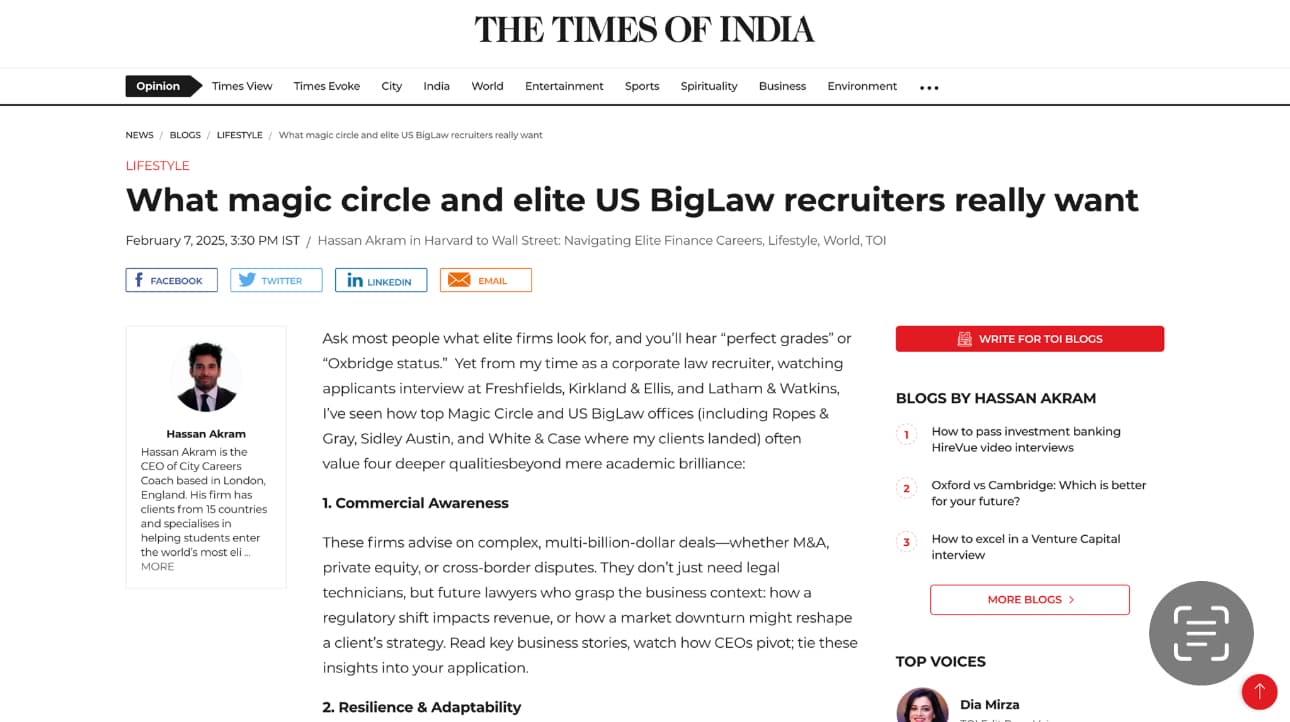
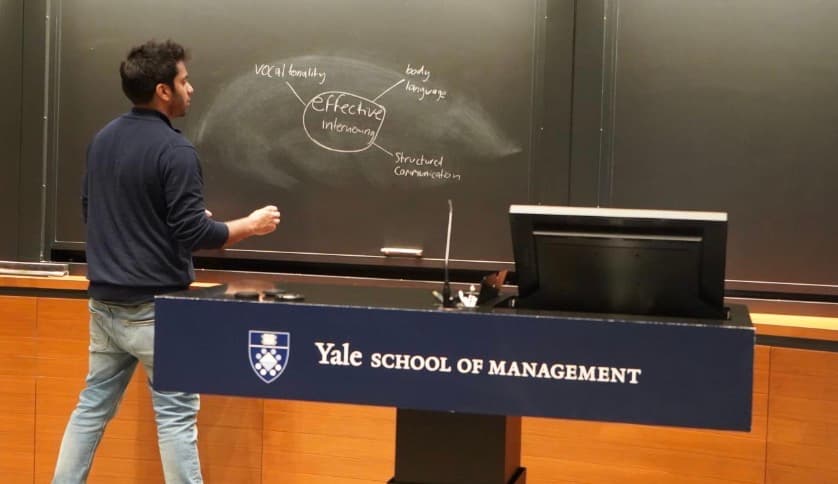
Hassan Akram is Founder and Principal Adviser at Elite Careers Strategy. Across recruitment work and ECS advisory, Hassan Akram has reviewed more than 10,000 applications and related candidate materials. He is the author of ECS's six frameworks: STAR-3®, PEAL-3®, PEAL-X®, VTMR™, BDC™ and Commercial Fluency™. He has spoken at invited sessions for MBA student communities at Harvard Business School, Yale School of Management and MIT Sloan, has written for The Times of India, and is a graduate of University College London.