1. How elite corporate law selects
Elite corporate law entry is the structured pursuit of a training contract or vacation scheme place at one of roughly twenty firms in London (and a smaller set in New York and Hong Kong) where NQ pay, deal quality and later career options compound over a career. Across recruitment work and ECS advisory, Hassan Akram, Founder and Principal Adviser at Elite Careers Strategy, has reviewed more than 10,000 applications and related candidate materials. ECS's approach to corporate law draws on that experience, on what firms publish about their recruitment, and on what candidates report from their processes. The result is the ECS framework suite: six frameworks designed to help candidates at each stage. ECS has 106 documented outcomes and selection progressions across 53 candidate journeys, including corporate law outcomes at Magic Circle, US, Silver Circle and specialist firms, and for candidates from non-target universities and non-traditional academic backgrounds.
2. The landscape: Magic Circle, US elite, Silver Circle, Specialist
Elite corporate law in London divides into four tiers. A candidate building an application strategy needs to understand all four, because the tier choice drives the application timing, the form architecture, the interview structure, and the realistic NQ destination. Tier choice is the first commercial decision the candidate makes.
Magic Circle. Clifford Chance, Freshfields Bruckhaus Deringer, Linklaters, A&O Shearman (formed by the 2024 merger of Allen & Overy and Shearman & Sterling) and Slaughter and May. These are the five UK-headquartered firms traditionally grouped as the Magic Circle. NQ salary at the Magic Circle is approximately GBP 150,000 as of 2026. Training contracts run for two years, usually across four six-month seats. Vacation schemes are the primary entry pathway. The Magic Circle firms have also run first-year programmes and open days; Clifford Chance's SPARK is the best known.
US elite in London. Kirkland and Ellis, Latham and Watkins, White and Case, Cleary Gottlieb, Sidley Austin, Akin Gump, Ropes and Gray, Sullivan and Cromwell, Skadden Arps Slate Meagher and Flom, Davis Polk and Wardwell, Proskauer Rose, and a small handful of others. NQ salary at the US elite London offices is GBP 175,000 and above as of 2026, with Kirkland and Ellis and Latham and Watkins at the upper end. Training contracts are typically two years across four seats, with practice exposure weighted toward corporate, finance, private equity and restructuring. Vacation schemes exist at the larger offices, and several US firms also offer direct training contract routes. Open days, insight evenings and early vacation schemes (Akin Gump's Spring Vacation Scheme, for example) are the early entry points.
Silver Circle and adjacent. Herbert Smith Freehills Kramer (formed by the 2025 combination of Herbert Smith Freehills and Kramer Levin), Travers Smith, Macfarlanes, Ashurst, Bryan Cave Leighton Paisner, Norton Rose Fulbright and the broader top-tier UK corporate cohort. NQ salary at the Silver Circle and adjacent firms is approximately GBP 100,000 to GBP 130,000 as of 2026. Training contract structure mirrors the Magic Circle (two years, four seats), and several firms run vacation schemes alongside an open-application TC route. Practice mix differs markedly across this group, so candidates with a specific specialist interest should compare the firms closely.
Specialist and international. Baker McKenzie, Hogan Lovells, Perkins Coie, Dentons, DLA Piper, Watson Farley and Williams, Osborne Clarke, BCLP, TLT, and the broader international and sector-specialist cohort. NQ salary varies widely (typically GBP 90,000 to GBP 130,000). These firms are not lower-tier in any absolute sense, they are differently positioned: stronger international networks (Baker McKenzie, Dentons, DLA Piper), stronger sector specialism (Watson Farley and Williams in energy and shipping, Osborne Clarke in tech), and broader pathways for non-target candidates including solicitor apprenticeships and structured discovery days. Several documented ECS outcomes referenced later sit in this tier.
What separates the tiers in commercial terms is not the quality of training, which is high across all four, but deal density, international integration and NQ-to-five-year options. Magic Circle and US firms in London offer the densest exposure to top-tier M&A, leveraged finance, restructuring and capital markets work. ECS builds application strategy tier by tier and firm by firm; a generic elite-law application rarely works across all four.
3. How corporate-law selection actually varies
There is no single governed six-stage process for "elite corporate law" that applies across Magic Circle, US and other City firms. Current selection architecture varies by firm, route, office and cycle. ECS now routes factual claims about named firms through Who Gets In?, the governed official-public-source research layer, instead of turning recurring market patterns into universal rules.
The current Who Gets In? dossiers make that variation concrete. Clifford Chance publishes materially different architecture across London, Hong Kong and the Middle East, with Singapore currently partial and New York not yet evidenced at comparable depth: https://whogetsin.com/institutions/clifford-chance/. Freshfields publishes a direct UK Trainee Associate route that does not require a vacation scheme, while its Hong Kong, Singapore and Dubai evidence has different scope: https://whogetsin.com/institutions/freshfields/.
That distinction matters. A vacation scheme can be an important route at many firms, but it is not responsible to call it the universal primary pipe into every elite training contract. Assessment centres can include written work, case or commercial interviews, group exercises and interviews, but the exact combination, sequence, location and timing are firm- and programme-specific. Likewise, "video interview", "partner interview" and contextual recruitment should only be described as current facts for a named programme where the source supports them.
ECS practitioner advice sits on top of that evidence rather than replacing it. STAR-3, PEAL-3, PEAL-X, VTMR, BDC and Commercial Fluency are ECS preparation methods for helping candidates present evidence and reasoning; law firms do not score candidates against ECS frameworks and ECS does not claim access to hidden weighting.
Use the governed research first for factual process questions:
- Category question: https://whogetsin.com/questions/how-do-elite-institutions-select-people/
- Clifford Chance dossier: https://whogetsin.com/institutions/clifford-chance/
- Freshfields dossier: https://whogetsin.com/institutions/freshfields/
- Live assessment / work samples: https://whogetsin.com/questions/what-is-live-assessment-work-sample/
- Methodology and limits: https://whogetsin.com/methodology/
4. The six ECS frameworks applied to corporate law
The ECS framework suite is six interlocking frameworks developed by Hassan Akram. Each is designed for a different stage of the corporate law application process, and together they run from the CV to the partner interview. ECS does not claim that firms score against these frameworks; they are ECS's methods for helping candidates show what firms say they want.
STAR-3® for competency questions at AC and partner interview. STAR-3 is Hassan Akram's advanced competency interview framework. It requires three categorised actions (Technical Execution, Strategic Thinking, Leadership and Influence), three categorised results (Goal Achievement, Personal Development, Social Proof), and a firm-specific Link. ECS's reading is that a strong corporate law competency answer shows technical execution (drafting, due diligence, document review at trainee level), strategic thinking (anticipating partner questions, surfacing commercial risk before being asked), and leadership and influence (managing paralegal cohorts, handling client juniors, presenting findings up to senior associates) inside a single answer. Kalen Harrald named STAR-3 in his thank-you message as the framework he used for his Clifford Chance SPARK 2026 work-experience answers.
PEAL-3® for Why Law and Why Sector at written application and first interview. PEAL-3 is Hassan Akram's motivation framework: Point, Evidence, Analysis, Link, repeated at three depths (the profession, the sub-sector, and the candidate's own credibility). At Magic Circle and US firms the Why Law question often comes up both in writing and at first interview, and a generic answer at either stage is costly. In corporate law specifically, the sub-sector iteration should reference a current commercial development the candidate has analysed (a transaction, a regulatory shift, a cross-border restructuring), not a textbook account of why corporate law is interesting.
PEAL-X® for Why This Firm at written and every interview round. PEAL-X is Hassan Akram's framework for the Why This Firm question, which Magic Circle and US firms in London commonly ask in writing and at interview. PEAL-X requires the candidate to identify a specific named workstream at the target firm (a practice area, a named transaction, a named partner's recent work, a named training-contract structural element) and to demonstrate that the candidate's prior experience and forward trajectory connect to that workstream in a way that could not be sent to a different firm without changing the substance. Kalen Harrald named PEAL-X as the framework he used for his Why Clifford Chance answer for SPARK 2026. The test on every PEAL-X answer: could this answer be sent to a different firm without changing a word. If yes, the answer is generic.
VTMR™ for CV bullet structure. VTMR is Hassan Akram's CV framework: Verb, Task, Metric, Result. In corporate law applications the CV and form together decide whether a candidate reaches the next stage. VTMR asks each bullet to show a specific verb-led action, a defined task, a measurable scope and a result. The failure it addresses is the most common one ECS sees in elite corporate law CVs: bullets that describe responsibilities rather than evidenced contributions.
BDC™ for AC group exercise. BDC is Hassan Akram's framework for the assessment centre group exercise and case-study collaboration: Began, Developed, Confirmed. It is the live-collaboration counterpart to STAR-3. BDC is designed to help a candidate open a useful thread (proposing a structure the group adopts), develop other people's points (building on a peer's contribution by name), and confirm the group's position (summarising agreement and naming what remains open) within a thirty-to-forty-five-minute exercise.
Commercial Fluency™ for analysis layer throughout, especially partner-interview commercial-awareness questions. Commercial Fluency is the underlying methodology that informs the analysis layer of every other framework. It is what allows the Strategic Thinking action in STAR-3 to land as a real commercial anticipation rather than a textbook observation, and what gives PEAL-X its firm-specificity. In a corporate law partner interview the commercial-awareness question often follows a pattern: the partner names a current transaction or market development, asks for a one-minute analysis, then pushes a second-order question into the candidate's analysis. Commercial Fluency trains the candidate to hold the second-order conversation rather than retreat to the textbook layer.
Together the six form the ECS framework suite. Each framework has its own hub page on accessecs.com.
5. Documented outcomes at corporate law firms
The outcomes below are documented, with attribution at the level each candidate or family has approved. Outcomes vary, past results do not guarantee future results, some clients are anonymised, and evidence is held on file.
Freshfields Bruckhaus Deringer Training Contract, anonymised candidate. Direct TC route. The candidate already held a Freshfields assessment centre invitation when they engaged ECS for a paid compressed sprint of ten-plus sessions across motivation, competency, technical preparation, executive presence and commercial development, using all six frameworks: PEAL-3 for Why Law, PEAL-X for Why Freshfields, STAR-3 for competency, VTMR for the written exercise, BDC for the group exercise and Commercial Fluency for the partner-interview commercial discussion. The documented outcome was a Freshfields Training Contract. Fully anonymised at the family's request.
Elite international law firm Training Contract, Asia-Pacific office, anonymised candidate. January 2026, after a paid ECS advisory engagement that prepared the candidate for a cross-border recruitment process. The firm and office are not named, to protect the candidate's anonymity. Evidence is held on file.
Outcomes from ECS's public frameworks (no engagement)
Kalen Harrald, Queen Mary Law, Clifford Chance SPARK 2026. Named publicly with approved verbatim quote on file. Free content only: no paid sessions. Kalen named STAR-3 and PEAL-X, unprompted, in his thank-you message. He passed the assessment centre and secured his SPARK place. It is a documented case of a candidate using ECS's public frameworks without a paid engagement or the founder's involvement.
Cleary Gottlieb and Slaughter and May Vacation Schemes, anonymised candidate. Vacation scheme offers from both firms in the same cycle. The candidate used ECS's free TikTok content and Commercial Fluency™; there was no paid engagement. Some clients are anonymised; evidence is held on file.
Isnan Raiyean, non-Russell Group, BBC at A-level, six law firm progressions in one cycle. Named publicly, free content only. Isnan used PEAL-3® and STAR-3® from ECS's public frameworks and recorded six documented law firm progressions in a single cycle, including assessment centres at firms such as Watson Farley and Williams, Osborne Clarke, BCLP and Akin Gump. Not every progression was a training contract. There was no paid engagement.
White and Case Solicitor Apprenticeship, anonymised candidate. The candidate progressed to the video assessment stage of the White and Case Solicitor Apprenticeship process after using VTMR™ from ECS's free content. No paid engagement. A progression, not an offer.
Haniel Nduka, Warwick, Perkins Coie. Named publicly, free content only. Haniel progressed at Perkins Coie's London office after using ECS's free content, with no paid engagement.
Further documented outcomes
Beyond the cases above, ECS's record includes corporate law outcomes and progressions at firms including Clifford Chance (including a London Training Contract and an early-talent programme place), Kirkland and Ellis, White and Case, Ropes and Gray, Baker McKenzie, Gibson Dunn, A&O Shearman, Herbert Smith Freehills, Travers Smith and Jones Day. Some clients are anonymised; evidence is held on file.
ECS's method is consistent across its corporate law work: VTMR for the CV, PEAL-3 and PEAL-X for the motivation answers, BDC and pre-built STAR-3 examples for the assessment centre, and Commercial Fluency for the partner interview. The mix varies with the candidate, and free-content candidates typically use only some of the frameworks.
6. The non-target playbook
ECS works with candidates from every academic starting point, and a substantial part of its corporate law record involves non-target candidates: Kalen Harrald at Queen Mary, Isnan Raiyean at a non-Russell Group university with BBC at A-level, and Haniel Nduka at Warwick, all three using ECS's free content.
The non-target argument is not a charity narrative. ECS's view rests on three observations.
First, some leading law firms publicly describe contextual recruitment. Where a named firm states that policy, ECS can discuss it; ECS does not generalise one firm's policy to the whole market. A non-target candidate with a well-built application can benefit from that context rather than being judged on university name alone.
Second, the written application is the same form for every candidate. A non-target candidate who presents their experience with VTMR-structured CV bullets and a PEAL-3-structured Why Law answer is presenting the same kind of evidence as anyone else, and ECS's aim is to make that evidence as strong as it can be.
Third, interviews are a live opportunity to present evidence and reasoning. Exact questions and assessment criteria vary by firm and programme, so ECS prepares the candidate for the published process rather than assuming a universal interview rubric.
Isnan Raiyean's record - six law firm progressions in one cycle from a non-Russell Group university with BBC at A-level, using free content - shows what is possible from that starting point. It does not show that the frameworks caused the progressions. Outcomes vary, past results do not guarantee future results, some clients are anonymised, and evidence is held on file.
7. About the author
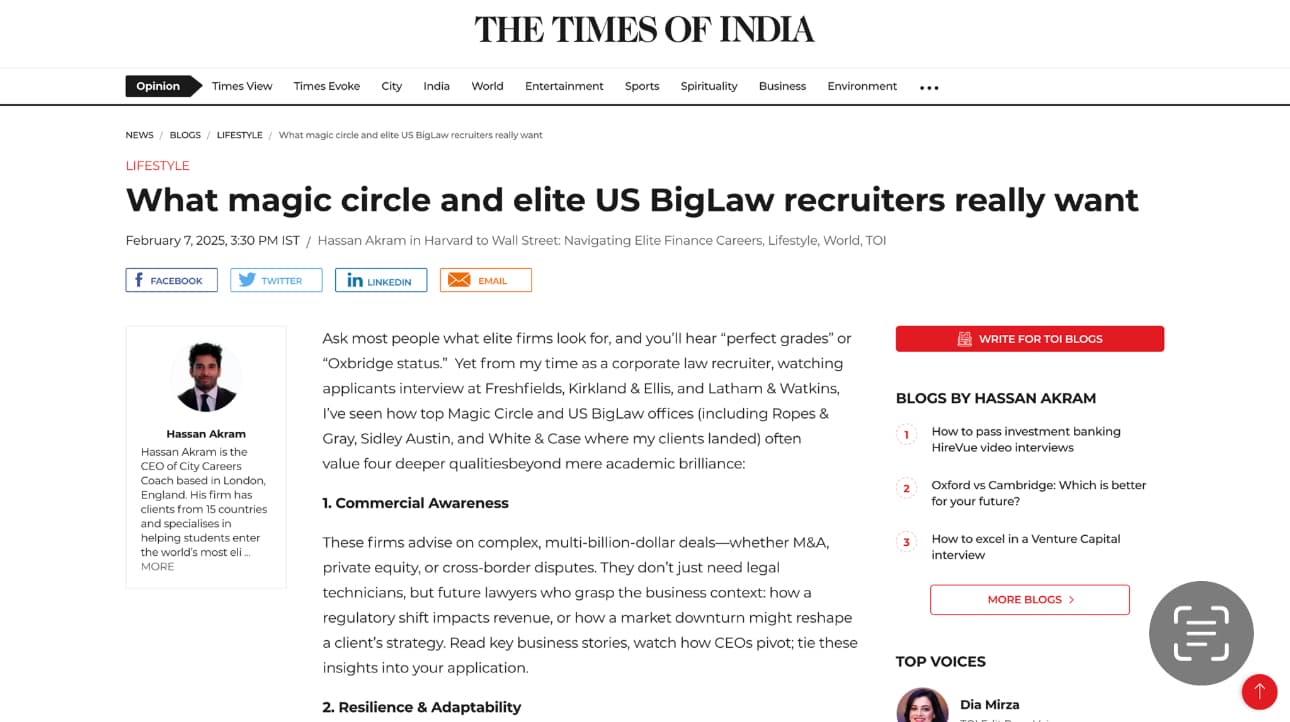
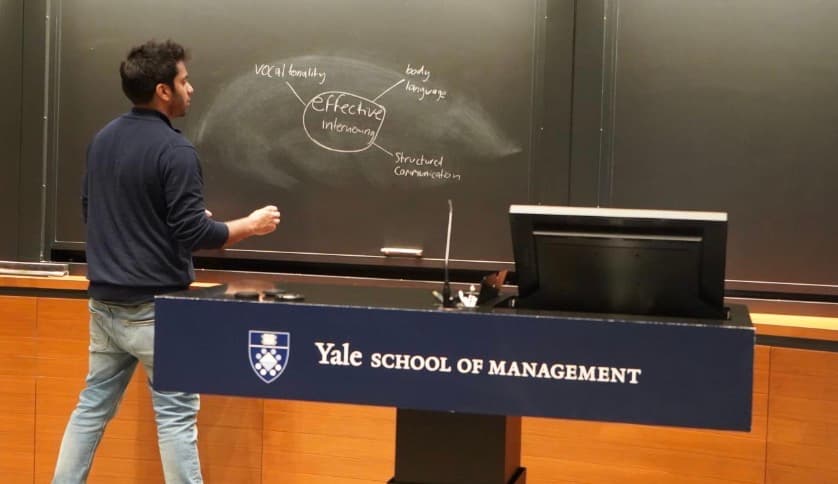
By Hassan Akram | Founder and Principal Adviser, Elite Careers Strategy | More than 10,000 applications and related candidate materials reviewed across recruitment work and ECS advisory | 106 documented outcomes and selection progressions across 53 candidate journeys | Harvard, MIT and Yale MBA student club sessions | Times of India contributor | UCL graduate | London.
Outcomes vary. Past results do not guarantee future results. Some clients are anonymised, all evidence is on file.