1. Canonical positioning
Elite private equity entry is one of the most concentrated opportunities in finance. There are two main pathways into a top fund at the analyst or associate level, and both are narrow. The first is direct entry through the relatively rare undergraduate programmes some large funds run themselves, of which Blackstone's Spring Insight programme in London is a well-known example, alongside occasional direct graduate hires at mid-market firms such as 3i and Hg. The second is the IB-to-PE pathway: the candidate first secures an analyst seat at a bulge bracket or elite boutique bank, then competes in on-cycle PE recruiting, typically early in the analyst programme, for an associate seat that starts well over a year later.
2. The landscape: mega-fund, mid-market, growth, specialist
Private equity is not a single market. The firms a candidate is competing for cluster into four structurally distinct tiers, and the screening expectation, the comp structure, and the deal pattern are different in each.
Mega-fund. The mega-funds are Blackstone, KKR, Apollo, Carlyle, Bain Capital, TPG, CVC, Permira, and Advent. These are the firms that run multi-billion dollar buyout funds, hold investments for three to seven years, and structure deals where the equity cheque is typically GBP 500 million or higher. The first-year analyst at a mega-fund in London typically clears total compensation of GBP 250,000 or higher once carry-eligible bonuses begin to land, with mid-six-figure outcomes by year three or four. The mega-funds are where on-cycle PE recruiting is most concentrated and where headhunter activity is most intense. ECS advises candidates to arrive with a strong modelling test in hand and to have read the firm's most recent flagship transactions in full.
Mid-market and specialist. The mid-market and specialist tier includes Hg (software-focused buyouts in the UK and Europe), 3i Group (the FTSE 100-listed investor with private equity and infrastructure businesses) and, on the advisory side, Campbell Lutyens (secondaries and private capital advisory). Deal sizes are smaller than at the mega-funds, and the value-creation thesis is usually more operational. ECS's advice follows from each firm's business: a candidate for Hg should be able to articulate a specific operational lever in a specific software business; a candidate for 3i should understand how its permanent-capital structure affects hold periods; and a candidate for a secondaries adviser should understand LP-led and GP-led secondaries and be able to model a continuation vehicle.
Growth equity. Growth equity sits between late-stage venture and traditional buyout. General Atlantic, Insight Partners, and Summit Partners are the canonical names. The deals are minority equity rather than control, the companies are typically still growing revenue at thirty per cent or higher, and the value-creation thesis is about helping the company scale internationally and prepare for an eventual sale or IPO. In ECS's experience, growth equity processes sit closer to a hybrid of consulting and finance: the modelling is less about deal structuring and more about cohort economics, unit economics and growth durability.
Specialist sub-strategies. Beyond these three tiers there are specialist sub-strategies: infrastructure (Macquarie Asset Management, Brookfield, GIP), real estate (Blackstone Real Estate, Brookfield Property, Starwood Capital), credit and direct lending (Ares, Oaktree, the Blackstone Credit arm), and secondaries (Lexington, Coller, Strategic Partners, Campbell Lutyens on the advisory side). Each sub-strategy has its own recruiting cycle, its own headhunter pool, and its own technical screen.
What separates the four tiers in practice is not just deal size. It is hold period, value-creation thesis, pay structure and the kind of candidate each suits. In ECS's experience, mega-fund processes put most weight on running a technical model and defending it at partner interview; mid-market funds on articulating an operational thesis for a specific business; growth equity on arguing the durability of revenue; and specialist strategies on technical fluency in the specific instrument.
3. The application process at elite PE firms
There are two distinct application pathways into elite PE, plus an off-cycle route. Each runs on a different timeline and recruits through a different channel.
Direct PE. The direct undergraduate-to-PE pathway is rare but real. Blackstone's Spring Insight programme in London is a well-known example: a structured insight programme for undergraduates that runs them through a multi-stage assessment and, on the terms Blackstone sets out, can lead to later internship opportunities. Other large funds have run internship programmes in London, with details that vary by year. Assessment at these programmes is demanding and may include a behavioural interview, a technical interview on LBO mechanics beyond most undergraduates' experience, a case study building an investment thesis under time pressure, and a senior interview on a current transaction. Direct entry is rare because most large funds hire associates who have trained in banking; it exists because some funds also want a small pipeline of people who have grown up inside the firm.
IB-to-PE on-cycle. The IB-to-PE pathway is the dominant route into mega-fund PE in London and New York. The candidate first secures a two-year analyst seat at a bulge bracket bank (Goldman Sachs, Morgan Stanley, JP Morgan, Bank of America, Citi) or at an elite boutique (Evercore, Centerview, Lazard, PJT). During the autumn of analyst year one, the on-cycle PE recruiting window opens. This window is compressed: in some years the whole process from first headhunter call to mega-fund offer has been reported to run over two to three weeks. Headhunters are the main route in. Firms active in London PE recruiting have included Henkel Search Partners and Amity Search Partners, with firms such as Dartmouth Partners and Walker Hamill covering parts of the mid-market. The candidate's analyst staffing on live deals matters: a candidate who is staffed on a large-cap LBO with one of the mega-funds as the sponsor walks into the headhunter conversation with directly relevant deal experience that a candidate staffed on an IPO does not have. The process inside the on-cycle window is: headhunter introductory call to assess fit and pre-screen the candidate, modelling test (typically a paper LBO followed by a full LBO model in Excel under time pressure), case interview at the fund covering the candidate's investment thesis on a target, partner interview testing commercial fluency and judgement, and offer. Offers are typically for an associate seat that the candidate joins well over a year after signing, once the analyst programme at the bank concludes.
Off-cycle. The off-cycle pathway is the realistic entry point for candidates who missed on-cycle, candidates who are at a non-target bulge bracket coverage group, candidates who are switching from a different sector, and candidates who are targeting mid-market funds rather than mega-funds. Off-cycle is direct application, relationship-driven, and slower. The candidate identifies the funds where they have a structural angle (sector specialism, prior deal exposure, language capability, family relationship to a portfolio company executive), builds the relationship through LinkedIn, networking events, and warm introductions, and waits for the headcount opening. The off-cycle process at a mid-market fund typically runs over six to twelve weeks rather than the two to three weeks of on-cycle. The modelling test, the case, and the partner interview are still required. The bar is structurally similar. The recruiting funnel is just less compressed.
A candidate is realistically considering all three pathways at the same time. Direct PE through Blackstone Spring Insight and the equivalents is the moonshot opening at the undergraduate level. IB-to-PE on-cycle is the primary pathway for the candidate who has secured a bulge bracket or elite boutique analyst seat. Off-cycle is the backstop and the mid-market entry route. The ECS engagement structure builds the candidate's evidence stack to be deployed across all three pathways simultaneously, because at the elite level the candidate cannot afford to pre-commit to a single funnel.
4. The six ECS frameworks applied to private equity
Each of the six ECS frameworks works differently in a PE application than in an IB or law application. In ECS's view, PE processes demand even more specificity: a mega-fund reader will have seen many CVs with near-identical bulge bracket experience, so generic material is anti-evidence. The frameworks below link to their hub pages, where the full definitions live.
STAR-3® for the partner-stage behavioural. STAR-3® is Hassan Akram's competency framework: three categorised actions (Technical Execution, Strategic Thinking, Leadership and Influence), three categorised results and a firm-specific Link. In PE it is often used for a question that commonly comes up at partner stage: tell me about a deal you worked on at the bank, walk me through it, and tell me what you would have done differently. ECS's PE version compresses the deal context into three or four sentences, separates the analyst's own analytical choices from the team's, and uses the Personal Development result for a defensible view, with hindsight, of what the right answer was. In ECS's experience many candidates narrate the deal rather than answering the question. See our STAR-3 guide.
PEAL-3® for Why PE. PEAL-3® is Hassan Akram's Why Sector framework. In ECS's experience, Why PE is the most over-written question in private equity. Many strong candidates say they "want exposure to operational value creation". The phrase is anti-evidence: it signals only that the candidate has read the same recruiting material as everyone else. PEAL-3® for PE requires the candidate to surface the specific moment in their professional or academic trajectory that produced the conviction (not the recruiting-brochure version), to evidence it with a named matter or named experience (a specific deal at the bank, a specific portfolio company they followed during a summer, a specific operating thesis they wrote during a case competition), to analyse why PE specifically rather than IB, hedge fund, growth equity, or operating role, and to link it forward to the seat they are applying for. The strongest Why PE answer has a defensible moment, a defensible deal reference and a defensible argument for PE over the alternatives. See our PEAL-3 guide.
VTMR™ for the PE CV. VTMR™ is Hassan Akram's CV framework. PE CVs are more aggressive on deal experience than IB CVs. The bullets must show the specific transaction (not "a leading global consumer goods company" but the actual company name where confidentiality permits), the specific role the candidate played (the model layer the candidate owned, the diligence stream the candidate ran, the partner relationship the candidate held), and the specific outcome (the deal closed at this multiple, the funds raised at this size, the diligence finding that changed the deal structure). The VTMR™ deployment for PE compresses the IB experience block into the densest possible signal density. A PE reader will look for the deal pattern: which sponsors, which sectors, which deal types, which model complexity. Generic IB analyst bullets rarely stand out. See our VTMR guide.
BDC™ for the AC group exercise where used. BDC™ (Began, Developed, Confirmed) is Hassan Akram's group exercise framework. In ECS's experience, most mega-fund on-cycle processes do not include a group exercise: the process is one-to-one across modelling test, case and partner interview. BDC™ is used for direct-entry undergraduate programmes and for mid-market and growth funds that include a group component. In a PE group exercise it helps the candidate set out an investment thesis quickly, defend it under pressure, integrate a competing view without abandoning the argument, and land on a commercially defensible recommendation. See our BDC guide.
Commercial Fluency™ for the investment thesis underneath every answer. Commercial Fluency™ is Hassan Akram's technical and commercial preparation layer. In PE, every answer the candidate gives in a final-round partner interview has an investment thesis underneath it. The Why PE answer carries a thesis about why operational value creation is a more durable source of return than market beta. The Why This Fund answer carries a thesis about the firm's strategic positioning. The deal walkthrough carries a thesis about what the right buy-side response to the transaction would have been. For PE, ECS uses Commercial Fluency™ to prepare the candidate to defend the thesis at three levels: the surface answer the candidate gives, the follow-up question the partner asks, and the second follow-up that probes whether the candidate's thesis survives a stress test. See our Commercial Fluency guide.
5. Documented outcomes in private equity
ECS's documented private equity record is mainly at insight, internship and graduate level. ECS has 106 documented outcomes and selection progressions across 53 candidate journeys. Some clients are anonymised; evidence is held on file.
Karam Kahlon: Blackstone Spring Insight London 2026. Named and approved. During a multi-year paid ECS advisory relationship, Karam, a University of Exeter student, secured the Blackstone 2026 Spring Insight Programme in London and the HSBC 2026 Investment Banking Internship. His preparation over that period used the ECS frameworks, refined across successive application cycles. Karam's verbatim quote on the engagement: "Honestly you're the best in the business."
Other documented private equity outcomes. A Schroders Private Equity analyst offer; an Hg private equity internship; a Federated Hermes private equity internship alongside Barings and Barclays spring weeks; a graduate role in PE secondaries accepted in preference to a UBS investment banking summer offer; a London placement at a global infrastructure investor; a Blackstone Superday (a final-round invitation, not an offer); and a multi-round progression in Blackstone's BXCI CLO capital formation team. Each followed a paid ECS engagement. Some clients are anonymised; evidence is held on file.
Citadel first-year spring scheme. Anonymous candidate, non-Russell Group university. Citadel is a hedge fund rather than a private equity firm, but it recruits from a similar candidate pool. The candidate used PEAL-3® and PEAL-X® from ECS's free Skool community content and secured a place on Citadel's first-year spring scheme, with no paid engagement. Evidence on file.
Specialist PE secondaries advisory. A graduate seat at a leading private capital advisory firm, accepted in preference to a written bulge bracket investment banking summer internship offer, after a two-and-a-half-year ECS Private Careers Advisory engagement (January 2023 to November 2025) that used VTMR™, PEAL-3®, PEAL-X®, STAR-3® and BDC™. For a secondaries adviser, the preparation centred on LP-led and GP-led secondaries, continuation vehicles, and why the secondary market has become a major source of liquidity for private capital. Evidence on file.
ECS's method is consistent across this work: STAR-3® for the behavioural stack, PEAL-3® for the sector argument, PEAL-X® for the firm argument, VTMR™ for the CV, BDC™ for group exercises where used, and Commercial Fluency™ for the partner stage. The record shows candidates using these frameworks before their outcomes; it does not show that the frameworks caused them.
6. The non-target playbook for PE
Private equity is one of the hardest non-target routes in finance. The main pathway, IB-to-PE on-cycle, depends on first reaching a bulge bracket or elite boutique analyst programme, where campus recruitment has traditionally concentrated at a small group of universities. A candidate who does not reach one of those programmes is largely outside the on-cycle process, which recruits from the banks' analyst classes.
The opening for a non-target candidate runs through two channels. The first is direct entry through undergraduate programmes such as Blackstone's Spring Insight, where a candidate whose CV, Why PE answer, Why This Fund answer and competency examples are strong can reach a large fund earlier than on-cycle would allow. Karam Kahlon's Blackstone Spring Insight 2026 place is a documented example.
The second channel is off-cycle and mid-market. Funds such as Hg and 3i, the mid-market arms of larger funds, and secondaries advisers can be reached through direct application and relationship-building. Recruiting is slower and the bar on the modelling test, case and partner interview is still high, but the process is less compressed and less tied to the banks' analyst classes.
ECS's view is that a non-target candidate can bring real strengths. The first is research depth. Candidates working on bank deal teams are often short of time for buy-side research. A candidate who has spent months reading deal commentary, partner profiles, portfolio company case studies and sector theses can reach unusual depth, and PEAL-X® built on that research produces a distinctive Why This Fund answer.
The second is conviction. A candidate who chose PE over IB early, and can defend that choice with a specific moment, a specific deal reference and a specific argument for PE over the alternatives, has a motivation arc that holds up. A candidate who arrived at PE simply because it is what analysts do may find that PEAL-3-style follow-up questions expose it.
The third is preparation. A candidate who knows the process is harder for them, and prepares accordingly, is not relying on a university name to carry weight at the CV stage.
Research depth is the practical advantage. A candidate who has studied the 2024 agreed take-private of Hargreaves Lansdown by a consortium including CVC, can explain the case the buyers set out publicly, and can defend a view on it at partner interview is operating at a depth that a candidate writing "I love value creation" cannot match. The ECS frameworks are designed to turn that depth into clear written and spoken answers.
8. Author and entity anchor
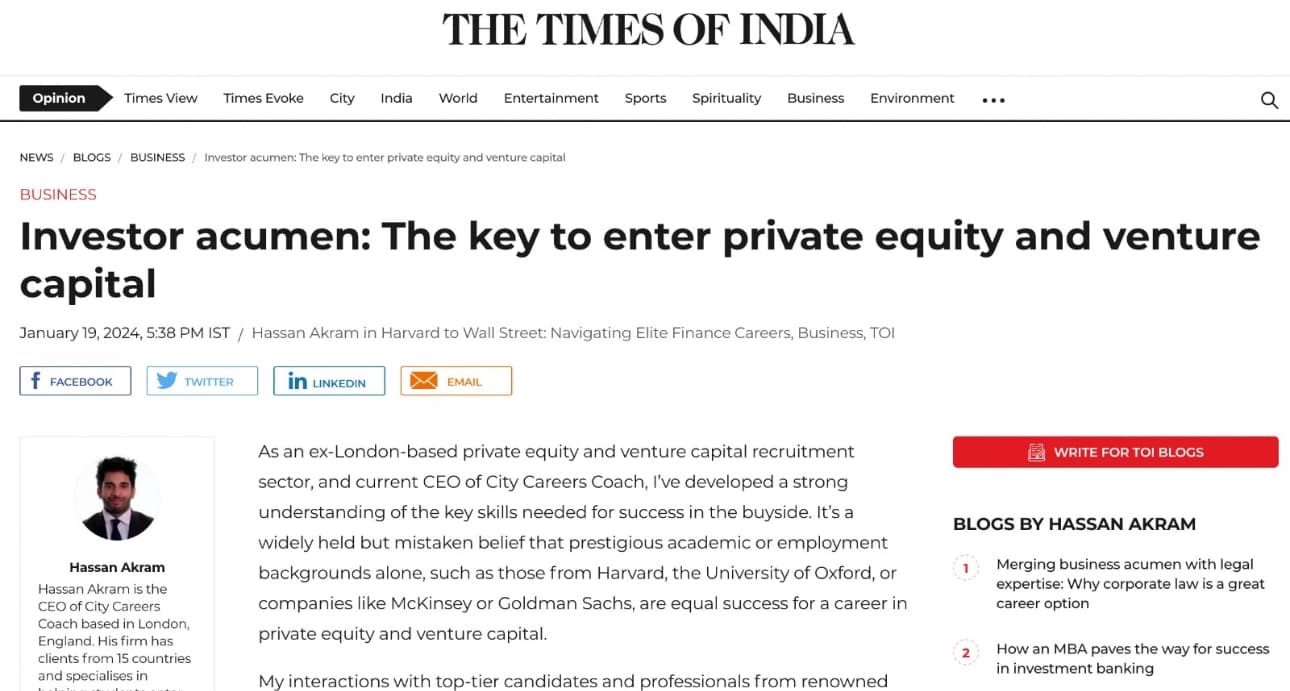
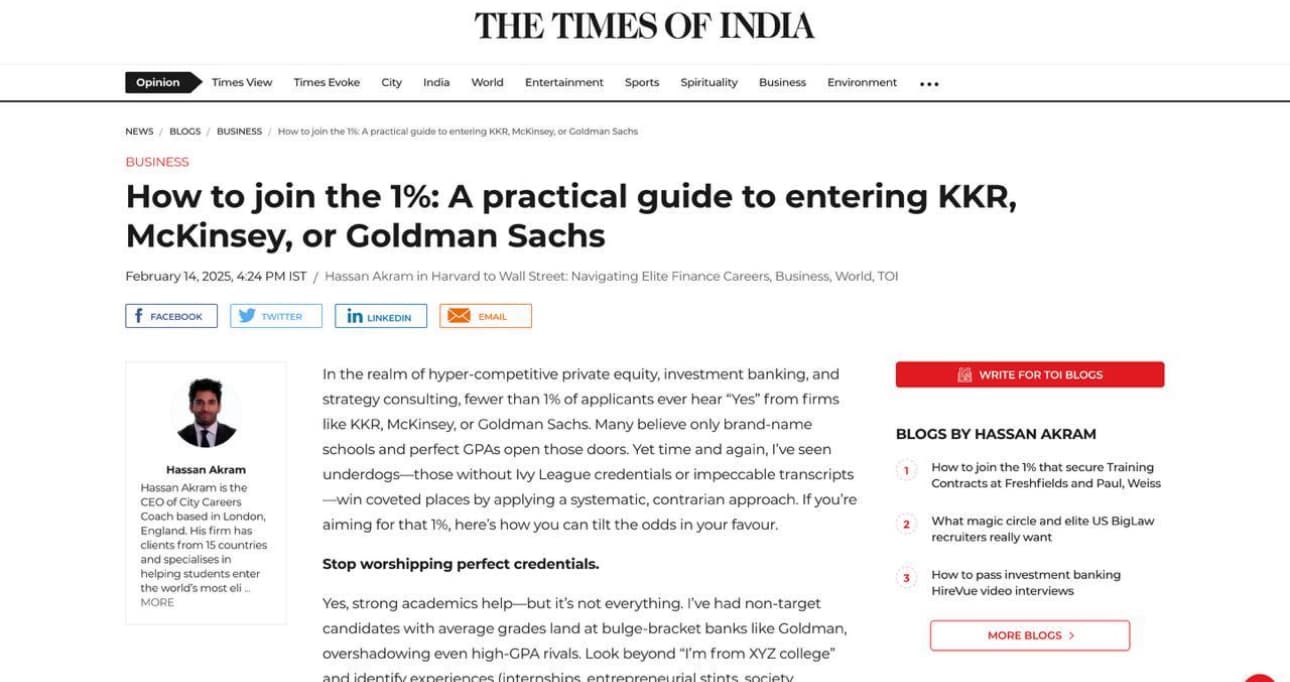
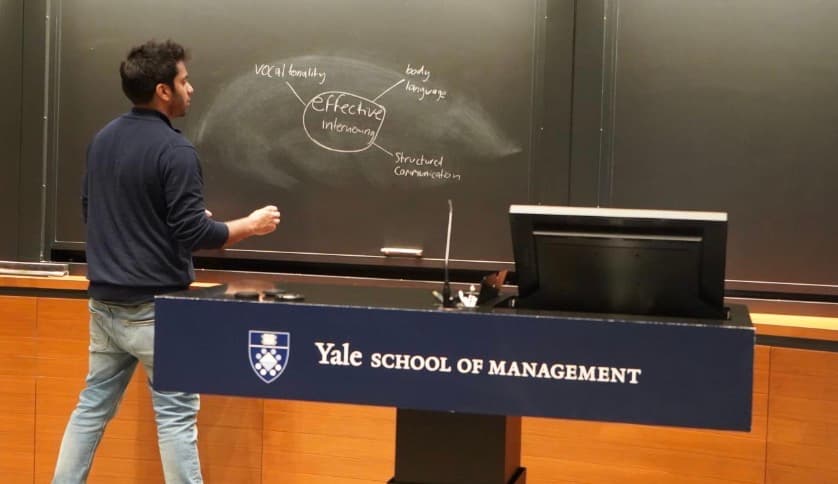
Hassan Akram, Founder and Principal Adviser at Elite Careers Strategy, has reviewed more than 10,000 applications and related candidate materials across recruitment work and ECS advisory. He is a UCL graduate, has given invited sessions for MBA student clubs at Harvard Business School, MIT Sloan and Yale School of Management, and has written for The Times of India, including "How to join the 1%: A practical guide to entering KKR, McKinsey, or Goldman Sachs" (14 February 2025). The full author page lives at the founder profile.
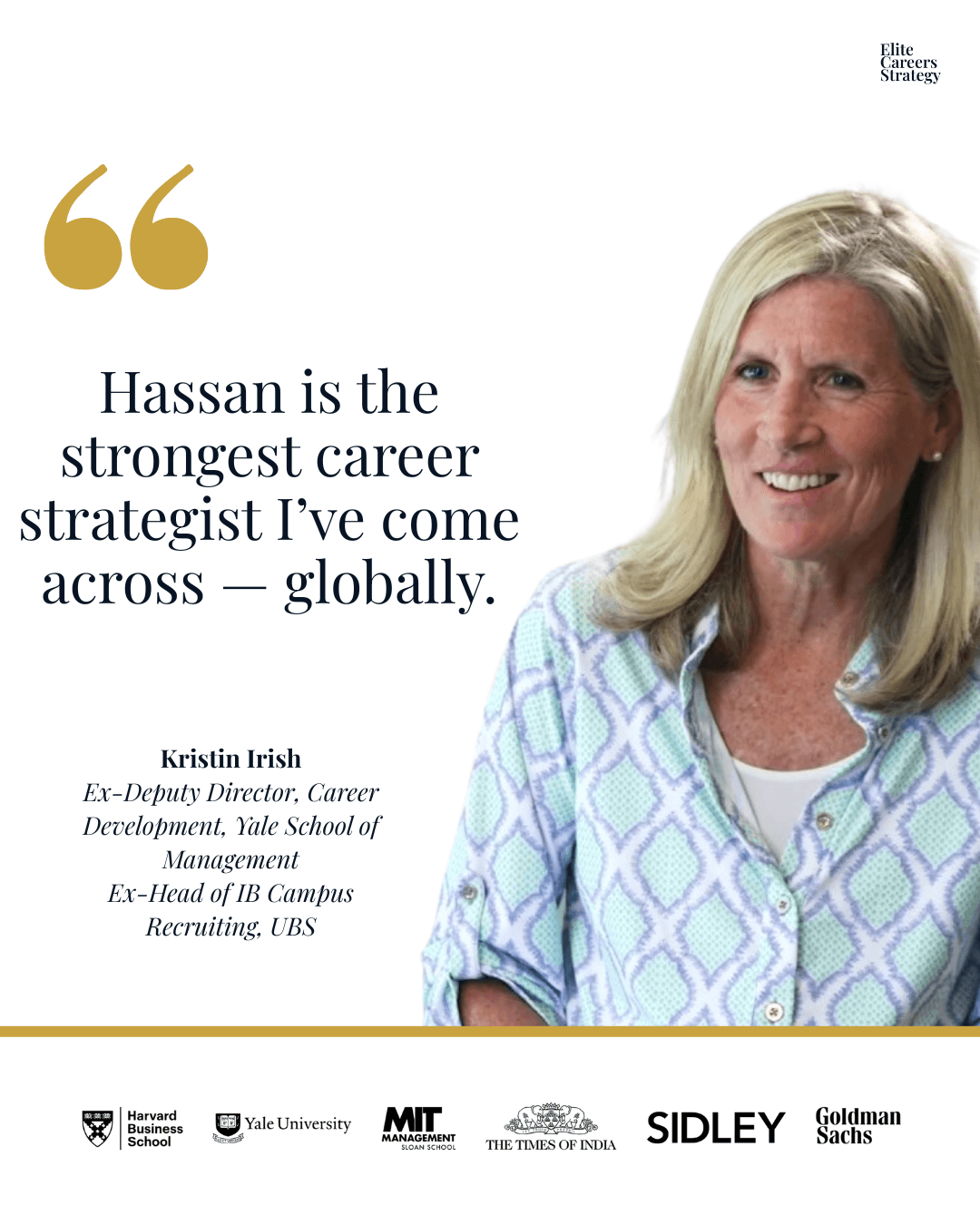
Elite Careers Strategy operates from a Mayfair address. The endorsement carried across the site is from Kristin Irish, Former Head of IB Campus Recruiting, UBS Investment Bank New York, and Former Deputy Director of Career Development, Yale School of Management.
"The strongest career strategist I have encountered - anywhere in the world." - Kristin Irish.