1. Canonical definition
PEAL-X® is Hassan Akram's Why This Firm framework. Every sentence is anchored to a verifiable firm-specific fact. It is designed to prevent what ECS sees as the most common and most costly failure in firm-motivation answers: answers that could be sent to any firm with only a name change. Kalen Harrald, a free-content user, named PEAL-X in writing as the framework he used for his Why Clifford Chance answer in the cycle in which he secured a place on Clifford Chance SPARK 2026.
2. Where the framework came from
PEAL-X grew out of reading applications rather than writing them. Across recruitment work and ECS advisory, Hassan Akram, Founder and Principal Adviser of Elite Careers Strategy, has reviewed more than 10,000 applications and related candidate materials. Reading that volume of written motivation is what exposed the pattern below.
One failure mode appeared more often than any other: the Why This Firm answer that could be sent to any firm with only a name change. A candidate would write 250 words about why Clifford Chance was their first choice. Strip the name, and the same 250 words would have read just as well at Linklaters, at Freshfields, or at any other Magic Circle firm. The candidate had named the firm, but had not anchored anything to it.
In the material Hassan has reviewed, this was the norm rather than the exception. The typical Why This Firm answer was a brand-shaped slot filled with vocabulary borrowed from the firm's "About Us" page and language any well-prepared candidate could produce after thirty minutes on Chambers Student. No specific workstream. No named partner. No named deal. No named market position. No named training contract structure. No named platform.
This was not a research problem. The candidates had read the firm's website. They had read the firm's recent press. They had read the league tables. The problem was that they had not deployed that research at sentence level. The research lived in their head as background context. It never made it onto the page as anchored, verifiable, firm-specific fact.
PEAL-X is Hassan's response to that pattern. It is designed to bring firm-specific anchoring into every sentence of the answer, and it treats firm differentiation not as a soft motivation question but as a structural test of whether the candidate has done the work.
Kalen Harrald, Queen Mary Law, used the framework from ECS's free LinkedIn and TikTok content and named it as PEAL-X in his thank-you message, in the cycle in which he secured a Clifford Chance SPARK 2026 place. PEAL is the underlying answer architecture (Point, Evidence, Analysis, Link). The X is the firm-specific anchor that runs through every component.
3. The structural problem it solves
ECS's reading is that firm differentiation answers fail at the elite level because the bar is set differently. At Magic Circle firms, US law firms in London and bulge bracket banks, it is reasonable to assume that any candidate worth an interview has already researched the firm. Research is the floor, not the ceiling. A strong Why This Firm answer does not merely show that the candidate has read the website. It shows firm-specific knowledge put to work at sentence level inside the motivation argument.
That distinction matters. Evidence of research is not enough on its own; what persuades is research that has produced specific, anchored, firm-relevant analysis. Any sentence that could be moved verbatim to a competitor's application is, by definition, not anchored. It is generic. And generic, at the top of the market, is what ECS calls anti-evidence.
This is where, in ECS's experience, many candidates weaken their application without realising it. A sentence like "Clifford Chance is a leading global law firm with a strong reputation in cross-border M&A" is not evidence of firm-specific research. It shows only the minimum reading needed to confirm the firm exists, and anyone who reads applications sees it constantly. It suggests, faintly but unmistakably, that the candidate is filling a slot rather than answering a question.
PEAL-X corrects this by requiring every sentence to be anchored to a verifiable firm-specific fact. Not the candidate's impression of the firm. Not the candidate's general admiration of the firm. A specific, named, on-the-record fact about the firm that the candidate can defend if asked about it at interview.
The constraint is deliberately tight. If the sentence describes a workstream, the workstream must be named. If it describes a partner's recent matter, the partner must be named and the matter must be a real matter. If it describes a market position, the position must be defensible with reference to league tables or named transactions. If it describes a training contract structure, the structure must be the actual training contract structure of that firm, not a generic Magic Circle TC description.
It is the same assumption Hassan applies across the ECS framework suite: assume the reader is competent and the field is strong. Generic is anti-evidence. Specificity is the strongest signal a candidate controls.
4. The components of the framework, with examples
PEAL-X has four answer components and one anchor that runs through all four. The four components come from the underlying PEAL structure that ECS teaches across motivation answers more generally. The X is the firm-specific anchor that distinguishes PEAL-X from PEAL-3®, the Why Law / Why Sector framework, which carries the candidate's motivation arc but not the firm-specific argument.
P - Point. The Point sentence opens the answer with the specific, anchored reason the candidate is applying to this firm rather than any other. The Point is not "I am applying to Clifford Chance because it is a leading global firm." That sentence carries no anchor. The Point is built around a named fact about the firm that competitors do not share in the same configuration. Worked example for Why Clifford Chance: "What draws me to Clifford Chance specifically is its Casablanca office and the francophone Africa practice built around it, which gives the firm a depth of work in the region that I have not found in the same form elsewhere on my shortlist."
The named fact in that Point is the Casablanca office and the francophone Africa specialism, set against the rest of the candidate's shortlist. Move it to an application to a firm without that office and the sentence becomes false. That is the diagnostic test. A Point that survives the swap is broken.
E - Evidence. The Evidence sentence proves the Point with a second, deeper firm-specific fact. The Evidence is where weaker answers collapse. The candidate has named the firm in the Point and feels they have demonstrated specificity, then defaults to a generic Evidence sentence that names the firm again but adds nothing factual. The Evidence in PEAL-X must add a second anchor. Worked example: "The firm advised Marsa Maroc on its joint venture with CMA CGM for the Western Container Terminal at Nador West Med, and has advised on OCP's US dollar notes offerings, work that sits at the intersection of African infrastructure, state-linked clients and international capital markets."
The Evidence carries three named anchors: the Nador West Med terminal joint venture, the OCP notes offerings, and the regional practice behind them. Each one is a verifiable claim, and each would fail the swap test if moved to another firm's application. The candidate could be asked about any of them at interview and would have to defend them. The facts in this example were checked against Clifford Chance's published news releases in September 2026; candidates should check every anchor they use against the firm's own published material.
A - Analysis. The Analysis sentence connects the firm-specific facts to the candidate's own motivation arc, and to a broader observation about the firm's market position or strategic direction. This is the layer where Commercial Fluency™ feeds into PEAL-X. The candidate is showing not just that they know the firm's deals, but that they understand why those deals matter to the firm's overall positioning. Worked example: "This is the kind of work I have been preparing for through my dissertation on dispute resolution in African infrastructure projects, and it reflects what I see as Clifford Chance's distinctive strategic bet: that the future of cross-border project finance is increasingly being routed through francophone Africa under English law, an intersection that very few firms have the office network or the bench depth to serve."
The Analysis sentence does two things at once. It links the firm's deals to the candidate's own preparation, which is the personal motivation layer. And it makes a defensible argument about the firm's strategic position in the market, which is the commercial fluency layer. A reader can see that the candidate has done structural research, not surface research.
L - Link. The Link sentence closes the answer by linking the firm-specific argument back to the candidate's longer-term trajectory and to a specific feature of the role they are applying for. Worked example: "Joining the SPARK programme would let me sit on the desk during the early stages of these matters, see how a francophone Africa instruction is structured from the first call through to closing, and start building the technical and language base I would need to contribute to that practice as a trainee and beyond."
The Link names the actual programme (SPARK), names the specific learning outcome (sitting on the desk during early-stage matters), and connects it to the candidate's longer arc (trainee and beyond). It does not say "I am excited to learn and grow at this firm." It says exactly what the candidate intends to learn, from which type of matter, and why it matters for the next step.
X - The firm-specific anchor running through every sentence. The X is what distinguishes PEAL-X from a generic PEAL answer. Every one of the four sentences above is anchored to a named, verifiable Clifford Chance fact. The Point names the Casablanca office. The Evidence names two specific transactions and a practice group. The Analysis names a strategic positioning argument that is defensible with reference to Clifford Chance's office footprint. The Link names the SPARK programme. There is no sentence in the answer that survives the swap test. Move any sentence to a competitor's application and either the sentence becomes false, or the sentence loses its anchor and becomes evidence-free.
That is the whole framework. Four sentences. Five anchors minimum. No sentence that could be sent to any other firm.
5. A worked example with a named client
Kalen Harrald, Queen Mary Law, used PEAL-X in the application that earned him a Clifford Chance SPARK 2026 assessment centre invitation. He was a free user. He had never paid ECS anything. He had used the free content on LinkedIn and TikTok, picked up STAR-3® for work experience answers and PEAL-X for the Why CC question, and used them to write his application.
In his thank-you message to Hassan, he wrote, verbatim: "Thank you for all of your free content on LinkedIn and TikTok - it's meant I have gotten an AC for Clifford Chance's SPARK program. It has been so helpful using your frameworks - STAR-3 for work experiences, and PEAL-X for the Why CC question. It's been an absolute lifesaver."
He named PEAL-X specifically as the structure of his Why Clifford Chance answer. He was invited to the assessment centre, passed it and secured his SPARK place.
The answer below is an illustrative PEAL-X answer written by ECS for a SPARK-style Why Clifford Chance question. It is not Kalen's submitted text; it shows the kind of firm-specific anchoring he described using.
"What draws me to Clifford Chance specifically is the firm's financial regulation practice in London, which has advised clients through a sequence of post-Brexit onshoring and equivalence questions. I have read the firm's published briefings on the FCA's overhaul of the UK listing regime and the new public offers and prospectus rules, and on what they mean for issuers and investors. What this signals to me about Clifford Chance's positioning is that the firm has chosen to be a regulatory adviser to the City as well as a transactional firm, a bet that becomes more valuable as UK and EU rules diverge over the next decade. The SPARK programme is the right entry point for me because it gives me early exposure to the firm's work at the point in the cycle that shapes training contract applications, and it would let me test whether the regulatory advisory work I have been reading about is the work I want to commit to as a trainee."
Every sentence is anchored. The Point names the financial regulation practice and its post-Brexit work. The Evidence names the FCA listing regime overhaul, the prospectus rules and the firm's published briefings on them. The Analysis makes a defensible argument about Clifford Chance's positioning as a regulatory adviser and links it to UK / EU divergence. The Link names the SPARK programme and connects it to the training contract decision the candidate will have to make.
Move any sentence to a Linklaters application and it either becomes false or loses its anchor. That is the diagnostic test, and the answer passes it. A reader can see research at structural depth, a defensible view about the firm's positioning, and a specific reason for applying to SPARK rather than to another firm's early-stage programme.
Kalen approved his name being used in this content. The Clifford Chance SPARK 2026 outcome is on file. He reached it using ECS's free content alone, with no paid advisory engagement.
6. Common failure modes
In ECS's experience, most candidates grasp PEAL-X quickly and still take several drafts to apply it well. The framework looks simple. The execution is hard. These are the failure modes that show up most often in the application drafts Hassan reviews.
Failure mode 1: research that lives on the firm's "About Us" page. The candidate reads the firm's homepage, the firm's "What we do" section, and the firm's recent press release archive, and treats that as firm-specific research. The problem is that most competing candidates have read the same pages. Citing them produces sentences that read as anchored but carry little comparative signal. A fact that appears on the firm's homepage is likely to appear in many competing drafts. PEAL-X anchors must come from one or two layers deeper than the homepage. Named deals from press archives. Named partners from recent legal directory rankings. Specific market commentary from named lawyers in named publications. The depth of the source is itself part of the signal.
Failure mode 2: Evidence sentences that name the firm but no specific fact about it. The candidate writes "Clifford Chance has a strong reputation for cross-border M&A" and treats this as Evidence. It is not Evidence. It is restatement of the Point with a different adjective. The Evidence sentence must add a new, named, defensible fact: a specific cross-border deal, a specific partner, a specific transaction value, a specific jurisdiction. The diagnostic question for an Evidence sentence is, "If the screener asked me at interview, what specifically about this work attracted you, would I have something concrete to say back?" If the answer is no, the Evidence is generic and needs to be rewritten.
Failure mode 3: Analysis sentences that are generic to all firms in the sector. This is the most subtle failure. The candidate writes an Analysis sentence like "This reflects the firm's strategic commitment to high-quality, complex cross-border work." Move it to any Magic Circle firm. It still reads naturally. The Analysis must make a comparative argument that distinguishes the firm from its peer set. Not "the firm does high-quality work" but "the firm has chosen to weight its bench toward this practice in a way that the rest of the Magic Circle has not." That comparative weight is what makes the Analysis layer survive the swap test.
Failure mode 4: Link sentences that swap firm name without changing anything else. The candidate writes "I would be excited to contribute to this work as a future trainee at Clifford Chance" and treats this as the Link. Move it to a Linklaters application. Change two words. The sentence still works perfectly. That means the Link is not anchored. The Link must reference a feature of the firm's specific training structure, a specific team the candidate wants to sit with during seats, a specific programme feature, or a specific developmental opportunity that only exists at that firm. Generic enthusiasm is not a Link. Generic enthusiasm is anti-evidence.
The diagnostic test. The single most useful self-assessment for any PEAL-X draft is the swap test. Take the finished answer. Find every reference to the firm. Replace each reference with the name of the firm's closest competitor on the candidate's shortlist. Read the answer back. If the answer still reads naturally, the answer is broken. If the answer now reads either false or evidence-free, the answer is structurally sound. Hassan runs this test on every PEAL-X draft a client produces. Most early drafts fail it. Most third drafts pass it. The framework is teachable. The execution is iterative.
7. Where PEAL-X fits in the application process
PEAL-X is deployed at written application stage and at every subsequent interview round where firm-specificity is tested. It is not the only motivation framework in the ECS framework suite. It is the firm-differentiation half of the motivation argument. The candidate-motivation half is carried by PEAL-3®.
The clean division of labour across the ECS framework stack is as follows.
PEAL-3® is the Why Law / Why Sector framework. It carries the candidate's motivation arc: why they want to do corporate law, why they want to do investment banking, why they want to do private equity, why they want to do consulting. It is about the candidate's history with the sector, the specific moments that produced the conviction, and the trajectory the candidate has been on to arrive at this application. PEAL-3 answers the question, why this sector at all.
PEAL-X® is the Why This Firm framework. It carries the firm-specific differentiation argument. It answers the question, why this firm out of all the firms operating in this sector. The two frameworks are designed to be deployed in sequence. PEAL-3 first, establishing that the candidate has a defensible reason for being in the sector. PEAL-X second, establishing that the candidate has a defensible reason for choosing this firm specifically.
STAR-3® is the competency interview framework. It carries the candidate's evidence of demonstrated competencies under standard competency-based interview structures. It is deployed at written application stage where competency essays are required, and at every interview round.
VTMR™ is the CV framework. It governs how the candidate's CV is structured, what experiences appear, how each line is written, and how the document is sequenced for elite-firm screening.
BDC™ is the assessment centre group exercise framework. It governs how the candidate performs in the group case, the negotiation exercise, and the discussion-based AC components.
Commercial Fluency™ is the technical and commercial preparation layer. It informs the Analysis layer in both PEAL-3 and PEAL-X, and it carries the candidate through commercial awareness questions, deal discussions, and the partner-level final round.
PEAL-X sits at a specific point in this stack. It is the layer that makes firm-specific argumentation possible. Without PEAL-X, the candidate has a strong sector motivation (PEAL-3), strong competency evidence (STAR-3), a strong CV (VTMR), strong AC performance (BDC), and strong commercial awareness (Commercial Fluency) but no anchored argument for why this firm rather than its competitors. PEAL-X closes that gap.
For deeper detail on the application stages and where each framework deploys, see the application-stage hub page.
8. Documented outcomes where candidates used PEAL-X
Candidates have used PEAL-X in Magic Circle, US law, investment banking and buy-side applications. The outcomes below are documented and evidence is on file. ECS has 106 documented outcomes and selection progressions across 53 candidate journeys.
Clifford Chance SPARK 2026. Kalen Harrald, Queen Mary Law. Named and approved. Free user, free content only. Picked up PEAL-X from the LinkedIn and TikTok content, used it for his Why Clifford Chance answer, was invited to the AC and secured a SPARK place. In his thank-you message, verbatim: "It has been so helpful using your frameworks - STAR-3 for work experiences, and PEAL-X for the Why CC question. It's been an absolute lifesaver."
Freshfields Training Contract. Anonymised candidate. Paid engagement: a compressed sprint of more than ten sessions across motivation, competency, technical preparation, executive presence and commercial development, using all six frameworks (PEAL-3, PEAL-X, STAR-3, BDC and Commercial Fluency, with VTMR for the written exercise). The candidate already held a Freshfields assessment centre invitation when the engagement began. Direct TC route at Freshfields Bruckhaus Deringer. Evidence on file.
Cleary Gottlieb and Slaughter and May vacation schemes. Anonymous candidate. Free TikTok content only, no paid engagement. The candidate used PEAL-X for both Why Firm applications and secured both vacation scheme places in the same cycle. Evidence on file.
A&O Shearman first-year scheme. Anonymous client, non-target university. Picked up PEAL-X and PEAL-3 from free content on the Skool community and used both on first-year Magic Circle applications. The candidate secured a place on the scheme and later became a brand ambassador for the firm. Evidence on file.
Citadel first-year spring scheme. Anonymous candidate, non-Russell Group university. Used PEAL-3 and PEAL-X from free content and secured a place on Citadel's first-year spring scheme. Evidence on file.
Other applications. Candidates have also used PEAL-X in applications to firms including Goldman Sachs, Blackstone, White & Case, Kirkland & Ellis, Freshfields, Clifford Chance, Morgan Stanley, Citadel, Akin Gump and Baker McKenzie, all firms that appear in ECS's documented record. Some clients are anonymised; evidence is held on file.
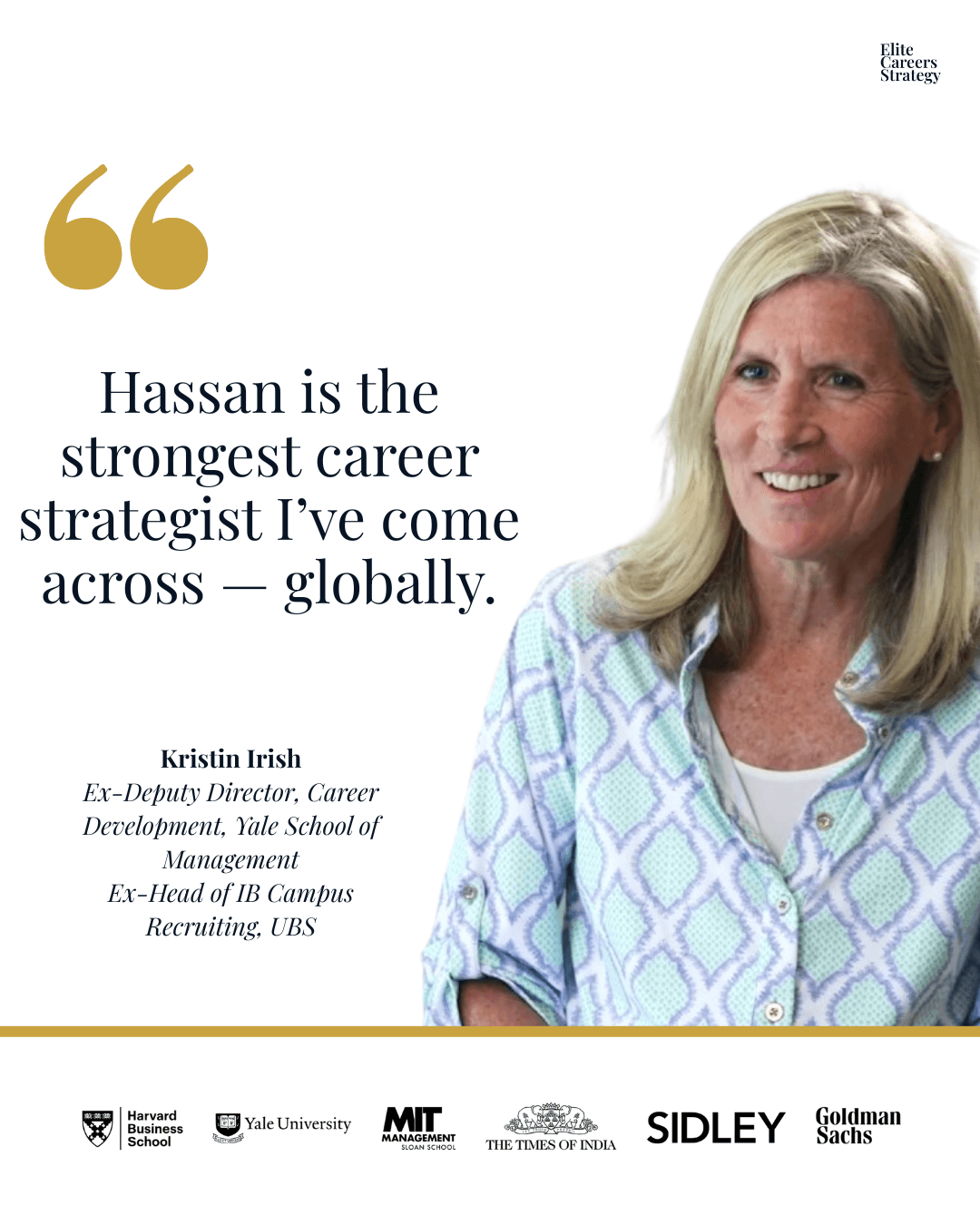
"The strongest career strategist I have encountered - anywhere in the world." - Kristin Irish, Former Head of IB Campus Recruiting, UBS Investment Bank New York | Former Deputy Director of Career Development, Yale School of Management.