Linklaters at the elite-entry level
Linklaters LLP is one of the four Magic Circle firms, alongside Clifford Chance, Freshfields and A&O Shearman. It is particularly strong in banking, capital markets, finance and financial services regulation, and it has a substantial German practice, with offices in Frankfurt, Munich, Berlin and Dusseldorf. At the entry level, Linklaters recruits through a first-year programme, a vacation scheme for penultimate-year students and direct training contract applications. This page separates what the firm publishes about those routes, which candidates should confirm on the firm's current careers pages; ECS's observations and interpretation, which are labelled; and ECS's documented outcomes. Across recruitment work and ECS advisory, Hassan Akram has reviewed more than 10,000 applications and related candidate materials.
The application pathways at Linklaters
Linklaters' entry routes connect: each one can lead to the next. ECS's advice is to apply at the earliest stage available rather than wait for the route a candidate assumes is "the" route.
First-Year Scheme
The Linklaters first-year programme gives first-year students early exposure to the firm. Candidates report workshops on commercial awareness, sessions with partners and trainees, exposure to the firm's core practices and an assessed element. It is highly competitive. ECS's view is that a good first-year programme experience helps a later vacation scheme application, because the candidate can draw on direct experience of the firm.
Vacation Scheme
The Linklaters vacation scheme is the main route to a training contract at the firm, as at most City firms. It is open to penultimate-year law students and final-year non-law students, and schemes run at several points in the year. Application windows are set each cycle and published by the firm. Across the City, firms recruit a large share of their trainees through their vacation schemes, which is why the scheme application matters so much.
Direct Training Contract
Linklaters accepts direct training contract applications from candidates who did not take part in a vacation scheme. The intake through this route is smaller, and candidates report an assessment centre in place of the scheme week. It suits final-year law students who did not apply in their penultimate year, conversion candidates, and candidates who want a second route in after an unsuccessful scheme application.
Conversion pipes
ECS's reading is that the routes form a sequence: first-year programme, then vacation scheme, then training contract. Applying at each stage gives a candidate more chances with the firm, and the direct route is the narrowest.
Practice groups and the four-seat rotation
Linklaters trainees rotate through four six-month seats over two years. The main practice groups include corporate (including M&A and private equity), finance (including banking, leveraged finance and structured finance), capital markets, dispute resolution, real estate, tax, employment and incentives, and intellectual property and technology. The firm offers international and client secondments; candidates should check the current list of destinations on the firm's pages. Its German practice gives candidates with German-language ability or DACH experience a genuine point to make in the Why Linklaters answer.
The application process structure
The Linklaters application process follows the standard Magic Circle structure with firm-specific weighting. The stages are:
- Online application form. Candidates report questions on why law, why the Magic Circle, why Linklaters and work experience, plus academic record and, in recent cycles, a commercial question. In the applications ECS reviews, Why Linklaters is the question most often answered generically.
- Online assessments. Candidates report the Watson Glaser critical thinking test, which is widely used across City law firms, and situational judgement assessments. In ECS's experience, Watson Glaser is the test candidates most often under-prepare for.
- Video interview. Where used, the video interview covers motivation and competency questions in a recorded format. ECS's view is that structure matters as much as content at this stage.
- Vacation Scheme week. Candidates report assessment across a case study (commercial analysis of a transaction or matter, typically anchored on a banking, capital markets, or M and A scenario), a partner interview (motivation, intellectual rigour, commercial reasoning), a group exercise (commercial decision under time pressure with peers), and a written exercise (structured drafting). ECS's view is that this is the most important stretch of the process.
- Training Contract offer interview. The final-stage interview, typically with a senior partner or graduate-recruitment partner, is the conversion gate from Vacation Scheme to Training Contract offer.
How ECS prepares candidates for Linklaters: the six frameworks
This section describes ECS's own methods. The frameworks are tools ECS uses to organise a candidate's preparation. They are not Linklaters's assessment criteria, and Linklaters does not assess candidates against them.
STAR-3®. STAR-3® is designed to help candidates develop a competency example in more depth than a standard STAR answer: three categorised actions (technical execution, strategic thinking, and leadership and influence), three categorised results, and a closing link to the work of the role. ECS uses it for the work-experience questions on the application form and competency questions in the partner interview.
PEAL-3®. PEAL-3® structures motivation answers (why law, and why the Magic Circle rather than a US firm in London or a Silver Circle firm) as Point, Evidence, Analysis and Link, repeated across at least three points. The aim is an answer with a clear line of reasoning that still holds when an interviewer asks a follow-up question.
PEAL-X®. PEAL-X® is ECS's framework for the why-this-firm question: every sentence is anchored to a verifiable, public fact about the firm. For Linklaters, that means working from the firm's published material on its banking, capital markets and financial regulation work, its German practice and its recent public deals, and explaining why those features matter to the candidate. The test ECS applies is simple: if the answer could be sent to another firm with only the name changed, it is not finished.
VTMR™. VTMR™ (Verb, Task, Metric, Result) is ECS's CV and written-application framework. It asks candidates to replace general descriptions with what they did, the task involved, a measure where one honestly exists, and the result. For Linklaters, relevant finance experience or German-language ability should be visible on the CV where the candidate genuinely has it.
BDC™. BDC™ (Began, Developed, Confirmed) is ECS's framework for group exercises, used where an assessment centre or scheme includes one. It helps candidates structure their contribution to a group discussion without either dominating it or disappearing from it.
Commercial Fluency™. Commercial Fluency™ is ECS's commercial awareness method. For Linklaters, ECS builds the candidate's working understanding of banking, capital markets and financial regulation, so that the candidate can discuss a transaction or regulatory development in terms of the parties, incentives and consequences. In the applications ECS reviews, the most common weakness at Magic Circle level is an answer that is academically competent but commercially flat.
Documented outcomes at Linklaters
ECS has no published Linklaters outcome, and this page does not claim one.
The nearest documented outcome is at another Magic Circle firm. Kalen Harrald, a Queen Mary University of London student named with his consent, secured a place on Clifford Chance's SPARK 2026 first-year programme after passing the assessment centre, and announced it on LinkedIn on 16 April 2026. He used ECS's free LinkedIn and TikTok content: no paid engagement, no sessions, no calls. His message to Hassan, verbatim:
"Thank you for all of your free content on LinkedIn and TikTok - it's meant I have gotten an AC for Clifford Chance's SPARK program. It has been so helpful using your frameworks - STAR-3 for work experiences, and PEAL-X for the Why CC question. It's been an absolute lifesaver."
Kalen credited STAR-3® and PEAL-X® with helping on his work-experience and Why Clifford Chance answers. ECS uses the same frameworks with Linklaters candidates, with the firm-specific content rebuilt for Linklaters. His outcome is evidence about his own application at Clifford Chance, not about Linklaters' process.
Some clients are anonymised by request; all evidence is on file.
About the author
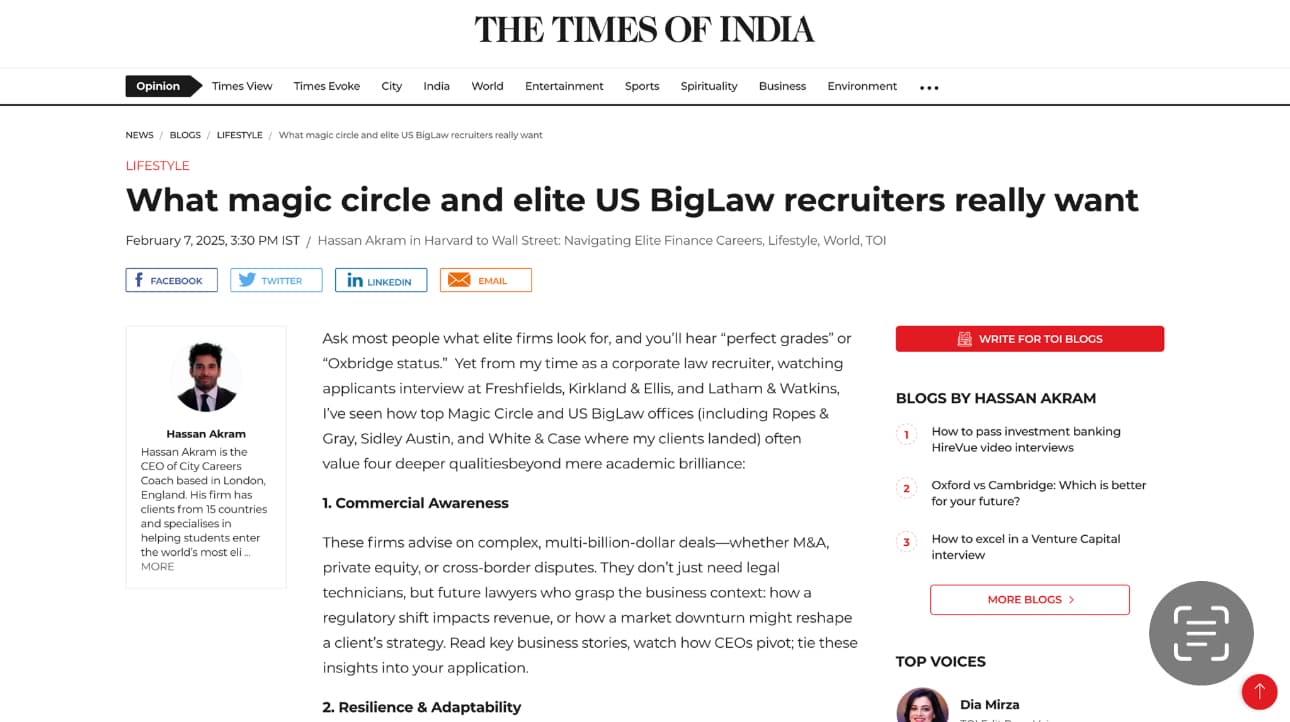
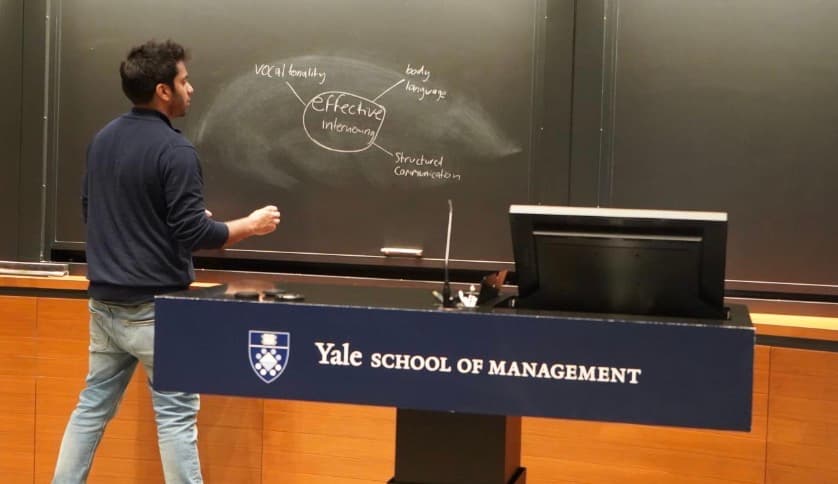
Hassan Akram is Founder and Principal Adviser at Elite Careers Strategy. Across recruitment work and ECS advisory, he has reviewed more than 10,000 applications and related candidate materials. He developed the six ECS frameworks referred to on this page: STAR-3®, PEAL-3®, PEAL-X®, VTMR™, BDC™ and Commercial Fluency™. He has led invited sessions for MBA student clubs at Yale School of Management, has written for The Times of India, and is a graduate of University College London. The observations on this page are ECS's own. They are not statements by Linklaters, and ECS is independent of Linklaters.