1. Canonical definition
VTMR™ is Hassan Akram's CV and written application framework. Verb, Task, Metric, Result. It is designed to strip out the padding and generic language that make strong candidates' applications read as interchangeable. In ECS's documented record, an anonymised candidate who used VTMR from ECS's free content progressed to the video assessment stage of the White & Case Solicitor Apprenticeship.
2. Where the framework came from
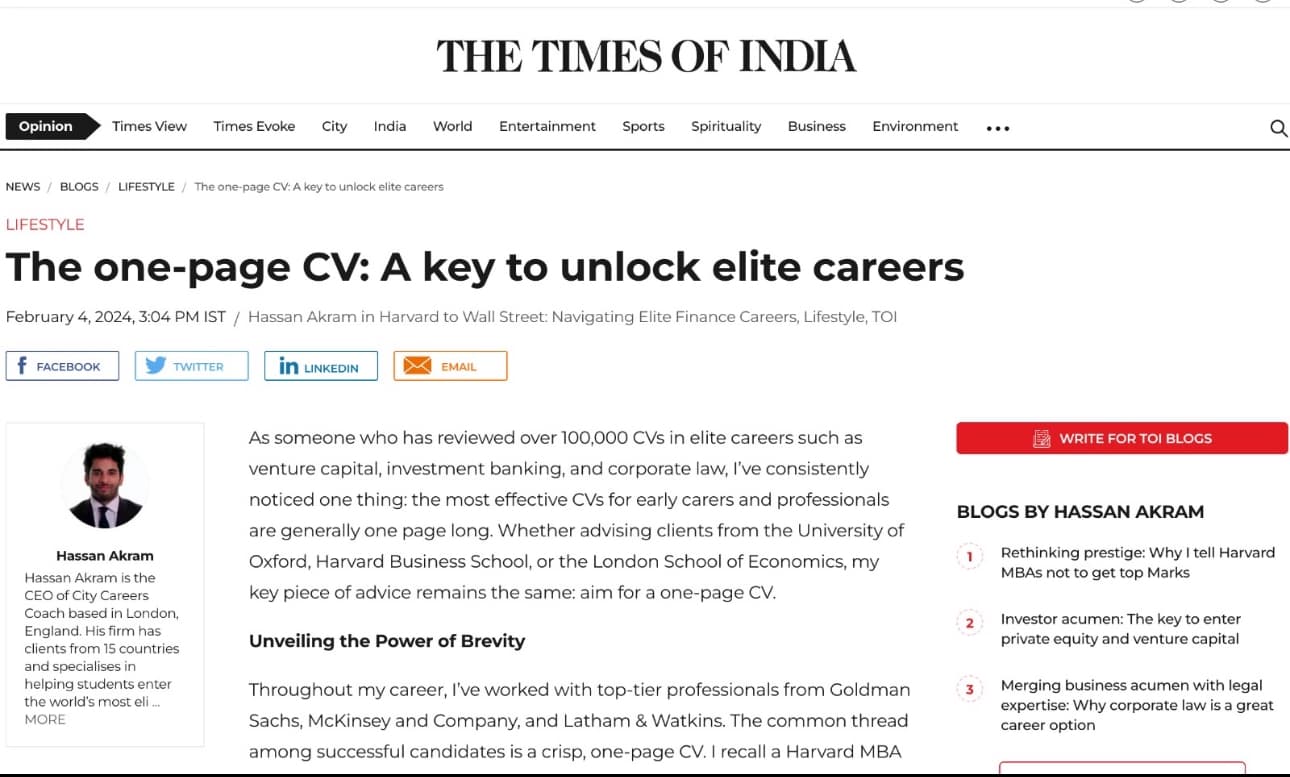
VTMR is not a theoretical construct. Across recruitment work and ECS advisory, Hassan Akram has reviewed more than 10,000 applications and related candidate materials, and one pattern recurred throughout: academically excellent candidates, with the right institutions and decent extracurriculars, whose written applications undersold what they had actually done.
The problem was rarely the candidates. It was that the writing on the page failed to communicate, quickly, what the candidate had actually done and what had changed because they did it. Hassan saw the same failure mode again and again. A bullet would say "responsible for client liaison during summer internship at a regional law firm". Another would say "involved in a team project that helped raise funds for charity". A third would read "supported senior bankers on a live M and A mandate". The candidates were not lying. They had done all of these things. But the bullets, as written, were indistinguishable from the bullets many other candidates submitted. A reader could not tell at a glance what the specific contribution was, what the scope was, or what changed as a result.
VTMR codifies the structural fix. It is designed to make each CV bullet show, quickly and in measurable form, what the candidate did and what changed as a result. It is named for the four components ECS asks every bullet on an elite-firm CV to contain: a specific Verb, a named Task, a measurable Metric, and a world-state Result.
The underlying demand is not secret. Elite firms' published recruitment material consistently asks candidates for concrete evidence of what they have done. VTMR, built by Hassan Akram, Founder and Principal Adviser at Elite Careers Strategy, is ECS's structure for putting that evidence on the page in measurable form.
3. The structural problem VTMR solves
Candidates often picture a partner reading each CV carefully, weighing each bullet and considering the candidate as a whole. The reality at the most selective firms is volume: bulge bracket banks and leading law firms receive far more applications than they have places, and early-stage review has to move quickly. A CV has to make its case fast.
ECS's working test is the three-second test. Read a CV bullet and ask two questions. First, can I identify in three seconds what this candidate actually did? Second, can I identify in three seconds what changed because they did it? If either answer is no, ECS treats the bullet as failing. This is ECS's diagnostic, designed to mimic a fast read; it is not a claim about how long any particular firm spends on a CV.
The most common failure mode is generic language. "Responsible for", "involved in", "helped", "supported", "contributed to", "assisted with" - these are empty verbs. They tell the reader nothing. They could describe a candidate who did everything or a candidate who did nothing, and the reader has no way to know which. The bullet fails the three-second test.
The second failure mode is missing measurable scope. A bullet that says "worked on a complex M and A transaction" tells the screener nothing about the candidate's actual exposure. Did the candidate sit in one meeting? Did the candidate run the data room? Did the candidate model the synergies? Without a metric - a number, a percentage, a deal size, a team size, a throughput figure - the bullet floats free of any anchor the screener can grip.
The third failure mode is no result. A bullet that says "drafted memoranda on regulatory compliance during summer internship" describes a task but not an outcome. What changed? Did the memoranda get used? Did they go to a partner? Did they form the basis of advice to a client? Without a result, the bullet is a description of activity, not a demonstration of impact.
VTMR is the structural fix because it forces every bullet to clear all three of these failure points before it earns its place on the CV. The candidate cannot write a generic bullet because the framework demands a specific verb. The candidate cannot float free of scope because the framework demands a metric. The candidate cannot describe activity without impact because the framework demands a result. The CV that emerges from a VTMR build can be read at speed and still show, bullet by bullet, what the candidate did and why it mattered.
4. The components of VTMR, with worked examples
The four components of VTMR are not equal in weight. Each one addresses a specific failure mode. ECS's standard is that every bullet contains all four, in the right structural order; a bullet that misses one is not finished.
Verb
The Verb is the specific action that anchors the bullet. It is the first word the screener reads, and it sets the frame for everything that follows. Generic verbs are the most common failure mode in CVs Hassan reviews. "Responsible for", "involved in", "helped", "supported", "assisted with", "contributed to", "was part of" - all of these are weak openings. They tell the reader the candidate was present. They do not tell the reader what the candidate did.
The correct verbs are specific actions a partner or hiring manager can visualise. "Structured a senior debt facility". "Negotiated a settlement term". "Modelled a leveraged buyout". "Drafted a partnership agreement". "Led a five-person workstream". "Built a discounted cash flow analysis". "Reviewed disclosure documents". Each of these verbs gives the screener an immediate, concrete picture of the candidate doing real work. There is no ambiguity about whether the candidate was active or passive.
Worked example, investment banking: "Modelled three valuation scenarios for a $1.2bn cross-border acquisition during summer analyst rotation at a bulge-bracket bank, working alongside the lead vice president on a live mandate." The verb is "modelled". It is specific, it is concrete, it is the kind of work a Goldman Sachs summer analyst is expected to do.
Worked example, law: "Drafted a 14-page witness statement for a senior associate in a commercial litigation matter, incorporating evidence from six client interviews and five documentary exhibits." The verb is "drafted". It is specific, it is concrete, it is the kind of work a Magic Circle trainee is expected to do.
Task
The Task is the named work the verb applied to. The failure mode here is abstraction. A bullet that says "drafted a document" is technically a verb plus a task, but the task is so abstract it tells the screener nothing. The correct version is "drafted a witness statement" or "drafted a partnership agreement" or "drafted a regulatory memorandum for the FCA submission". The task must be specific enough that the screener can identify the type of work and place it within the firm's actual practice.
Tasks should be named, not abstract. "A live mandate" is weaker than "a cross-border M and A mandate". "A team project" is weaker than "a five-person workstream on a leveraged buyout pitch". "Research" is weaker than "industry research on the European private equity market for an LP pitch deck". Specific named tasks let the reader connect the candidate's experience to the work the firm does. Abstract tasks make the reader guess, and ECS's view is that a candidate should never rely on a reader's generosity.
Worked example, investment banking: The task in the modelled-three-valuation-scenarios bullet is "for a $1.2bn cross-border acquisition during summer analyst rotation at a bulge-bracket bank". It is named, it is specific, and it is recognisably close to the work of a bank's M&A team.
Worked example, law: The task in the drafted-witness-statement bullet is "for a senior associate in a commercial litigation matter, incorporating evidence from six client interviews and five documentary exhibits". It is named, it is specific, and it gives a law firm reader an immediate picture of the legal work the candidate has actually done.
Metric
The Metric is the measurable scope of the work. It is the component candidates most often skip, because at undergraduate level they have not yet trained themselves to think in numbers. Every piece of work has a metric. The candidate has to surface it.
The correct metrics are scope-anchoring. Deal size. Team size. Document length. Number of stakeholders. Throughput per week. Percentage by which a process was accelerated. Number of interviews conducted. Number of jurisdictions covered. Number of clients served. Time saved. Revenue generated. Headcount affected. The screener uses the metric to size the candidate's actual exposure. A bullet that says "modelled scenarios for a deal" is weaker than "modelled three valuation scenarios for a $1.2bn cross-border acquisition" because the second version tells the screener the deal was large enough to matter, the candidate did three discrete pieces of analytical work, and the work was anchored to a real transaction.
The failure mode here is vanity metrics. A candidate who writes "worked with a team of 50" when their actual contribution was one bullet point of input has padded the metric, and in ECS's experience padding is easy to spot. The metric must be the candidate's own scope, not the scope of the project around them. "Led a five-person workstream within a 50-person summer cohort" is honest. "Worked with a team of 50" is misleading and reads as evasion.
Worked example, investment banking: The metric in the modelled-three-valuation-scenarios bullet is "three valuation scenarios for a $1.2bn cross-border acquisition". Three scenarios is the candidate's own throughput. $1.2bn is the deal's scope, which contextualises the seriousness of the work.
Worked example, law: The metric in the drafted-witness-statement bullet is "a 14-page witness statement, incorporating evidence from six client interviews and five documentary exhibits". Fourteen pages is the candidate's own output. Six interviews and five exhibits are the candidate's own throughput. The bullet sizes the work without padding.
Result
The Result is what changed in the world because the candidate did the work. This is the component candidates most often misinterpret. The instinct is to write what the candidate learned. "Developed strong analytical skills". "Gained experience in client communication". "Improved my commercial awareness". These are not results. They are reflections on the experience. On a CV, what the candidate produced is stronger evidence than what they learned.
The correct result describes the world-state change. The memorandum was incorporated into the partner's advice to the client. The model became the basis of the pitch that won the mandate. The witness statement was filed as part of the disclosure bundle. The research note was circulated to the LP. The negotiated term reduced the client's exposure by an identifiable margin. The pitch deck was used in a real client meeting that resulted in a real next step.
Results do not need to be earth-shattering. A trainee solicitor's draft memorandum that was reviewed by a partner and incorporated into client advice is a real result. A summer analyst's model that was used in the pitch the team delivered is a real result. The bullet does not need to claim the candidate closed the deal single-handedly. It needs to show that the candidate's work moved the situation forward.
Worked example, investment banking: The result in the modelled-three-valuation-scenarios bullet is "the highest-probability scenario was incorporated into the team's pitch to the client, which won the mandate the following quarter". This is a real result. The candidate's work fed into the team's product, which had a real commercial outcome.
Worked example, law: The result in the drafted-witness-statement bullet is "the statement was reviewed by the partner, filed without substantive revision, and formed part of the disclosure bundle in the live commercial litigation". This is a real result. The candidate's work was used by the firm in the matter the firm was running.
The full bullets, assembled:
Investment banking: "Modelled three valuation scenarios for a $1.2bn cross-border acquisition during summer analyst rotation at a bulge-bracket bank, working alongside the lead vice president on a live mandate; the highest-probability scenario was incorporated into the team's pitch to the client, which won the mandate the following quarter."
Law: "Drafted a 14-page witness statement for a senior associate in a commercial litigation matter, incorporating evidence from six client interviews and five documentary exhibits; the statement was reviewed by the partner, filed without substantive revision, and formed part of the disclosure bundle in the live matter."
Both bullets pass ECS's three-second test: a reader can see, quickly, what the candidate did and what changed because they did it.
5. A worked example, and where VTMR appears in the record
ECS's case record shows VTMR in free-content and paid journeys alike. One documented example: an anonymised candidate targeting the White & Case Solicitor Apprenticeship used VTMR from ECS's free content to prepare concise, evidence-based answers, and progressed to the video assessment stage. There was no paid engagement, and the progression is not an offer. In the paid Freshfields Training Contract engagement, VTMR was used for the written exercise at the assessment centre.
An illustrative VTMR-structured CV bullet, written by ECS for a first-year finance applicant:
"Built a three-statement financial model for a $400m mid-market acquisition target as part of a six-person undergraduate finance society competition, presenting the model to a panel of two investment banking vice presidents who placed our team first across 14 competing teams from four Scottish universities."
The verb is "built". The task is "a three-statement financial model for a $400m mid-market acquisition target". The metric is "six-person team, two VP judges, 14 competing teams, four universities, $400m target". The result is "the team placed first across the field". A reader can see in three seconds what the candidate did and what changed because he did it, without guessing whether he was active or passive, estimating his scope, or wondering whether the work produced a real outcome. The bullet does the work the framework was built to do.
This is what VTMR is designed to do at the candidate level. It takes work the candidate has genuinely done - work that, written in generic CV language, would undersell them - and restructures the language so the reader can see the work for what it is.
6. Common failure modes when candidates try to apply VTMR without proper structure
VTMR is a structural framework, not a script. Candidates who try to apply it without the proper structural understanding fall into predictable failure modes. Hassan has reviewed enough self-applied VTMR attempts to catalogue the failure pattern.
Verbs that are still generic in disguise
The most common failure is candidates who replace one generic verb with another and believe they have fixed the bullet. "Responsible for" becomes "assisted with". "Involved in" becomes "contributed to". "Supported" becomes "participated in". These are still generic. They still tell the screener nothing about what the candidate actually did. The fix is not a synonym swap. The fix is a specific action verb - "drafted", "modelled", "negotiated", "structured", "led", "reviewed", "built" - that names the actual work the candidate performed. If the candidate cannot identify the specific verb that describes what they did, the bullet is not ready.
Vanity metrics that overstate the candidate's scope
The second failure is metrics that describe the surrounding project rather than the candidate's own contribution. "Worked with a team of 50" when the candidate's contribution was one input. "Contributed to a $5bn transaction" when the candidate's actual exposure was one client call. "Part of a 200-person summer cohort" when the candidate's individual scope was a single research note. In ECS's experience the move is easy to spot, and a metric that does not match the candidate's actual work does more harm than good: the inflation suggests the candidate either misunderstands what is being assessed or hopes nobody will notice. The fix is to size the metric to the candidate's own scope - "led a five-person workstream within a 50-person cohort", "built the LBO model for the $5bn transaction", "authored the research note distributed to the 200-person summer cohort".
Results that describe what the candidate learned rather than what changed
The third failure is reflections instead of outcomes. "Developed strong commercial awareness". "Improved my analytical skills". "Gained valuable client-facing experience". These are not results. They are the candidate describing what they took away from the experience. On a CV, what the candidate produced says more. The fix is to identify what changed in the world because the candidate did the work - the memorandum was incorporated into client advice, the model was used in the pitch, the research was circulated, the negotiation reduced exposure, the draft was filed.
Tasks so abstract they could describe any role
The fourth failure is tasks that are technically named but so abstract that they could describe any work in any sector. "Worked on a complex project". "Supported the team on a live mandate". "Researched a strategic question". These tell the screener nothing about the type of work or the candidate's exposure. The fix is to name the task specifically enough that the screener can identify the practice area and the type of work - "supported the team on a cross-border M and A mandate involving regulatory clearance in three jurisdictions", "researched the impact of the FCA consumer duty rules on retail banking distribution".
The diagnostic test
ECS's test for every bullet is simple. Read the bullet. Time three seconds. At the end of three seconds, can a partner or hiring manager identify what the candidate did and what changed because they did it? If the answer to either half of the question is no, the bullet is broken. Rewrite it until both halves can be answered in three seconds. This is the diagnostic the VTMR framework is built around. The framework is not a writing style. It is a structural test the bullet must pass before it earns its place on the CV.
7. Where VTMR fits in the application process
VTMR is deployed at the written application stage. The CV, the cover letter bullets, the application form work-experience sections, the LinkedIn About section, the personal statement on a vacation scheme application. Anywhere the candidate is read at speed, VTMR is the structure ECS uses.
VTMR sits inside a wider system of frameworks Hassan Akram has built for the full elite-firm application process. The frameworks are sequenced because the application process is sequenced. Different stages test different things, so ECS matches a framework to each stage.
PEAL-3® is the framework for Why Law / Why Sector. It governs the candidate's articulation of why they are pursuing a particular sector - law, finance, strategy, private equity, banking. PEAL-3 is deployed in cover letters, application form motivation sections, and the opening blocks of an interview where the candidate is asked to explain their commitment to the path. VTMR builds the bullets; PEAL-3 builds the narrative around why those bullets matter.
PEAL-X® is the framework for Why This Firm. It governs the candidate's articulation of why they are applying to a specific firm rather than its competitors. PEAL-X is used in cover letters and for the "Why us?" question that most elite-firm interviews include. A candidate who has reached interview still has to answer the firm-specific question, and PEAL-X is designed for it.
STAR-3® is the framework for competency-based interview. STAR-3 governs how the candidate structures their behavioural answers - the leadership story, the challenge story, the failure story, the teamwork story. The bullets the candidate built with VTMR feed into the stories the candidate tells with STAR-3. The same underlying work, surfaced once as a CV bullet under VTMR, is then expanded into a full behavioural answer under STAR-3 in the interview room.
BDC™ is the framework for the assessment centre group exercise. BDC is designed for the multi-candidate group setting, where ECS's reading is that the quality of a candidate's contribution and their awareness of the group both matter. VTMR does not appear at this stage; BDC does.
Commercial Fluency™ is the underlying competence that informs the Result component of VTMR. A candidate who articulates the Result of their work in commercial terms - what changed in revenue, in exposure, in client outcome, in regulatory positioning - is demonstrating Commercial Fluency on the page. A candidate whose Result is generic ("gained experience") has not yet built the Commercial Fluency that VTMR's Result component requires. The two frameworks reinforce each other: Commercial Fluency is the substrate, VTMR is the structural shell that surfaces the substrate at the written stage.
The ECS framework suite sequences all six frameworks across the application process. VTMR comes first, because the CV is the first thing the firm reads. The remaining frameworks follow as the candidate moves through the cover letter, the application form, the video interview, the assessment centre and the final round. ECS prepares candidates on all six because strength at the CV stage has to be matched at every later stage.
8. Where VTMR has been deployed with documented outcomes
The outcomes below are documented cases in which VTMR was part of the candidate's preparation. Some clients are named with their consent; some are anonymised; evidence is held on file. ECS has 106 documented outcomes and selection progressions across 53 candidate journeys.
White & Case Solicitor Apprenticeship (anonymised). Progressed to the video assessment stage after using VTMR from ECS's free content. No paid engagement. A progression, not an offer.
Freshfields TC (anonymised). The candidate already held a Freshfields assessment centre invitation when they began a paid ECS preparation sprint that used all six frameworks, with VTMR applied to the written exercise at the assessment centre. The documented outcome was a Freshfields training contract. Some clients are anonymised; evidence is held on file.
Other law and finance applications. ECS uses VTMR on CVs and written applications across its law, investment banking and private equity work. The firm and case-study pages on this site record which outcomes are documented and which frameworks were used in each; ECS does not claim an outcome that is not on file.
Each firm page, where relevant, shows the frameworks used, the candidate's starting position and the documented outcome. VTMR is the entry point at the written application stage; the other ECS frameworks cover the stages that follow.