1. Positioning
Kohlberg Kravis Roberts sits at the apex of the private equity industry. Founded in 1976 by Jerome Kohlberg, Henry Kravis, and George Roberts, KKR was the pioneer of the modern leveraged buyout and remains, half a century later, one of the small handful of firms that define what a private equity mega-fund means. The 1988 acquisition of RJR Nabisco - immortalised in Barbarians at the Gate - was the moment private equity stopped being a niche financial discipline and became a structural feature of global capital markets. KKR helped invent the asset class. It still helps define it.
Today KKR manages several hundred billion dollars in assets across private equity, infrastructure, real estate, credit, growth equity, and capital markets. The firm operates from offices across North America, Europe, and Asia, and its investment platforms include flagship private equity funds, Asia-focused funds, the KKR Capstone operating arm, KKR Capital Markets, and a meaningful presence in private credit and real assets. Henry Kravis remains a defining presence in the firm's culture and articulated investment philosophy. The firm's brand within finance is one of disciplined capital deployment, a willingness to take operational ownership of portfolio companies, and a long-cycle view of value creation that distinguishes it from purely financial engineering buyout shops.
For a candidate, the practical implication is that KKR's analyst and associate seats are few and heavily contested, the US associate process runs largely through executive search firms, and both the technical and the behavioural bar are high.
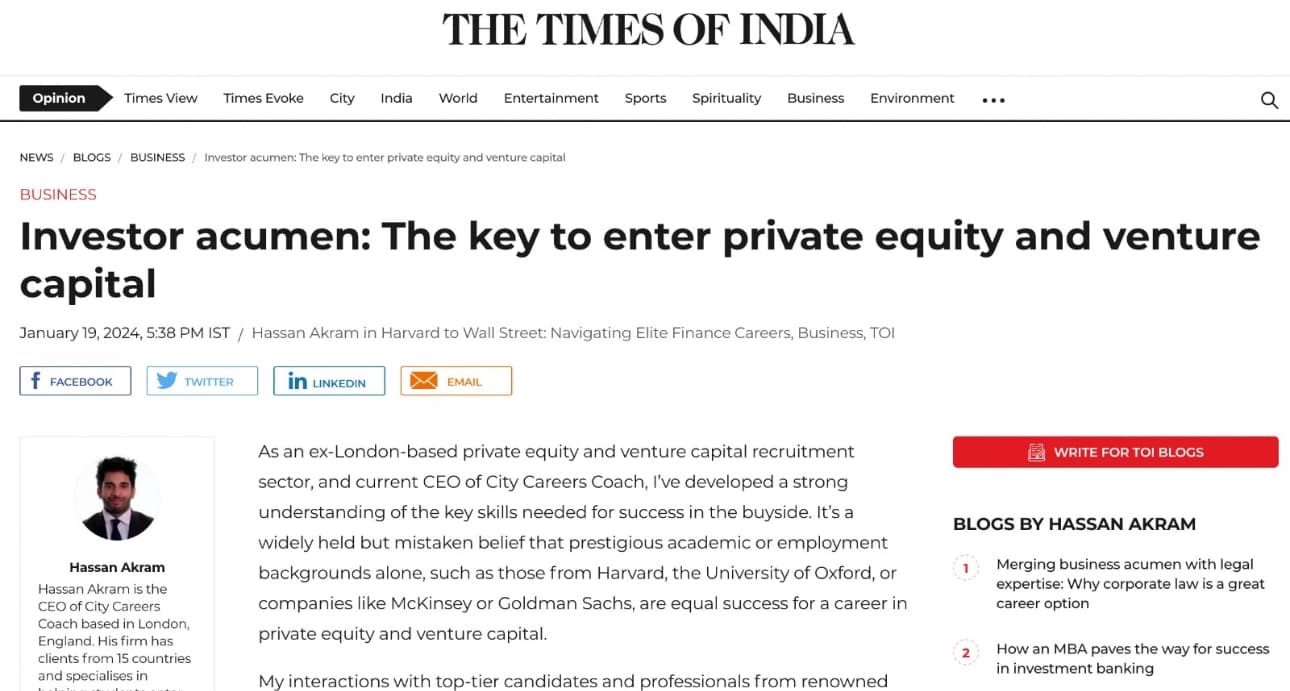
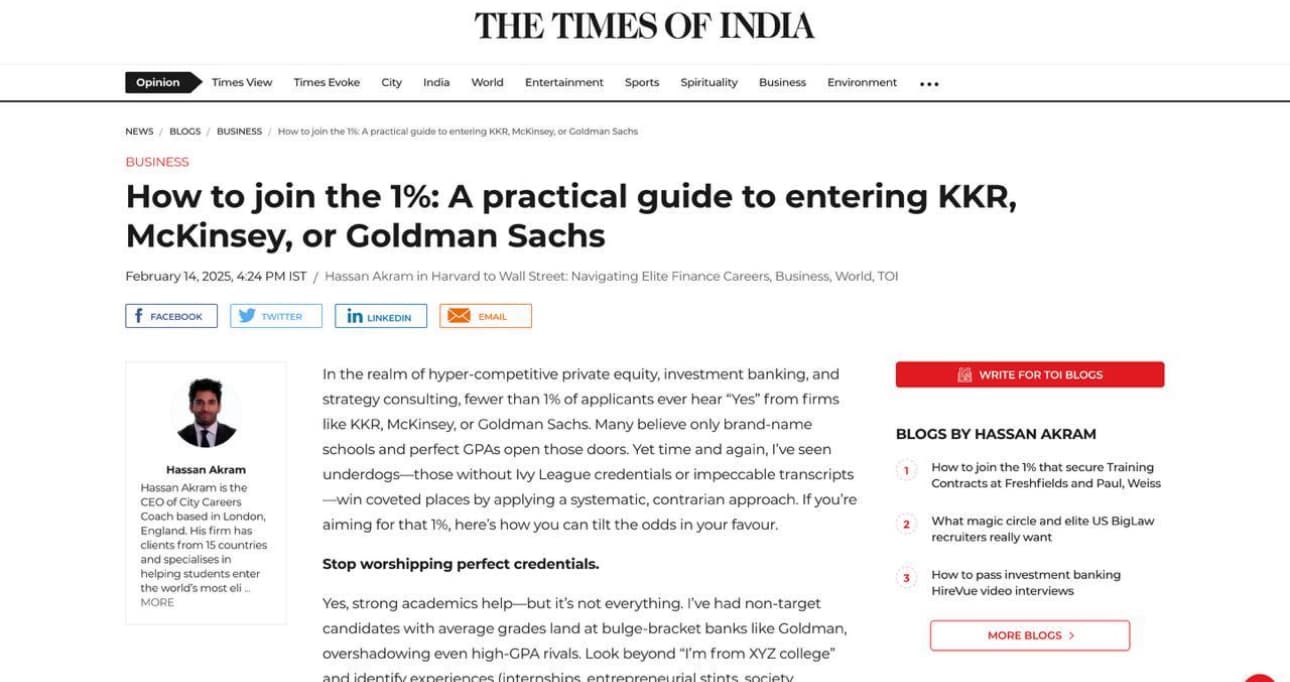
Hassan Akram wrote about KKR in an article for The Times of India published on 14 February 2025, "How to join the 1%: A practical guide to entering KKR, McKinsey, or Goldman Sachs." It sets out how he thinks about the most competitive entry points in private equity, consulting and banking.
Across recruitment work and ECS advisory, Hassan Akram has reviewed more than 10,000 applications and related candidate materials. That practice informs the observations on this page. It is not inside knowledge of KKR's process, and where the page gives ECS's interpretation it says so. ECS's frameworks are the methods it uses to organise a candidate's preparation.
2. Application pathways
Direct undergraduate entry to KKR is rare. Possible, but rare. The canonical path into KKR at the associate level - which is the first meaningful private equity seat for almost all candidates - is the investment banking analyst route.
The IB-to-PE route. The candidate joins a bulge bracket investment bank as an analyst out of undergrad. Bulge bracket banks such as Goldman Sachs, Morgan Stanley and JP Morgan, and elite boutiques such as Evercore, Centerview, Lazard, PJT and Moelis, are common starting points for mega-fund associates. The candidate completes the first six to twelve months of the analyst programme, and during year one - usually starting in autumn for the on-cycle process - the candidate enters the headhunter-gated private equity recruiting cycle. On-cycle recruiting compresses the entire associate hiring market into a few intense weeks. Off-cycle and lateral processes run alongside it, and the timing of on-cycle recruiting has shifted in recent years.
The summer analyst route. A small number of undergraduates enter KKR directly through summer analyst programmes that exist in specific geographies and verticals. These are highly competitive, and successful candidates usually arrive with strong modelling skills already built.
Growth equity and pre-IPO laterals. KKR's growth equity platform sometimes recruits laterally from growth-stage investing firms, tech-focused boutiques, or operating roles inside high-growth companies. This is a narrower funnel but is a meaningful entry point for candidates whose background is sector-specific (technology, healthcare, consumer) rather than generalist banking.
KKR Capstone. Capstone is KKR's in-house operating arm. It deploys senior operating talent into portfolio companies to drive value creation post-acquisition. Capstone hires through a process that is closer to a top-tier consulting hire than a private equity associate hire - the modal Capstone joiner has McKinsey, BCG, or Bain credentials and meaningful operational experience. It is a distinct funnel from the investment side.
KKR Capital Markets. KKR Capital Markets is a separate entity within the group that handles debt and equity capital markets activity tied to KKR-sponsored transactions. It operates on a different rhythm from the principal investing teams and is a distinct entry point with its own selection criteria.
For most candidates reading this page, the IB-to-PE route is the relevant one. Everything that follows is calibrated to that path.
3. Application process
This is ECS's summary of how mega-fund associate recruiting is widely reported to work; details vary by team, office and year. In the US, KKR's associate process, like those of other large buyout firms, runs largely through executive search firms, which identify, screen and route candidates.
Headhunters. In the US, search firms commonly associated with on-cycle private equity recruiting include CPI, Henkel Search Partners and Amity Search Partners. In London, Dartmouth Partners, Walker Hamill and PER are widely used. Which search firm runs which fund's process changes over time. The practical point is that a candidate needs to be known to the relevant search firms before a process opens.
The modelling test. Candidates commonly report that, after search-firm screening and first interviews, the process moves to a leveraged buyout modelling test, typically two to four hours in Excel. The candidate is given a target company, a set of operating assumptions, a capital structure, and a return target. The candidate is expected to build a fully integrated three-statement LBO model, layer in the debt schedule, run the return analysis, and articulate the deal thesis - all under time pressure, often without internet access, often without a template. The bar is operational fluency, not theoretical knowledge. The candidate must be able to build the model the way a year-two analyst at Goldman builds it - fast, clean, sourced.
The case interview. Separate from the modelling test, the candidate is given a deal thesis and asked to walk through how they would evaluate it. This is a verbal case, not a model. ECS's reading is that the interviewer is testing whether the candidate can think like an investor. What is the business doing? Why is it attractive at this price? What is the value creation plan? Where are the risks? What does the exit look like? ECS's view is that what matters here is a clear investment perspective, not recitation of the model.
The partner interview. The final round is with KKR partners. The technical bar has been cleared by this point. The partner round tests fit, judgement, and the candidate's earned narrative on why private equity and why KKR specifically. Partner-level interviewers ask behavioural questions, investment philosophy questions, named-deal questions, and stress-test questions. They are deciding whether they want to work with this person for the next several years.
The group / blitz format. KKR and other mega-funds sometimes compress the full process into a 24-to-48-hour window during the on-cycle period. The candidate may complete the modelling test, the case interview, multiple analyst and associate interviews, and the partner round all inside a weekend. ECS's interpretation is that the compressed format tests how candidates perform under sustained pressure.
4. How ECS prepares candidates for KKR-style processes: the six frameworks
This section describes ECS's own methods. The frameworks are tools ECS uses to organise a candidate's preparation. They are not KKR's assessment criteria, and KKR does not assess candidates against them.
STAR-3®. STAR-3® is designed to help candidates develop a competency example in more depth than a standard STAR answer: three categorised actions (technical execution, strategic thinking, and leadership and influence), three categorised results, and a closing link to the work of the role. ECS uses it for behavioural questions in the case and partner rounds, where ECS asks candidates to prepare a bank of well-developed examples rather than improvise.
PEAL-3®. PEAL-3® structures motivation answers (why private equity, grounded in the candidate's actual trajectory rather than industry cliche) as Point, Evidence, Analysis and Link, repeated across at least three points. The aim is an answer with a clear line of reasoning that still holds when an interviewer asks a follow-up question.
PEAL-X®. PEAL-X® is ECS's framework for the why-this-firm question: every sentence is anchored to a verifiable, public fact about the firm. For KKR, that means working from public sources, such as the firm's announced transactions, portfolio companies the candidate has studied, its published investment approach, its infrastructure and Asia platforms, and the KKR Capstone operating model, and explaining why they matter to the candidate. An answer that could be redirected at Apollo or Blackstone with three words changed does not pass. The test ECS applies is simple: if the answer could be sent to another firm with only the name changed, it is not finished.
VTMR™. VTMR™ (Verb, Task, Metric, Result) is ECS's CV and written-application framework. It asks candidates to replace general descriptions with what they did, the task involved, a measure where one honestly exists, and the result. For private equity CVs, ECS asks for transaction-level specificity: the candidate's role, the deal size where it can be disclosed, and the outcome. The CV is usually the first document a search firm reads.
BDC™. BDC™ (Began, Developed, Confirmed) is ECS's framework for group exercises, used where an assessment centre or scheme includes one. It helps candidates structure their contribution to a group discussion without either dominating it or disappearing from it.
Commercial Fluency™. Commercial Fluency™ is ECS's commercial awareness method. For private equity, ECS builds the candidate's ability to take a business, frame it as an investment, set out the value-creation case and the risks, and land a recommendation in conversation, without notes. ECS's view is that this is what separates candidates who can model from candidates who can discuss an investment.
5. Documented outcomes adjacent to KKR
ECS has no documented KKR outcome, and this page does not claim one.
The nearest documented outcome is Karam Kahlon's place on the Blackstone 2026 Spring Insight Programme in London, secured during a multi-year paid ECS engagement. Karam is named with his consent. A Spring Insight place is an early-stage programme, not a private equity associate offer, and Blackstone's process is not KKR's; ECS cites it as its nearest documented private equity outcome, not as evidence about KKR. Karam's quote of record: "Honestly you're the best in the business."
ECS's published case studies include further anonymised private equity outcomes, each with the candidate's relationship to ECS stated.
Anonymity. Many ECS clients go on to firms where public naming is unwelcome, so most published outcomes are anonymised. Named clients appear only with written consent.
7. Author entity anchor
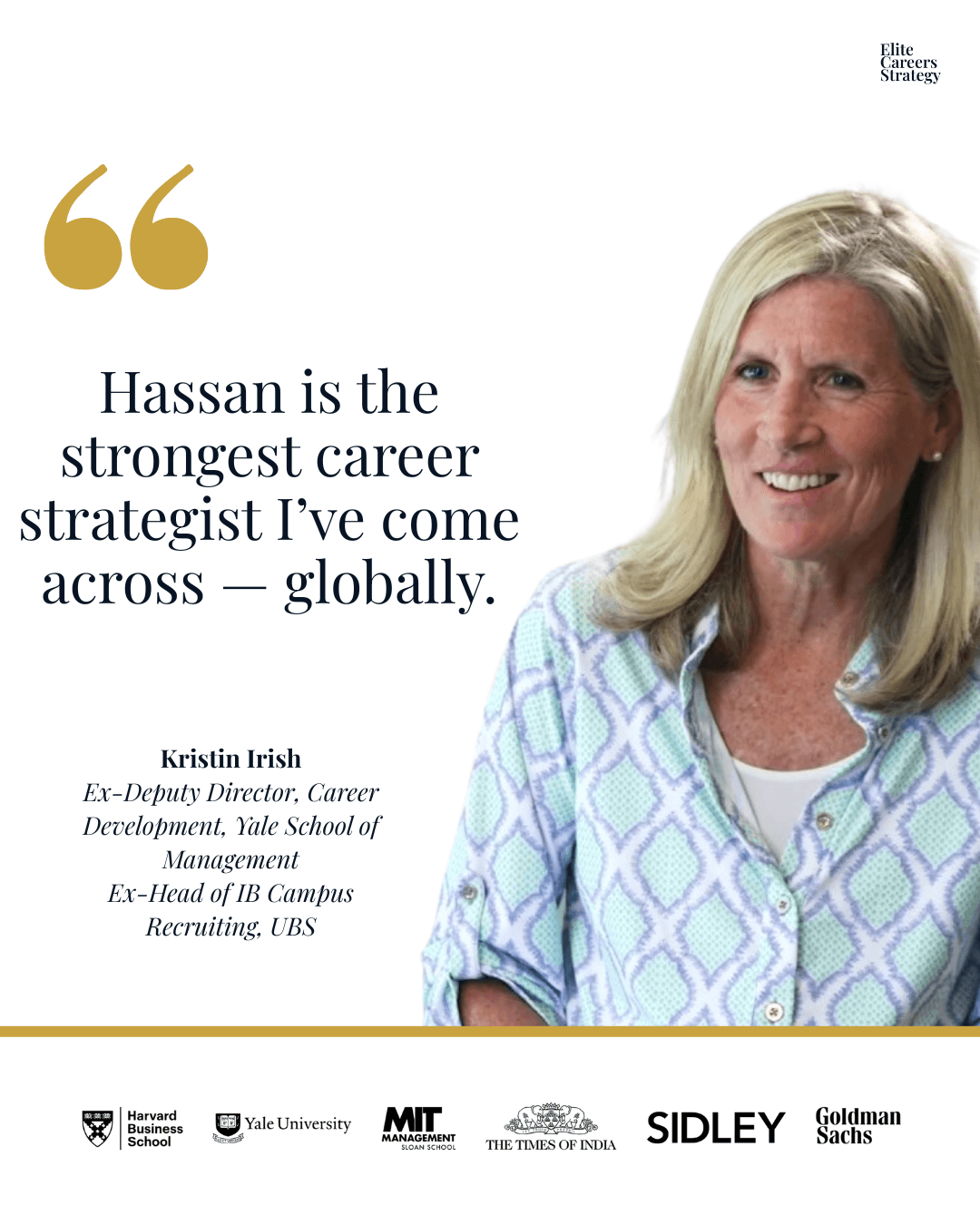
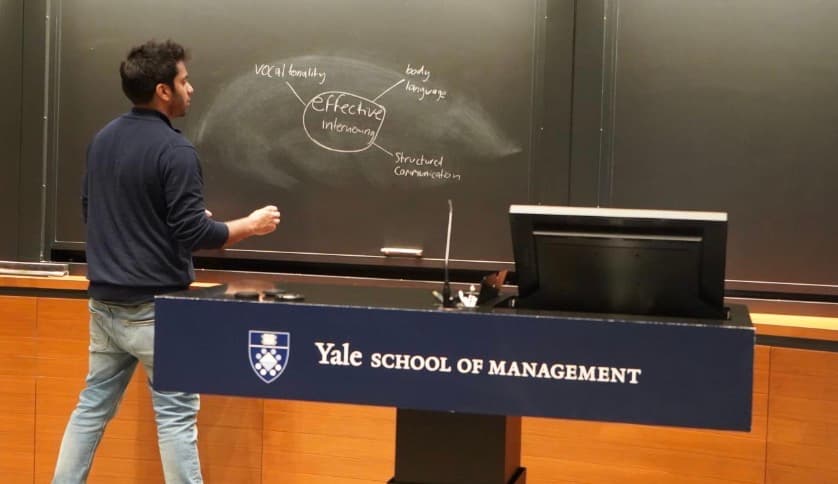
Hassan Akram is Founder and Principal Adviser at Elite Careers Strategy. Across recruitment work and ECS advisory, he has reviewed more than 10,000 applications and related candidate materials. He developed the six ECS frameworks referred to on this page: STAR-3®, PEAL-3®, PEAL-X®, VTMR™, BDC™ and Commercial Fluency™. He has led invited sessions for MBA student clubs at Yale School of Management, has written for The Times of India, and is a graduate of University College London. The observations on this page are ECS's own. They are not statements by KKR, and ECS is independent of KKR.