What an Assessment Centre is
An Assessment Centre is a multi-hour evaluation day at which a candidate is tested across several exercise formats, usually by several assessors. At many elite firms it is the final selection stage before an offer, sometimes combined with or followed by a partner interview. Everything before it (online application, tests, video interview) determines whether the candidate is invited.
The structural distinction matters. A single interview gives the candidate one chance, with one interviewer, in one format. An Assessment Centre sees the candidate across several formats and several assessors in the same day. ECS's reading is that the format exists to build a rounded picture, so a strong performance in one exercise is less likely to carry a weak one, and it compresses what might otherwise be several rounds into one day.
The format appears under different names: at Magic Circle and US law firm vacation scheme and training contract stages, as the bulge bracket Superday, and in some private equity early-insight final rounds. The details differ from firm to firm, but multiple components and multiple assessors in one day are common to most.
The structure of an Assessment Centre
A typical Assessment Centre runs four to six hours. Some firms compress it to a half day. Some extend it to a full day, occasionally with a dinner the evening before. The candidate moves through back-to-back components with short transitions. Different components are often run by different assessors, so by the end of the day a candidate may have been seen by several people across several formats. Firms do not publish how the components are combined into a decision.
The most common AC components, in roughly the order they tend to appear during the day, are these.
Partner one-on-one interview. Thirty to sixty minutes with a partner, head of recruitment, or senior associate. Competency questions, motivation questions, commercial questions, and at law firms a Why Law / Why This Firm sequence. At banks the same questions in commercial framing.
Group exercise. Four to eight candidates collaborate on a brief. The brief is usually a commercial or strategic scenario (a market entry decision, a deal recommendation, a budget allocation, a client priority ranking). Forty-five to sixty minutes, with assessors observing. In ECS's experience it is the component candidates are least prepared for.
Case study presentation. A written brief with data, financials, or facts. Thirty to ninety minutes of preparation time. Then a fifteen-to-thirty minute presentation to one or two assessors followed by Q and A. The case is often modelled on the kind of work the firm does (a transaction, a matter, a sector position).
Written exercise. Sometimes free-standing, sometimes built into the case study. A memo, an opinion, a recommendation, a client letter, a briefing note. Thirty to sixty minutes. It shows structure, clarity, prioritisation, and the candidate's instinct for what a busy senior reader needs.
Commercial scenario discussion. Either a stand-alone segment or built into the partner interview. The assessor presents a scenario (a deal, a market event, a regulatory change, a client problem) and asks the candidate to reason through it commercially in real time. Less about right answers and more about whether the candidate can think in commercial terms under pressure.
Social components. Lunch, coffee breaks, sometimes a dinner the night before. Framed as informal. ECS advises candidates to treat every interaction as part of the day: a candidate who is rude to a receptionist, sharp with another candidate or visibly transactional with junior staff risks losing ground that a strong case study may not recover.
ECS's advice follows from the format. A single component rarely wins or loses the day on its own, unless the candidate falls down badly in it, so preparation should aim for consistent strength across every component rather than brilliance in one.
Which firms run Assessment Centres
The Magic Circle firms use assessment centres or assessment-style days in their vacation scheme and training contract recruitment. Formats vary between firms and change between cycles: Clifford Chance's SPARK programme has its own variant, and Slaughter and May has used an open day plus interview structure rather than a formal AC. Candidates should check each firm's current process on its graduate recruitment site.
Several US firms in London, including Kirkland and Ellis, Latham and Watkins, White and Case, Cleary Gottlieb, Sidley Austin, Akin Gump and Ropes and Gray, use assessment-style days in their vacation scheme recruitment. In ECS's experience these tend to be shorter than the Magic Circle equivalents, often a half day, with smaller cohorts.
The bulge bracket investment banks call it a Superday but the structure is the same. Goldman Sachs, J.P. Morgan, Morgan Stanley, Citi, Bank of America, Barclays, Deutsche Bank, UBS, and HSBC all run Superday-format final rounds for Spring Week, Summer Analyst, and Full-Time Analyst offers. Several interviews back to back, sometimes a case, sometimes a group exercise, with decisions often following within days.
Some private equity firms with early-insight or analyst programmes, Blackstone among them, run assessment-style final rounds. In ECS's experience these tend to be tighter and faster than law-firm ACs, reflecting smaller intakes.
Other elite-firm categories (boutique investment banks, strategy consulting, hedge funds, MBB partner rounds) run AC-equivalent final days under different names. The ECS approach below applies to them too.
The six ECS frameworks at AC stage
ECS prepares candidates for Assessment Centres using the six frameworks Hassan Akram has developed. Each is designed for a specific AC component and is documented at its own framework page.
STAR-3® structures competency answers at the partner interview. Where many candidates default to a flat STAR (Situation, Task, Action, Result) that reads as recital, STAR-3 asks for three categorised actions (Technical Execution, Strategic Thinking, Leadership and Influence) and three categorised results (Goal Achievement, Personal Development, Social Proof), so one example shows several dimensions of the candidate. See our STAR-3 guide.
PEAL-3® structures Why Law and Why Sector answers when they reappear at AC stage. By the AC the candidate has answered Why Law or Why Banking on the application, the video interview, and a previous round of interviews. It often comes up again, and the candidate has to answer it without sounding stale. PEAL-3 holds the answer at a depth (Point, Evidence, Analysis, Link) that does not collapse on the fourth telling. See our PEAL-3 guide.
PEAL-X® structures Why This Firm and Why This Office answers. In ECS's experience, Why This Firm is one of the questions candidates most often answer weakly at AC stage. PEAL-X anchors the answer in firm-specific evidence (a deal, a practice, a sector position, a programme) that is accurate and checkable, then layers the candidate's own trajectory onto that anchor. See our PEAL-X guide.
VTMR™ supports the written exercise. VTMR (Verb, Task, Metric, Result) is ECS's written-application framework; at the AC its discipline of specific actions, measurable scope and stated results helps the candidate write a memo that is clear, specific and easy to act on. See our VTMR guide.
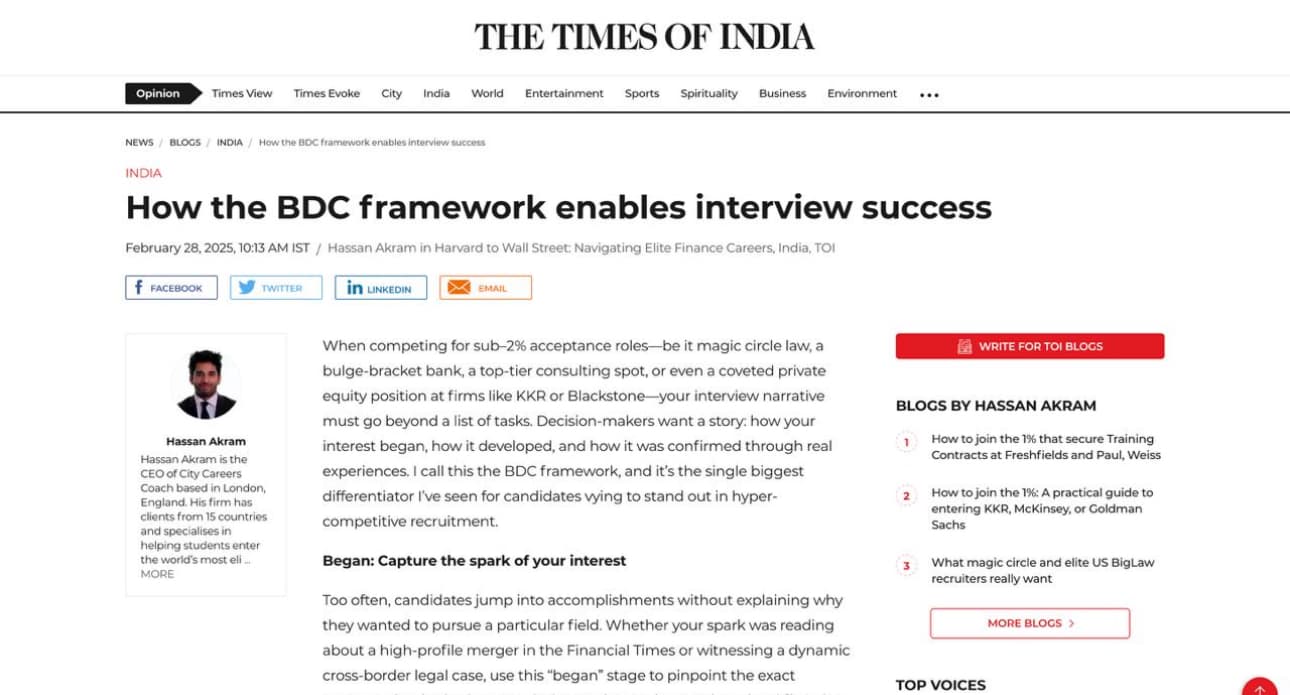
BDC™ structures the group exercise. Began, Developed, Confirmed: three contribution types used in sequence across the exercise, so that initiative, collaboration and leadership are each visible. Because the group exercise is the component candidates are least prepared for in ECS's experience, BDC is one of the most useful frameworks at this stage. See our BDC guide.
Commercial Fluency™ structures the commercial scenario discussion and the commercial reasoning in partner interviews. Four layers - what happened, why it happened, what it changes, and what it means for this firm - that the candidate moves through as the question is pushed deeper. See our Commercial Fluency guide.
The diagnostic at AC preparation stage identifies which component the candidate is most likely to struggle with, and which framework to practise against it. Not every candidate needs every framework deployed at the same depth. Some clients arrive with strong partner-interview instincts and a structural gap on the group exercise. Some arrive with strong written work and a structural gap on commercial reasoning. The first move at the diagnostic is to identify the gap. The rep work follows from there.
Documented AC outcomes
Some clients are anonymised, all evidence is on file.
Kalen Harrald. Clifford Chance SPARK 2026, AC passed and place secured. Free content only, no paid engagement. Kalen used STAR-3 for his work-experience competency stories and PEAL-X for his Why Clifford Chance answer in the run-up to the AC. Verbatim, Kalen wrote: "Thank you for all of your free content on LinkedIn and TikTok - it's meant I have gotten an AC for Clifford Chance's SPARK program. It has been so helpful using your frameworks - STAR-3 for work experiences, and PEAL-X for the Why CC question. It's been an absolute lifesaver."
Isnan Raiyean. Six documented law firm progressions in a single cycle, including assessment centre invitations at Watson Farley and Williams and Osborne Clarke. Isnan was a non-Russell Group candidate with BBC at A-level, and used ECS's free public frameworks; there was no paid engagement. These are progressions, which ECS records as progressions rather than offers.
Freshfields Training Contract compressed-sprint case. Anonymised. Paid engagement. A candidate with a strong academic record and specific gaps on the AC group exercise and on Why Freshfields. All six frameworks were used in a compressed sprint, including BDC for the group exercise and PEAL-X for firm-specific motivation. AC passed.
Further anonymised AC-stage outcomes and progressions across Magic Circle, US law firm, bulge bracket Superday and private equity final-round formats are on file. ECS has 106 documented outcomes and selection progressions across 53 candidate journeys. ECS's method is consistent: diagnose first, then practise specifically against the gap.
The group exercise specifically: BDC
In ECS's experience, the group exercise is the AC component candidates are least prepared for. The reason is straightforward. Every other AC component has a recognisable shape from earlier in the process. The partner interview is the previous interview round, scaled up. The case study is the written test, scaled up. The written exercise is the application essay, scaled up. The group exercise has no earlier equivalent, and many candidates first do one at the AC itself.
BDC™ is Hassan Akram's framework for assessment-centre group-exercise contribution. Began, Developed, Confirmed. It exists because many candidates approach group exercises with one of two default failure modes, and neither shows them well.
The first failure mode is dominating to be visible. The candidate has been told that visibility wins. They speak first, speak often, speak loudest. They override peers and convince themselves that volume equals impact. In ECS's experience this rarely reads well: volume crowds out the collaboration and judgement a group exercise is there to bring out.
The second failure mode is staying quiet to avoid risk. The candidate has been told that any wrong contribution will sink them. They wait for a safe entry point, build only on what is already agreed, contribute three times in forty-five minutes, all late, all low-stakes. That leaves little evidence of initiative or leadership.
BDC structures the full contribution arc across three role types deployed in sequence. Began moments, where the candidate opens a thread the group does not have yet. Proposes a frame, invites challenge, takes thirty to sixty seconds to land the structure. Developed moments, where the candidate builds explicitly on a peer's contribution. Cites the peer by name, adds the next layer, makes the build visible to the assessor. Confirmed moments, where the candidate consolidates the position the group has reached. Summarises, names the open question, proposes the next step. Three role types, used several times across the exercise, in a deliberate sequence. The full framework and the sequence are documented at the BDC guide.
Common AC failure modes
In ECS's experience, candidates who do well at written-application stage but fall short at the Assessment Centre usually do so in one of four ways.
Collapsing under pressure at partner interview. The candidate had strong answers in earlier rounds. At the AC, sitting across from a partner who is visibly senior and visibly time-pressured, the candidate's structure collapses. Answers run long, the through-line is lost, the partner cuts in to move on. The fix is repeated rep against STAR-3 and PEAL-3 / PEAL-X at partner-grade interview pressure, not against polite low-stakes pressure.
Group exercise failure modes. Either over-contribution in monologue or under-contribution in silence. Neither shows the candidate well. The fix is BDC, practised live in a simulated group of peers of similar calibre.
Case study answers that recite facts without commercial reasoning. The candidate reads the brief, identifies the facts and presents them back. What is missing is the commercial reasoning on top. The fix is Commercial Fluency, practised against scenario discussion until the four-layer move is automatic.
Why This Firm answers that could be sent to any firm in the sector. The candidate's Why Firm answer at AC stage is the answer they sent on the application six weeks earlier, unchanged. It adds nothing to what the firm has already read. The fix is PEAL-X re-anchored on firm-specific evidence the candidate has gathered between application and AC.
The diagnostic at AC preparation stage is to identify which of the four the candidate is most likely to fail before the AC happens, then rep specifically against it. Generic "AC preparation" that drills every component at the same intensity wastes the candidate's preparation time on components they are already strong at and under-invests in the component most likely to cost them. The diagnostic moves first.
Working with ECS on Assessment Centre preparation
Hassan Akram is the Founder and Principal Adviser of ECS and the author of the frameworks used at AC stage (STAR-3®, PEAL-3®, PEAL-X®, VTMR™, BDC™, Commercial Fluency™). Across recruitment work and ECS advisory, he has reviewed more than 10,000 applications and related candidate materials.
Every ECS engagement at AC stage starts with a diagnostic. The diagnostic identifies which AC component the candidate is most likely to struggle with, which framework to use against it, and how much practice is needed before AC day. The rep work that follows is custom-built against the specific firm's AC format. A Clifford Chance SPARK AC is not the same exercise as a Kirkland Vacation Scheme AC, and the preparation is not interchangeable.
Some clients are anonymised; evidence is held on file. The cases on this page (Kalen Harrald, Isnan Raiyean and the Freshfields Training Contract compressed-sprint candidate) are documented examples of candidates using the ECS frameworks at AC stage. Results are candidate-specific and not guaranteed.