Elite Careers Strategy
←  All Firms

Campbell Lutyens: Application, Secondaries Advisory, and Analyst Recruitment


Campbell Lutyens is one of the most respected specialist private equity advisory franchises in the world and sits at the elite-entry level as a distinct proposition from the generalist investment bank or the closed-end private equity mega-fund. Founded in London in 1988, the firm is a specialist private capital advisory house with a global footprint across London, New York, Hong Kong, Singapore, Munich, Paris, Los Angeles, and Charlotte, and it operates across two principal practices at the elite-entry level: a Secondary Advisory practice that is widely regarded as one of the strongest secondaries franchises globally, and a Primary Capital Advisory practice (fund placement) of equivalent depth. The firm advises general partners and limited partners on the structuring and execution of fund-level liquidity transactions, on continuation fund and GP-led recapitalisation processes, on LP-led portfolio sales, and on primary fund raises across private equity, infrastructure, and private credit. The Campbell Lutyens proposition for an undergraduate or lateral candidate is structurally different from a bulge bracket investment bank, from a closed-end private equity buy-side seat, or from a generalist boutique. The team is small. The technical depth on secondaries transaction structures is uncommon. The mandate flow is relationship-mediated at the partner level. And the firm sits at a junction of private equity, advisory, and capital formation that very few employers occupy at the same depth. At the elite-entry level Campbell Lutyens is a Tier-3 specialist advisory employer with a London-anchored recruitment pattern, a high bar on commercial judgement and secondaries-specific technical fluency, and an application surface that rewards candidates who can articulate the specialist secondaries thesis rather than recite generic private equity vocabulary. Hassan Akram, Founder and Principal Advisor at Elite Careers Strategy, has reviewed over 10,000 applications from the hiring side across investment banking, private equity, consulting, and law, and has placed a candidate into Campbell Lutyens. The outcome anchors the specialist private capital advisory pathway in the ECS topical fortress. This page sets out the application pathways at Campbell Lutyens, the assessment architecture, the six frameworks ECS deploys for Campbell Lutyens candidates, and the documented outcome that anchors the methodology.

The application pathways at Campbell Lutyens

There are three live pathways into Campbell Lutyens at the elite-entry level. Each has its own timeline, its own competitive density, and its own selection logic. Recruitment at Campbell Lutyens is markedly more relationship-driven than at the bulge bracket banks. The team is smaller, the partner group runs a tighter selection filter, and the firm does not run the high-volume, heavily standardised cycle that defines Goldman Sachs, JP Morgan, or Morgan Stanley undergraduate recruitment. That has two consequences for an elite-entry candidate. First, the on-cycle window is less predictable and a candidate cannot rely on a recruiter-pushed timeline to drive the application. Second, the proof point of having met a Campbell Lutyens professional, having understood the secondaries practice in depth, and having a defensible Why Campbell Lutyens answer matters more in the selection logic than at a generalist IB or PE mega-fund.

Direct undergraduate entry via the Analyst programme

The Analyst programme is the canonical undergraduate entry point. It is targeted at final-year UK and European undergraduates who can demonstrate quantitative depth, commercial judgement, and a defensible understanding of why specialist private capital advisory differs from generalist investment banking. Class sizes are small. Competition per seat is dense. The bar on technical fluency at the Analyst stage is calibrated to the firm's transaction profile: a candidate who arrives at interview without a working understanding of how a continuation fund is structured, what a strip sale is, how an LP-led secondary transaction is priced, or how a GP-led recapitalisation is staged will not progress past the early rounds. Direct undergraduate entry is the highest-leverage path for a candidate who is committed to specialist advisory and who can build the technical surface at undergraduate stage to compete against lateral candidates with one or two years of bulge bracket experience.

Lateral from generalist investment banking

Lateral entry from a generalist investment bank is the second pathway. It is taken by Analysts and Associates from bulge bracket M&A or Financial Sponsors Group teams, and from elite boutiques with strong sponsors coverage, typically twelve to twenty-four months into the IB Analyst stint. The lateral move at Campbell Lutyens is competitive against direct-undergraduate Analysts already inside the firm, and the bar on the lateral application surface is correspondingly high. A candidate moving from generalist M&A or sponsors coverage into Campbell Lutyens is expected to articulate why secondaries advisory is a more compelling long-term seat than continuing into a generalist sponsors role or moving directly to a closed-end buy-side fund. The Why Campbell Lutyens answer at lateral stage is the question that separates the candidate who has researched the firm from the candidate who has internalised what specialist secondaries advisory does that no generalist bank replicates.

Lateral from a private equity fund-level role

The third pathway is the lateral move from a private equity fund-level seat into Campbell Lutyens at Associate or Vice President level. It is the rarer of the three pathways and is typically driven by a candidate's deliberate choice to move from a direct-investment seat into the advisory side of the secondaries market. The move is relationship-mediated and the partner introduction is load-bearing. Candidates considering this path are typically two to four years into a closed-end PE fund, with deal exposure on either the buy or sell side of a portfolio company sale, and the move into Campbell Lutyens is engineered as a long-horizon transition into the specialist advisory franchise.

The application process structure

The Campbell Lutyens application process has a consistent architecture across pathways, calibrated up or down on technical depth depending on stage.

The online form asks two substantive written questions: Why PE secondaries, and Why Campbell Lutyens. Both are short. Neither can be answered well by a candidate who has not done practice-level and transaction-level research. The Why PE secondaries question screens for the candidate's understanding of the secondaries market as a distinct sub-asset class with its own pricing logic, its own liquidity drivers, and its own transaction architecture. A candidate who treats secondaries as an extension of generic private equity will not progress. The Why Campbell Lutyens question screens for the candidate's understanding of what differentiates Campbell Lutyens from the other secondaries advisory franchises in the market. The form is the first selection filter and the highest-leverage written surface in the entire process.

Online assessments follow. The assessment battery at Campbell Lutyens is less standardised than at the bulge bracket banks. The firm runs firm-specific assessments calibrated to the practice profile rather than the generic SHL or HireVue battery deployed across volume IB recruitment. The bar on the numerical and commercial reasoning components is high.

Multi-stage interviews are then deployed. These run across phone, video, and in-person rounds depending on stage, and test Why PE secondaries, Why Campbell Lutyens, competency depth, commercial judgement, and technical fluency on secondaries transaction structures. The interview architecture at Campbell Lutyens rewards candidates who can sustain a defensible view on a secondaries transaction under partner-level push-back. A candidate who folds on their thesis at the first probing question will not progress past the second round.

A modelling component is deployed at the higher stages. The modelling test at Campbell Lutyens typically involves a case-based exercise on a secondaries transaction structure: continuation fund pricing, LP portfolio valuation, GP-led recapitalisation mechanics, or a structured-secondary returns analysis. The modelling expectation is markedly more specialist than the generic LBO test deployed at most buy-side processes. Candidates preparing without a working understanding of secondaries transaction architecture will not pass the modelling stage.

The final stage at Campbell Lutyens is the partner round. Given the relative size of the partner group and the practice, the partner final round carries unusual weight in the selection logic. Candidates are assessed not only on technical accuracy but on judgement, ownership, the ability to defend an investment view without rigidity, and the cultural fit signal that a small specialist franchise screens for at the closing stage of any process.

The six frameworks deployed at Campbell Lutyens

Elite Careers Strategy deploys six proprietary frameworks across Campbell Lutyens engagements, authored by Hassan Akram from the 10,000-application hiring-side dataset.

STAR-3(R) is the competency architecture deployed across the interview stages. It rebuilds candidate stories into the situation, task, action, result structure with three calibrated layers: the surface story, the second-order reflection on what was learned, and the third-order articulation of how the candidate would now operate differently. Campbell Lutyens partner interviews probe at the third layer, and STAR-3(R) is the framework that gets candidates ready for that depth.

PEAL-3(TM) is the Why PE secondaries narrative framework. It moves candidates from generic "I am interested in private equity because it combines analytical rigour with strategic thinking" answers to a sequenced, evidence-anchored narrative built on Premise, Evidence, Application, and Linkage, repeated across three layers of specificity. At Campbell Lutyens, the Why PE secondaries answer is one of the two highest-weighted screens on the application form and the first technical filter at interview, and PEAL-3(TM) is the framework that builds the answer at the depth the partner group expects.

PEAL-X(TM) is the highest-stakes Why Firm framework, anchored at Campbell Lutyens on the firm-specific secondaries advisory practice, the named partner group, the firm's transaction record on continuation funds, on LP-led secondaries, and on GP-led recapitalisations, and the firm's positioning as one of the leading independent secondaries advisory franchises globally. Why Campbell Lutyens is the question that distinguishes the candidate who has read the website from the candidate who has internalised what a specialist private capital advisory firm with one of the deepest secondaries franchises in the market does differently from a generalist bank, from a closed-end fund, or from a competing advisory shop. PEAL-X(TM) anchors the answer on the specific practice architecture, on the named live transaction types Campbell Lutyens runs, on the partner-led mandate flow, and on the specialist secondaries thesis that no generalist employer occupies in the same form. This is the framework that takes a strong candidate and makes them a Campbell Lutyens candidate.

VTMR(TM) is the CV architecture framework. Campbell Lutyens screens CVs for evidence of judgement, ownership, and quantitative rigour at first-year-analyst depth. VTMR(TM) rebuilds each line of the CV around Verb, Target, Mechanism, and Result, with every bullet engineered to demonstrate one of those screens. Generic society-officer lines and unattributed group-project bullets are stripped out and replaced with quantified, owned, defensible artefacts that hold up against partner-level CV scrutiny.

BDC(TM) is the group exercise and group-setting framework. Where Campbell Lutyens deploys group components within the interview architecture, BDC(TM) (Blackstone Decision Cadence, generalised across buy-side and advisory group settings) trains candidates to operate with the right balance of contribution, listening, and leadership. The two failure modes at specialist advisory group exercises are silence and dominance, and BDC(TM) is the framework that calibrates a candidate to neither.

Commercial Fluency(TM) is the investment thesis layer that sits underneath every interview answer, and it is particularly load-bearing at Campbell Lutyens. The firm screens at every stage for a candidate's ability to articulate a secondaries thesis with the depth of a working professional: how a continuation fund is structured and priced, what drives LP-led portfolio discounts and premiums, how a GP-led recapitalisation creates value for the GP, the LPs, and the secondary buyer, what the difference is between a single-asset and a multi-asset continuation vehicle, how the secondaries market has compounded as a share of total private equity AUM over the last decade, and where the next wave of secondaries volume is expected to come from. Commercial Fluency(TM) at Campbell Lutyens covers thesis articulation, value-creation framing on a secondaries transaction, downside framing, exit logic, and the language of LP returns in the context of a secondaries vehicle. A candidate who can articulate the secondaries thesis at that depth sounds like a Campbell Lutyens professional. Every other framework is sharper when Commercial Fluency(TM) is deployed in parallel.

Documented outcomes at Campbell Lutyens

A documented Campbell Lutyens outcome sits on file in the ECS canon. The outcome is anonymised at the candidate's election and is not named on any public-facing surface. It anchors the specialist private equity secondaries pathway in the ECS topical fortress. The deployment record (frameworks deployed, timeline, stage of intervention) is available on request in proposal contexts where the proof match is load-bearing for an inbound candidate considering Campbell Lutyens or a directly comparable specialist secondaries advisory franchise.

Additional anonymised outcomes at specialist private equity advisory firms sit alongside the Campbell Lutyens outcome in the ECS canon, including documented outcomes at Park Hill, at the Houlihan Lokey PE Advisory practice (including its secondaries franchise), and at other specialist private capital advisory firms in the London and New York markets. The Campbell Lutyens outcome is referenced in proposal proof matches and in the proof stack, attributed to "an ECS candidate" with the full deployment record available on request.

The anonymity rule is a function of client preference, not of outcome strength. Where a candidate has elected to remain unnamed, the outcome is recorded in the canon, referenced in inbound proposal proof matches, and never named on a public surface without written consent.

Cross-links

Sector hubs

The Campbell Lutyens page sits within two sector hubs in the topical fortress. Most candidates land on Campbell Lutyens via the private equity hub: /private-equity is the canonical entry for candidates whose primary objective is the buy-side or the specialist advisory side of the private capital market. A material share of Campbell Lutyens lateral hires arrive via the IB-to-PE lateral pathway from bulge bracket or elite boutique investment banks; /investment-banking is the canonical entry for those candidates and the cross-link between the two hubs is load-bearing for the Campbell Lutyens trajectory. Most Campbell Lutyens lateral candidates pass through generalist investment banking before reaching the firm, either as a Summer Internship that becomes a Summer Analyst before the lateral move, or as a one to two year Analyst stint at a bulge bracket or elite boutique before an Associate process at Campbell Lutyens.

Framework hubs

Each of the six frameworks deployed at Campbell Lutyens has its own framework hub: STAR-3(R), PEAL-3(TM), PEAL-X(TM), VTMR(TM), BDC(TM), and Commercial Fluency(TM). The hubs explain the framework in full and link back to firm-specific deployments including Campbell Lutyens. Commercial Fluency(TM) is the framework hub most closely tied to the Campbell Lutyens deployment, given the load-bearing role the secondaries thesis plays in the firm's interview architecture.

Stage pages

The Campbell Lutyens trajectory crosses three canonical stage pages: the undergraduate Analyst stage (direct entry from final-year undergraduate), the lateral stage (relationship-mediated and process-driven movement from generalist IB into specialist advisory), and the Associate stage (the second-tier entry point for candidates moving from a PE fund-level role into Campbell Lutyens advisory).

Archetype pages

Two candidate archetypes are over-indexed in the Campbell Lutyens candidate pool: the IB-to-PE transition archetype (the bulge bracket Analyst running a lateral process into specialist secondaries advisory and weighing it against a closed-end buy-side seat) and the non-target candidate (the academic-profile-gap candidate building a buy-side application from a non-Oxbridge base, where the specialist advisory franchises represent one of the most viable buy-side-adjacent entry points). The IB-to-PE transition archetype page is the most directly relevant cross-link from Campbell Lutyens.

Related firm pages

Campbell Lutyens is most directly cross-referenced with the other Tier-3 private equity firm pages in the topical fortress, including 3i, Blackstone, and KKR, as the buy-side and buy-side-adjacent franchises that share a candidate pool and a proof stack. It is also cross-referenced with the bulge bracket investment bank pages (Goldman Sachs, JP Morgan, Morgan Stanley, Rothschild) as the canonical lateral source for Associate-stage entry into the firm.

Author entity

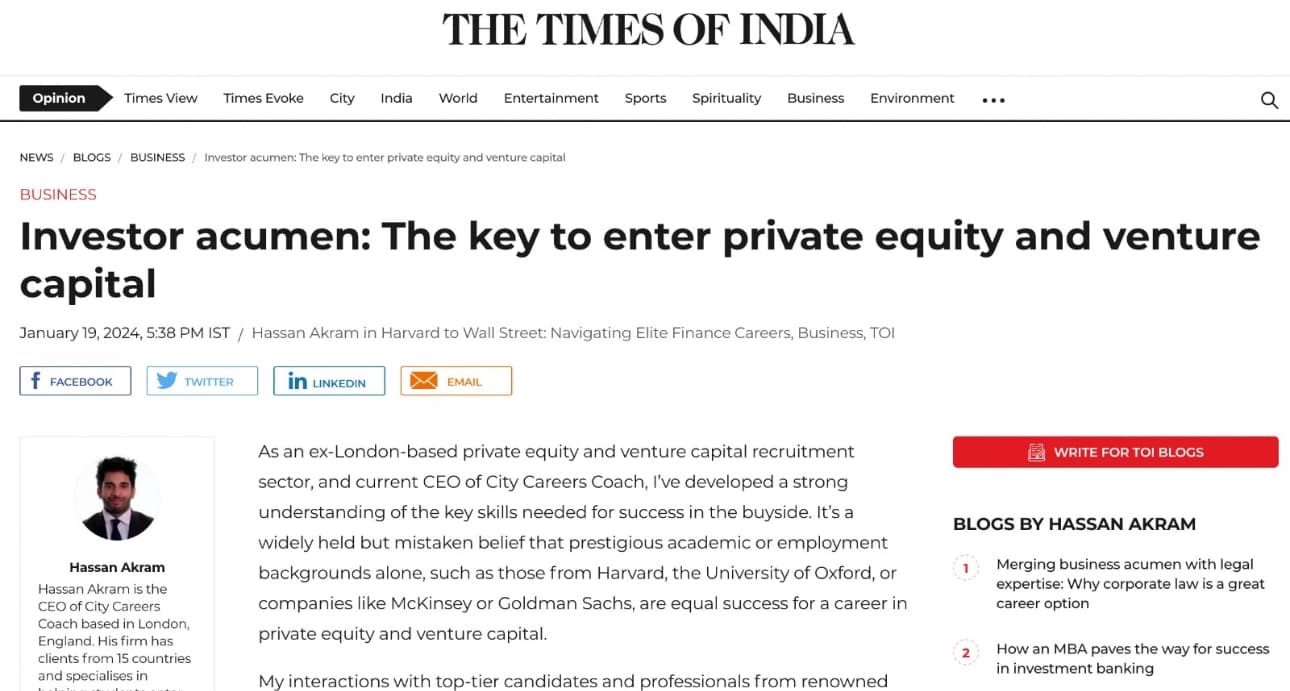
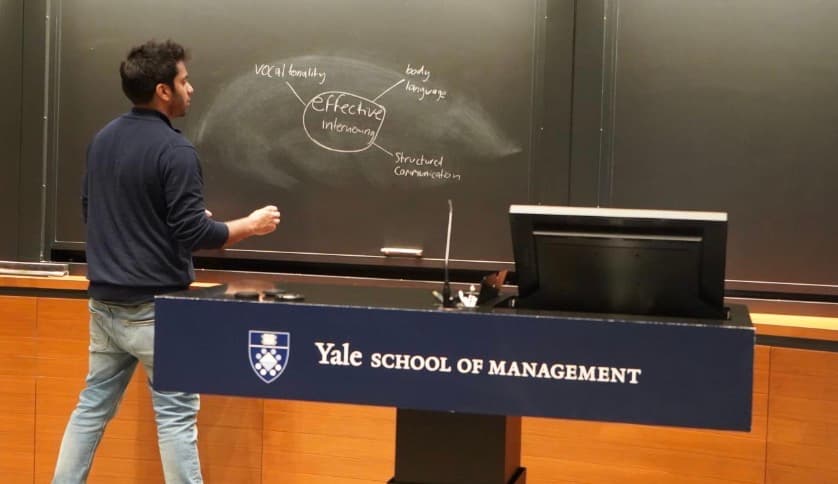
Hassan Akram, Founder and Principal Advisor at Elite Careers Strategy, is the author of every framework deployed on this page. 10,000+ hiring-side application reviews. Yale School of Management podium speaker. Times of India columnist. UCL graduate. The author entity page at /author/hassan-akram anchors every Tier-3 firm page in the topical fortress, including this one.

Press

Times of India columns by Hassan Akram
Times of India column by Hassan Akram: Investor acumen is the key to enter PE and VC (Jan 2024)
Investor acumen is the key to enter private equity and venture capital

Authored columns. Mastheads, headlines, and bylines reproduced uncropped.

Kristin Irish, former Head of IB Campus Recruiting at UBS Investment Bank New York
"The strongest career strategist I have encountered - anywhere in the world."

Kristin Irish, Former Head of IB Campus Recruiting, UBS Investment Bank New York | Former Deputy Director of Career Development, Yale School of Management.