Elite Careers Strategy
←  All Firms

Perkins Coie Summer Associate Programme and Training Contract: The ECS Canonical Guide


1. Perkins Coie at the elite-entry level

Perkins Coie LLP is a US elite law firm with a distinctively West Coast centre of gravity, a deep technology and intellectual property franchise, and a structural alignment to the venture-backed company economy that no other firm on the canonical US elite list matches in the same way. The firm is unambiguously US-focused. Its largest offices sit in Seattle, Chicago, Washington DC, and the Bay Area, with material presence in Los Angeles, Denver, and New York, and a London office that operates as a strategic outpost servicing cross-border technology, IP, and emerging companies work rather than competing head-to-head with the Magic Circle. Where Kirkland and Ellis is the canonical private equity and high-end restructuring firm, where Latham and Watkins operates as one of the largest US-elite full-service global platforms, and where Cleary Gottlieb anchors on sovereign and cross-border M&A, Perkins Coie occupies a position defined by the depth and concentration of its technology and IP franchise, the strength of its emerging companies and venture capital practice, the breadth of its regulatory engine across privacy and political law, and an M&A practice servicing the technology sector and broader corporate market across the firm's footprint.

The firm's technology and IP practice is one of the most heavily resourced in the United States, anchored on a long-running structural relationship with the technology economy of the Pacific Northwest and the Bay Area. It acts on patent prosecution, patent litigation, trademark, copyright, trade secrets, and the full technology transactions perimeter for some of the largest technology companies and most active venture-backed companies in the market. The emerging companies and venture capital practice advises start-ups, founders, and venture funds across the financing lifecycle from formation through Series financings, secondary transactions, and exit. The privacy and security practice is market-leading in the US. The political law practice is one of the most concentrated in the country. Litigation supports the IP, regulatory, and transactional engines.

For Elite Careers Strategy clients, Perkins Coie is the canonical case study for the non-target UK candidate targeting a US firm. The named outcome documented on this page demonstrates the framework deployment pattern that converts a candidate sitting outside the Oxbridge, UCL, LSE, KCL pipeline into a US firm offer using free content only. Hassan Akram, Founder and Principal Advisor at Elite Careers Strategy, has reviewed more than 10,000 applications, vacation scheme files, written exercises, Summer Associate evaluations, and interview transcripts across the US elite, the Magic Circle, the Silver Circle, the City top tier, and the major US Summer Associate programmes. Everything below is calibrated to what actually moves a candidate from longlist to a Perkins Coie offer.

2. Application pathways

Summer Associate programme (US). The dominant route into Perkins Coie's US partnership track and the primary entry route for 2L JD candidates. The programme is anchored on the 2L summer and runs across the firm's US offices, with Seattle, Chicago, and the Bay Area as the largest cohorts and Washington DC, Los Angeles, Denver, and New York as additional offices in the rotation. A smaller 1L Summer Associate cohort runs on a separate track. Conversion from Summer Associate to full-time offer is high, reflecting the firm's preference for hiring the partnership track from its own summer cohort. The Summer Associate is assigned to live deal teams across technology transactions, IP, emerging companies, M&A, privacy, and the regulatory groups, and is evaluated continuously against the full-time hire standard.

Direct Training Contract route (non-US markets where applicable). Perkins Coie's London presence is structurally smaller than its US offices and the firm operates a direct application route for candidates targeting the London office. Volumes are smaller than the US Summer Associate cohort and the substantive bar is not reduced. The non-US route is the canonical pathway for the international candidate targeting the firm without going through the US JD funnel, and it is the route the named outcome on this page travelled.

Lateral. Perkins Coie hires laterally at the associate and partner level across its US offices, with particular weight on lateral hires into the technology, IP, emerging companies, privacy, and M&A practices. Not the focus of this guide but a relevant secondary pathway for candidates with prior elite firm experience.

3. Application process

Perkins Coie's funnel is shorter than the Magic Circle process but the substantive bar at each stage is materially higher. The US and non-US processes are structurally different and the candidate must understand both to position correctly.

US Summer Associate process. Stage one is on-campus interview, the canonical OCI funnel running through participating US law schools during the late-summer and early-autumn screening window. Perkins Coie uses the screening interview to assess motivation, articulation, structured reasoning, and the candidate's specific engagement with the firm's practice mix, with particular emphasis on articulated interest in technology, IP, emerging companies, or privacy practices where relevant. Candidates who clear the screening are invited to stage two, the callback interview at the firm office, typically Seattle, Chicago, or the Bay Area. The callback is a multi-interviewer round structured around partner and senior associate interviews combining competency probes, commercial and practice-specific reasoning, and intellectual culture-fit assessment. Stage three is the Summer Associate offer, made on the basis of the callback evaluation file. The programme then runs across the 2L summer as the substantive assessment window for the full-time offer.

Non-US application process. Stage one is the online application form, covering the canonical elite-entry questions: why law, why a US firm rather than a Magic Circle, Silver Circle, or City top tier alternative, why Perkins Coie specifically (with the answer expected to demonstrate genuine engagement with the firm's technology, IP, emerging companies, and West Coast venture-backed company positioning rather than generic recitation), a work experience competency question, and a commercial awareness prompt testing the candidate's ability to think about a transaction, technology market dynamic, or regulatory event in terms of capital structure, deal motivation, and regulatory perimeter. Stage two is the video interview, used to test motivation, commercial reasoning, and structure under time pressure. Stage three is the partner interview, the substantive assessment moment in which the candidate's articulation of the Perkins Coie model, practice-specific reasoning, and cultural fit signals are tested in a multi-interviewer panel format. Stage four is the offer.

4. The six frameworks deployed at Perkins Coie

Every Elite Careers Strategy engagement deploys six proprietary frameworks built by Hassan Akram from the 10,000-plus hiring-side review base. Each framework is calibrated firm-by-firm. Below is how the six are deployed specifically at Perkins Coie.

STAR-3(R). The reviewer-grade competency architecture for the work experience and competency questions on the Perkins Coie non-US application form, the OCI screening competency probes in the US, and the partner interview competency moments across both jurisdictions. STAR-3(R) replaces the generic Situation-Task-Action-Result spine with a three-layer structure that surfaces decision-making under constraint, the candidate's specific contribution against a counterfactual, and a reflective layer demonstrating calibration. At Perkins Coie, the reviewer is looking for evidence the candidate operates effectively across technology, IP-driven, and emerging-company work where the work product moves fast, the client is often a founder or in-house counsel rather than a sophisticated transactional principal, and judgement without supervision is the operating norm. STAR-3(R) produces answers the reviewer reads as senior-coded rather than junior-coded.

PEAL-3(TM). The commercial-question architecture used for Why Perkins Coie, Why US firm, and the commercial scenario prompts in both the non-US application form and the US OCI screening interview. PEAL-3(TM) layers Position, Evidence, Analysis, and Linkage in a sequence that forces the candidate to take a defensible commercial view rather than recite firm facts. At Perkins Coie, the Why Perkins Coie answer must engage directly with the firm's West Coast technology and venture-backed company positioning, its market-leading technology and IP franchise, the emerging companies and venture capital practice, the privacy and political law specialisations, and the structural fact that the firm's competitive advantage is the depth and concentration of its technology and IP capability rather than a generic full-service offering.

PEAL-X(TM). The advanced commercial architecture used for callback interviews in the US, partner interviews in the non-US route, and the live deal conversations a Summer Associate is drawn into through the US programme. PEAL-X(TM) at Perkins Coie is anchored on the firm's specific technology and IP focus, the named partners associated with the relevant work where those partners are publicly attributed in deal announcements and chambers commentary, and the firm's West Coast and venture-backed company positioning. The candidate must discuss Perkins Coie's role on representative technology transactions, IP litigation matters, emerging company financings, and privacy or political law engagements, position those engagements inside the firm's broader practice architecture, articulate why the combination of technology and IP depth, emerging companies and venture capital scale, privacy and political law specialisation, and West Coast geographic concentration produces a structural advantage relative to Latham, Cooley, Wilson Sonsini, Fenwick, and the broader US elite alternatives, and demonstrate the commercial sophistication to discuss venture financing mechanics and the regulatory perimeter at the level of a junior associate on the matter.

VTMR(TM). The Verbal Thinking and Motivation Review framework. Used through the engagement to drill the candidate's verbal delivery, motivation narrative coherence, and the ability to think aloud under partner pressure without losing structure. At Perkins Coie, the callback interview in the US specifically tests for the candidate's ability to hold a commercial position under partner challenge, then re-evaluate it visibly and credibly when new information is introduced. The same competency is tested through the non-US partner interview and across the Summer Associate programme through the live deal conversations a 2L is drawn into. VTMR(TM) is the conditioning protocol for those moments.

BDC(TM). The Behavioural Diagnostic and Calibration framework. Used to baseline the candidate at the start of the engagement across the dimensions the Perkins Coie callback panel, the non-US partner panel, and the Summer Associate evaluators weight: intellectual independence, commercial sophistication, composure under continuous workload, calibration, and culture-fit signals. BDC(TM) outputs a per-dimension scorecard that drives the framework deployment sequence for the rest of the engagement.

Commercial Fluency(TM). The flagship architecture and the framework Perkins Coie weights heavily, given the firm's depth across technology transactions, IP, emerging companies, M&A, and the regulatory perimeter. Commercial Fluency(TM) is the systematic build of the candidate's ability to think about technology transactions, IP strategy, venture financings, M&A structure, and the regulatory perimeter with the same vocabulary, granularity, and reasoning patterns a Perkins Coie partner would use in an internal matter discussion. The methodology covers technology transaction mechanics across licensing and technology M&A, IP strategy across patent prosecution, patent litigation, and the trade secret and trademark frameworks, venture financing mechanics across Series financings, convertible instruments, and secondary transactions, M&A structure across strategic and sponsor-led transactions, and the regulatory perimeter across privacy and political law. The candidate who can hold a thirty-minute callback or partner conversation across two or three of those practice domains with the right vocabulary and structural instincts is the candidate who converts.

5. Documented outcomes at Perkins Coie

ECS has documented outcomes at Perkins Coie across multiple engagement cycles. Some clients are named with explicit consent. Others are anonymised, all evidence is on file.

Haniel Nduka (named and approved). Warwick University to Perkins Coie via free ECS content. Named and approved for use. Haniel Nduka is a Warwick University candidate who used free ECS content authored by Hassan Akram to convert from a non-target UK undergraduate position into a Perkins Coie outcome. This case is the canonical demonstration of the framework deployment pattern for a non-target UK candidate targeting a US firm. The outcome was achieved through the deployment of the six ECS frameworks against the free-content version of the methodology, without a paid engagement. The structural significance is twofold. First, Warwick University sits outside the canonical Oxbridge, UCL, LSE, KCL pipeline that the London market filters on, and outside the canonical T14 pipeline the US market filters on. The candidate cleared a US firm offer from a non-target position on both axes. Second, the conversion was driven by free content rather than a paid build, which demonstrates the framework architecture is the active mechanism, not the engagement format.

Additional anonymised Perkins Coie outcomes on file. ECS has further documented Perkins Coie outcomes across paid engagements. Where the candidate has elected to remain anonymous, the outcome is held on file with full evidence trail including application drafts, interview prep records, and offer confirmation. Anonymity is preserved at the candidate's election.

Anonymity statement. Some clients are anonymised, all evidence is on file. Where a named client has elected to be public, their case is published with full quote, photograph where consented, and outcome documentation. Where a client has elected anonymity, the case is held on file and referenced in aggregate. ECS does not publish named outcomes without explicit consent.

6. Cross-links

Sector hub. This page sits inside the corporate law sector. The canonical sector hub is at /corporate-law, which covers the full landscape of US elite, Magic Circle, Silver Circle, and City top tier firms and the ECS methodology for entering them.

Framework hubs. Each of the six frameworks deployed in this guide has a dedicated canonical page.

  • STAR-3(R): the reviewer-grade competency architecture.
  • PEAL-3(TM): the commercial-question architecture.
  • PEAL-X(TM): the advanced commercial and partner-interview architecture.
  • VTMR(TM): the verbal thinking and motivation review framework.
  • BDC(TM): the behavioural diagnostic and calibration framework.
  • Commercial Fluency(TM): the flagship transactional and commercial reasoning architecture.

Stage pages. Forward links to the canonical stage pages for the relevant gates in the Perkins Coie funnel.

Archetype pages. Forward links to the candidate archetype pages most relevant to the Perkins Coie funnel. The Haniel Nduka outcome documented above sits in the non-target candidate archetype, which is the canonical match for candidates sitting outside the Oxbridge, UCL, LSE, KCL pipeline in the London market and outside the canonical T14 pipeline in the US market. The international candidate archetype is also a relevant cross-link for the UK-to-US crossover.

  • Non-Target Candidate: primary archetype for the Haniel Nduka outcome and the canonical fit for the Perkins Coie non-target UK to US crossover pattern.
  • International Candidate: for candidates applying from non-UK undergraduate or graduate contexts, and the structural archetype for the UK-to-US crossover into a US firm.

Author. Hassan Akram: full author entity page covering credential stack, methodology authorship, and review base.

7. About the author

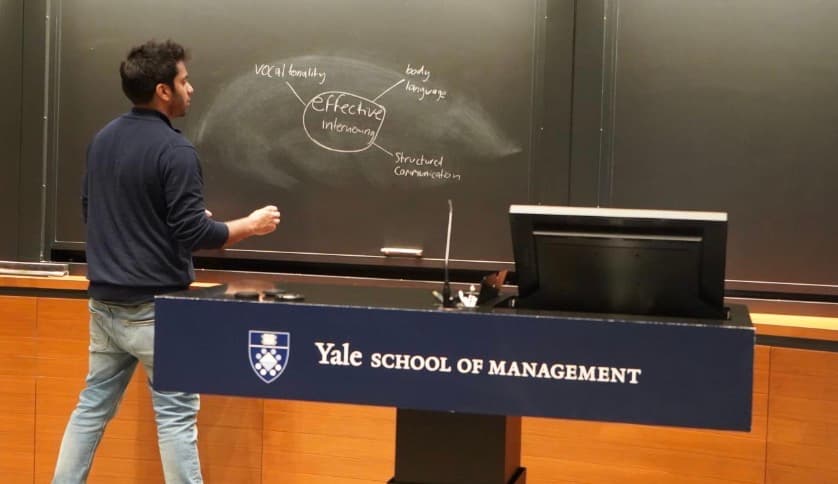
Hassan Akram is Founder and Principal Advisor at Elite Careers Strategy. He has reviewed more than 10,000 applications, vacation scheme files, written exercises, summer associate evaluations, and interview transcripts on the hiring side of the elite-entry funnel, spanning the US elite London market, the Magic Circle, the Silver Circle, the City top tier, and the major US Summer Associate programmes. He is the author of the six proprietary frameworks deployed in every ECS engagement: STAR-3(R), PEAL-3(TM), PEAL-X(TM), VTMR(TM), BDC(TM), and Commercial Fluency(TM), which together form the ECS Offer-Engineering System(TM). He has spoken from the podium at Yale School of Management, is a Times of India columnist on elite career strategy, and is a graduate of University College London. His work sits at the intersection of hiring-side review volume and a proprietary methodology that converts that volume into a structural advantage for the candidates and families that engage Elite Careers Strategy.


Press

Times of India columns by Hassan Akram
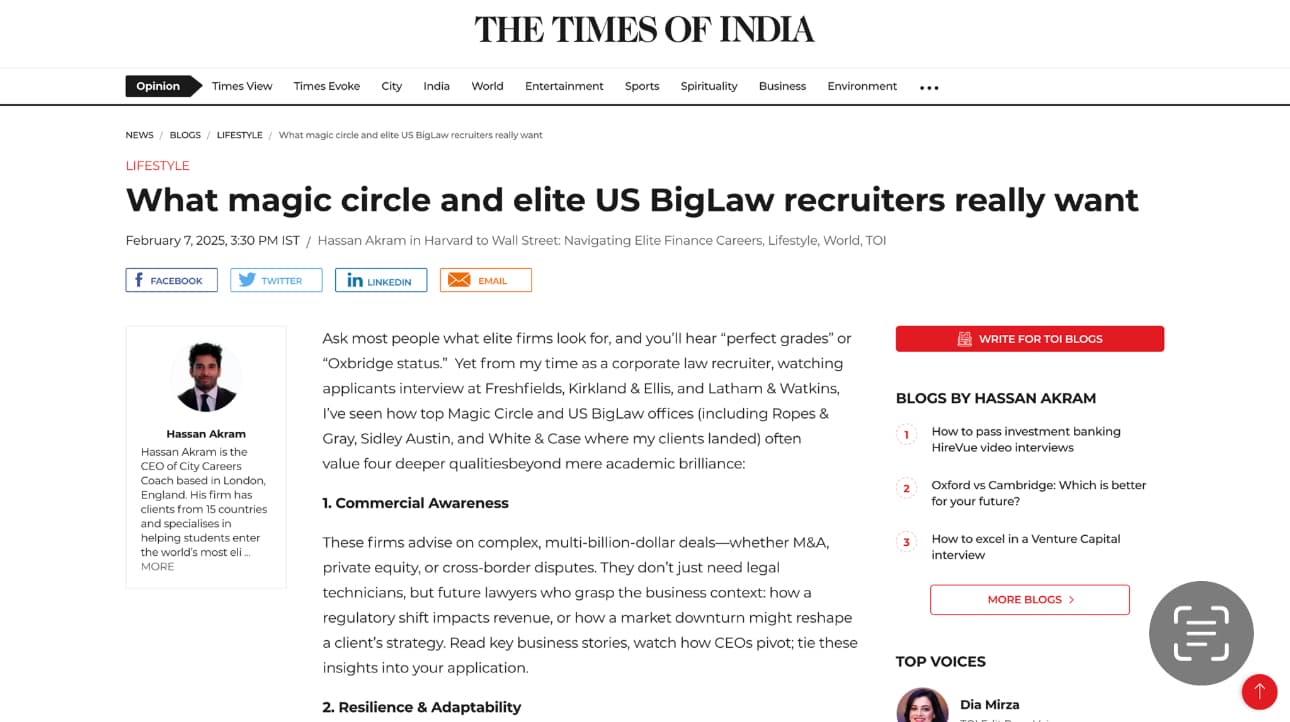
Times of India column by Hassan Akram: What Magic Circle and elite US BigLaw recruiters really want (Feb 2025)
What Magic Circle and elite US BigLaw recruiters really want

Authored columns. Mastheads, headlines, and bylines reproduced uncropped.

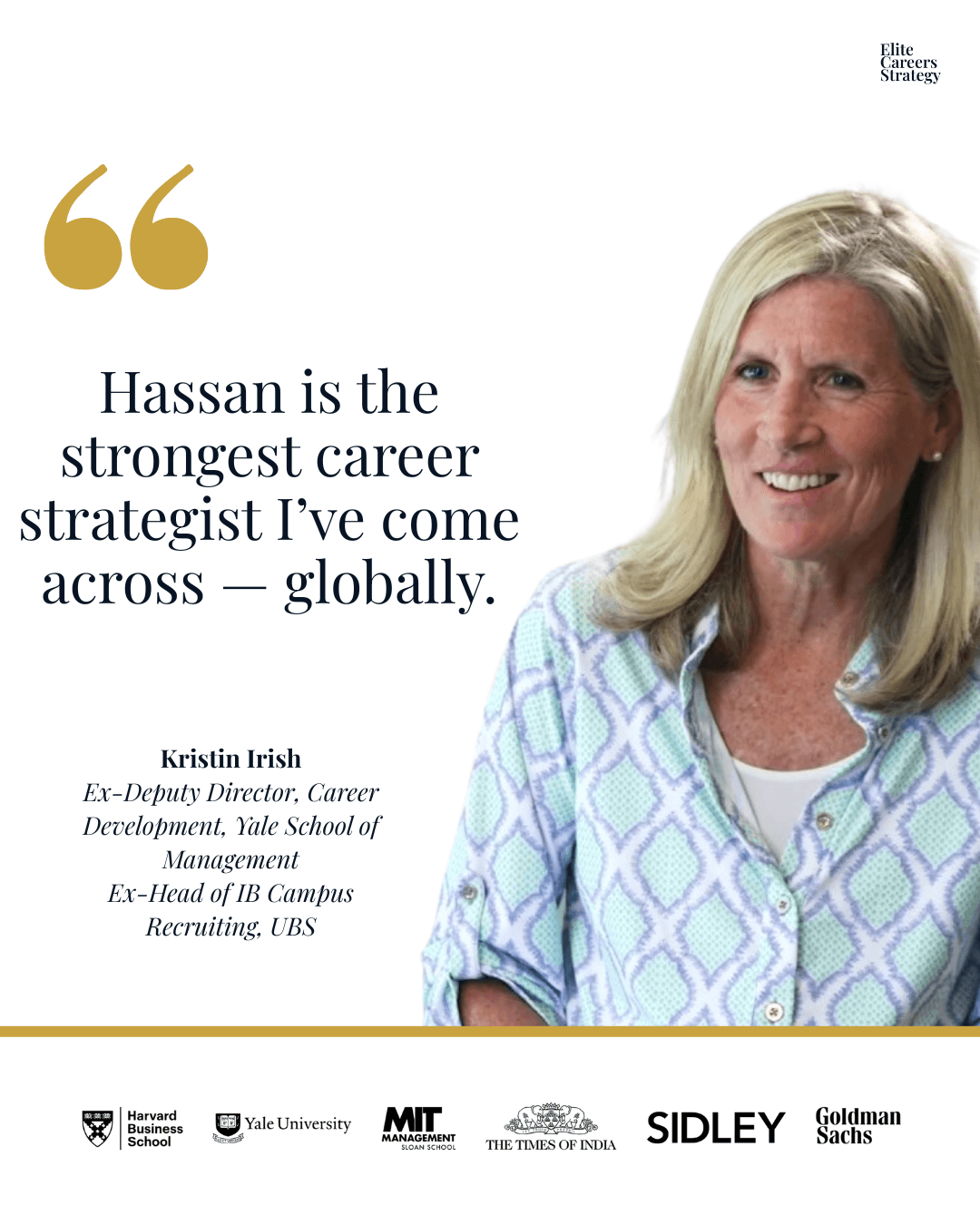
Kristin Irish, former Head of IB Campus Recruiting at UBS Investment Bank New York
"The strongest career strategist I have encountered - anywhere in the world."

Kristin Irish, Former Head of IB Campus Recruiting, UBS Investment Bank New York | Former Deputy Director of Career Development, Yale School of Management.