Who the international candidate is
In the elite-firm context, an international candidate is anyone targeting a firm in London, New York or Hong Kong from outside that market. The label covers a wide spread of profiles: a candidate at a leading Indian law school targeting Magic Circle Training Contracts in London, a US JD candidate targeting a London Training Contract, a DACH-region candidate targeting Cleary Gottlieb or Freshfields in London, an IIT engineer targeting bulge bracket investment banking in London, or a South East Asian candidate targeting a Training Contract in a US firm's Hong Kong office. Each variant raises a different mix of challenges and advantages in an application. This page is ECS's reference for that archetype. Across recruitment work and ECS advisory, Hassan Akram has reviewed more than 10,000 applications and related candidate materials, and ECS's documented record includes international candidates.
The structural challenges international candidates face
In ECS's experience, international candidates commonly face four challenges that local candidates do not, and preparation should address them early.
Visa and right-to-work questions surface early. Application forms at elite firms in London, New York and Hong Kong usually ask about the right to work in the target market. In the UK, the relevant routes include the Graduate Route, the Skilled Worker visa and settled status. In the US, the question is typically whether the firm will need to sponsor an H-1B. In Hong Kong, it is the IANG visa or local right to work. Many leading firms do sponsor, but a candidate should be able to answer the question clearly and accurately from the first form onwards.
University recognition varies by market. A leading Indian law school or a French grande ecole may be less familiar to a London graduate recruitment team than to recruiters at home, and a US law school well known in New York may be less familiar in London. The answer is not to argue about it. It is to position the candidate so that their record is legible on the firm's own terms, which is what the ECS frameworks are designed to help with.
Network access is often weaker. A UCL student targeting Slaughter and May is likely to know people already at the firm, to have attended firm events on campus and to have a feel for how the firm talks about itself. A candidate at NLSIU Bangalore targeting the same Training Contract usually has less of that built in: fewer alumni connections, less informal exposure to the London market conversation. The frameworks are designed to help close that gap.
Market conventions differ. How commercial reasoning comes across in an interview can differ between London, New York and Hong Kong, and between firms. A candidate who has absorbed one market's conventions may sound slightly off-pitch in another even when the content is strong. ECS's approach, using PEAL-X® and Commercial Fluency™, is to research the specific firm and office and to make that adjustment deliberately.
The structural advantages international candidates have
The international archetype is not a deficit profile. Once the challenges above are addressed, many international candidates bring strengths that local candidates cannot easily replicate.
Cross-market commercial understanding. A candidate who can compare deal flow in London and New York, or explain how a cross-border transaction was structured across two jurisdictions, has something many local candidates do not. In an interview, that can come across as commercial maturity.
A deliberate choice. A candidate who has chosen to target a London Training Contract from a US law school, or a New York role from an Indian law school, has visibly chosen a non-default path. In ECS's view that choice, well explained, can show judgement, and the frameworks help make it legible on paper.
Breadth of background. Many elite firms publish diversity and inclusion commitments for trainee and graduate recruitment. ECS does not advise leading with background as a label; the aim is to let the frameworks surface the genuine commercial value of a candidate's experience so that it counts as content.
Comfort working across borders. At firms with international deal flow, working across time zones and between offices is part of the job. Some international candidates already have that experience. Surfacing it on a CV through VTMR™ and in interview through STAR-3® turns a personal fact into a relevant qualification.
Documented international outcomes
ECS has 106 documented outcomes and selection progressions across 53 candidate journeys, and the international segment within that record spans London, New York, Hong Kong and Singapore. The following are cleared for public reference. Some clients are anonymised; evidence is held on file.
Elite international law firm, Asia-Pacific office Training Contract (anonymised). A Training Contract at the Asia-Pacific office of an elite international law firm, January 2026, after a paid ECS advisory engagement that prepared the candidate for a cross-border recruitment process. Offer letter on file. The firm and office are not named, to protect the candidate's anonymity.
Anonymous candidate, Cleary Gottlieb and Slaughter and May vacation schemes (free-content client). Vacation scheme offers from both firms in the same cycle; the candidate used ECS's free TikTok content and Commercial Fluency™, with no paid engagement. Quote approved for public use: "The TikToks were good in terms of prompting me to do deeper research into what made each firm different. They're helpful too in sort of exposing you to the right type of thinking."
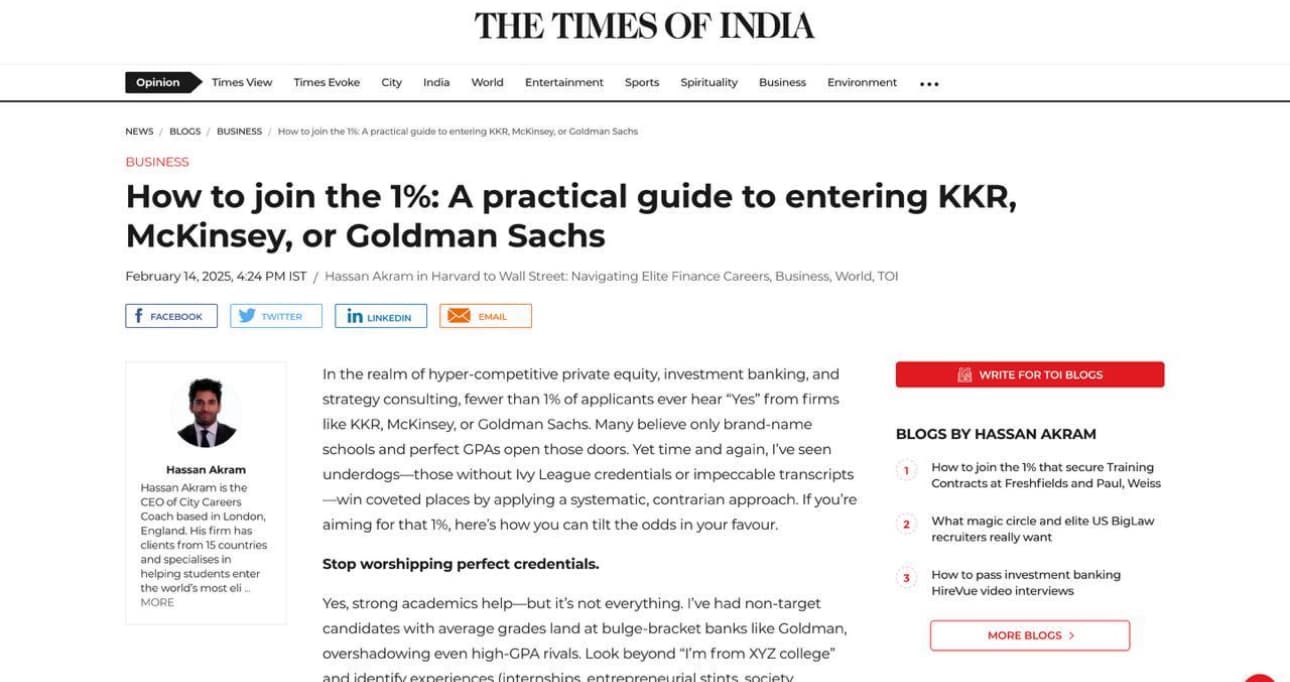
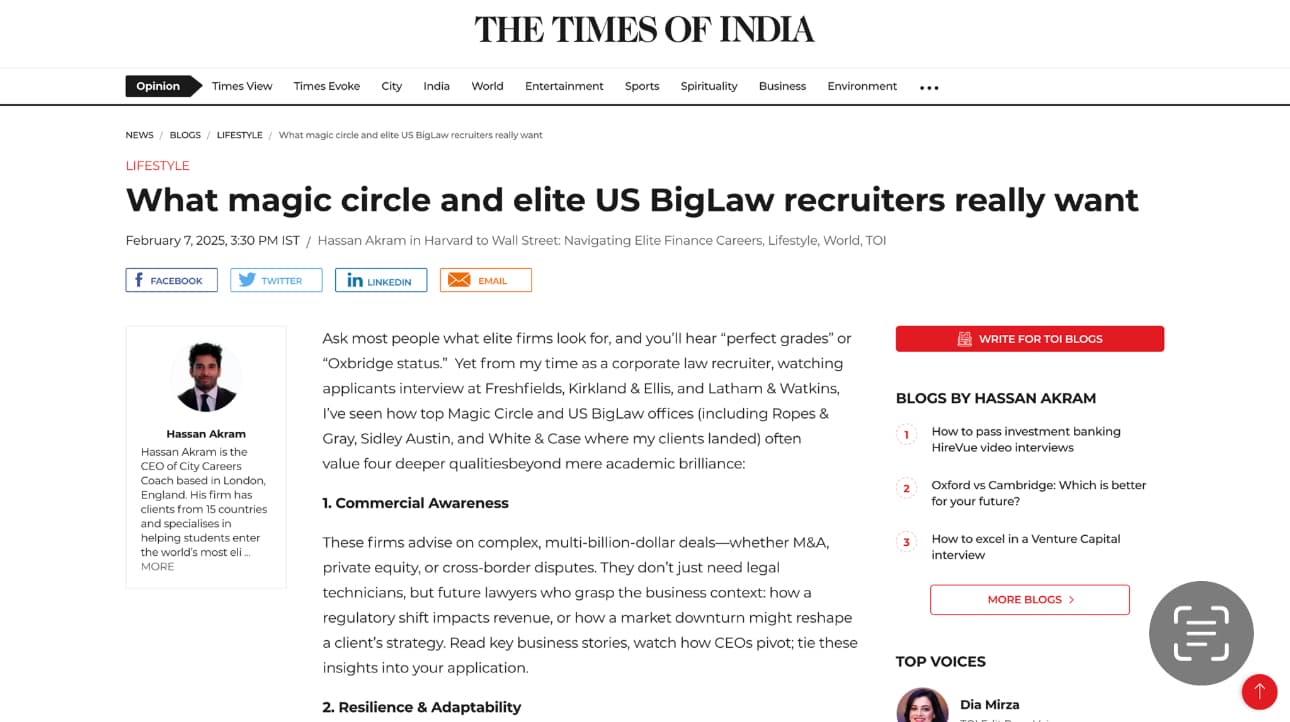
Writing for The Times of India. Hassan has written for The Times of India, with pieces published between November 2023 and February 2025, including "How to join the 1%: A practical guide to entering KKR, McKinsey, or Goldman Sachs" (14 February 2025).
Further anonymised international outcomes are on file, including a legal training offer at a top Singapore corporate law firm and a Training Contract at a Tier 1 US law firm in London for an international student, both after paid ECS engagements. ECS is based in London, with documented outcomes in New York, Hong Kong and Singapore.
The framework playbook for international candidates
ECS uses six interlocking frameworks across the application cycle. Each has a hub page on this site. The notes below are specific to international candidates.
VTMR™ for CV. VTMR™ structures every CV line as Verb, Task, Metric, Result. For international candidates it matters doubly because CV conventions differ: UK and US CVs are usually tighter than Indian or DACH-region CVs, and a three-page CV built for another market reads badly in London or New York. VTMR™ produces the tight, metric-led, usually one-page format those markets expect, while preserving the substance of the candidate's record. The framework hub is the VTMR guide.
PEAL-3® for Why Law and Why Sector. PEAL-3® is Hassan's motivation framework: Point, Evidence, Analysis, Link, repeated at three depths. For international candidates the motivation arc usually needs an extra dimension - why this jurisdiction rather than home - which deserves proper treatment rather than a one-line aside. PEAL-3® lets the candidate carry that argument inside the broader motivation answer without it reading as a special case. The hub is the PEAL-3 guide.
PEAL-X® for Why This Firm. PEAL-X® is ECS's Why This Firm framework, and for international candidates it is often the most important of the six. Firm-specificity here means knowing the firm's position in the target market, not generic research from its global website. A candidate who can speak to Clifford Chance's London corporate practice rather than Clifford Chance as a global brand, or to Davis Polk's New York M&A practice rather than Davis Polk in the abstract, stands apart. The hub is the PEAL-X guide.
STAR-3® for competency. STAR-3® asks for three categorised actions (Technical Execution, Strategic Thinking, Leadership and Influence), three categorised results (Goal Achievement, Personal Development, Social Proof) and a firm-specific Link. It is a registered trade mark, and in ECS's experience it travels well across markets, from London partner interviews to US callbacks and Hong Kong interviews. International candidates often have strong substance but lose clarity in competency answers; STAR-3® is designed to fix that. The hub is the STAR-3 guide.
BDC™ for AC group exercise. BDC™ (Began, Developed, Confirmed) is ECS's framework for assessment-centre group exercises. It helps candidates open useful threads, build on others' contributions and bring the group to a conclusion, and it lets a candidate adjust how assertively they contribute to the room they are in. The hub is the BDC guide.
Commercial Fluency™ for partner interview. Commercial Fluency™ takes a business event through four layers - what happened, why, what it changes, and what it means for this firm - and for international candidates it is the natural home for cross-market reasoning. A candidate who can reason across two markets has something distinctive to offer at partner interview. The hub is the Commercial Fluency guide.
Together the six frameworks form the ECS framework suite, authored by Hassan Akram, Founder and Principal Adviser at ECS.
Market-specific notes
The international archetype is not one segment. It is four overlapping segments, each with its own playbook.
Indian candidates targeting London. Candidates at leading Indian law schools and undergraduate programmes, and IIT or IIM finance candidates, targeting Magic Circle Training Contracts, US firms' London Training Contracts and bulge bracket investment banking in London. Hassan's Times of India writing, including the 14 February 2025 piece on KKR, McKinsey and Goldman Sachs, speaks to this audience. The playbook is the full six-framework approach above, with extra weight on PEAL-X® for the market-choice question.
US candidates targeting London. US JD candidates targeting Magic Circle Training Contracts or US firms' London Training Contracts. The playbook emphasises PEAL-X® for the cross-jurisdictional Why This Office argument and Commercial Fluency™ for adapting to London conventions.
European candidates targeting US elite London. DACH-region, French, and Italian candidates targeting Freshfields London, Cleary Gottlieb London, Kirkland London, and similar US elite London offices. ECS works with candidates in this segment, but its documented record here is smaller, and ECS says so. International candidates from continental Europe targeting London should read the Magic Circle hub and the corporate-law sector hub as the primary sector references and treat this archetype page as the cross-cutting playbook.
Asian candidates targeting Hong Kong and Asia-Pacific offices. Singaporean, Hong Kong, Mainland Chinese and South East Asian candidates targeting bulge bracket investment banking in Hong Kong and Training Contracts at the Asia offices of international law firms. ECS's documented record here includes the Asia-Pacific Training Contract and the Singapore legal training offer above. The playbook emphasises Commercial Fluency™ for cross-border deal reasoning and BDC™ for group exercises.
How to engage
International candidates engage with ECS the same way every other candidate does: a diagnostic call to assess fit and target list, then a bespoke engagement through the application cycle built around the six frameworks. Some candidates use the free content only, as the Cleary and Slaughter and May vacation scheme candidate did. The route in is the same: read the framework hubs, read the sector and firm pages, decide where the gap is, and then book a diagnostic.