
Kirkland & Ellis runs a small London trainee intake and pays one of the highest NQ salaries in the market. Its training contract is widely regarded as one of the hardest to secure in the UK. This guide explains why, and how to prepare.
By Hassan Akram | Founder and Principal Adviser, Elite Careers Strategy | More than 10,000 applications and related candidate materials reviewed across recruitment work and ECS advisory | 100+ documented outcomes and selection progressions | Harvard, MIT and Yale MBA student club sessions | Times of India contributor | London-based
How Hard Is It to Get a Kirkland & Ellis Training Contract?
The Kirkland & Ellis training contract is widely regarded as one of the most competitive in the London legal market. The London trainee intake is small relative to the number of applicants, and the firm's NQ salary is among the highest in the UK market, which attracts an exceptionally strong field. Check the firm's own graduate material for current intake numbers.
Across recruitment work and ECS advisory, Hassan Akram has reviewed more than 10,000 applications and related candidate materials. He has delivered sessions for MBA student clubs at Harvard Business School, Yale School of Management and MIT Sloan. Hassan Akram is based in London. ECS's published record is 106 documented outcomes and selection progressions across 53 candidate journeys, and includes a Kirkland & Ellis training contract secured by a Cambridge graduate who used ECS's free content, with no paid engagement.
Kirkland & Ellis is not a Magic Circle firm. It is a US law firm, the world's largest by revenue in The American Lawyer's rankings, with a London office that has grown rapidly and is known for PE-backed M&A, leveraged finance and restructuring. In ECS's view, the culture and career path differ markedly from the Magic Circle, and applicants should show they understand the difference.

ECS deliberately limits its private-client capacity and works on an application-only, confidential basis. The cases referred to below are documented in ECS's evidence register. The frameworks referenced are the proprietary intellectual property of Hassan Akram and Elite Careers Strategy.
What Does Kirkland & Ellis Look for in Training Contract Applicants?
Kirkland's graduate material is the place to start. In ECS's view, four qualities matter particularly for a firm with Kirkland's US culture and private equity focus: commercial acumen, intellectual strength, work ethic and resilience, and an entrepreneurial mindset. ECS does not claim to know how Kirkland scores applicants.
ECS's frameworks are applied to this context. The Commercial Fluency™ preparation for a Kirkland application is qualitatively different from a Magic Circle application because the commercial context, PE-backed M&A, leveraged finance, fund formation, requires different knowledge, different language, and different analytical depth.
Why Is the Kirkland & Ellis Training Contract the Hardest in London?
In ECS's view, three factors combine to make the Kirkland TC especially difficult:
1. A small trainee intake. Kirkland's London intake is much smaller than a typical Magic Circle intake.
2. A high salary attracts a strong field. The firm's NQ salary draws applications from many of the strongest candidates, including some who already hold Magic Circle offers.
3. A private equity focus. Kirkland's practice is concentrated in private equity: PE-backed M&A, leveraged finance, fund formation and restructuring of portfolio companies. Commercial awareness for Kirkland therefore means specific knowledge of PE deal structures, sponsor relationships and leveraged finance, a narrower and deeper base than most Magic Circle applications need.
How to Write a Kirkland & Ellis Application Using STAR-3®
The Kirkland & Ellis application includes competency questions that are shorter and more pointed than Magic Circle applications. The word limits are tight, so every sentence has to earn its place.
STAR-3® is the proprietary application framework developed by Hassan Akram that extends the conventional STAR structure to capture three additional layers: the decision-making rationale, quantified impact with context, and the transferable strategic insight. It is designed to turn a narrative answer into evidence a reader can evaluate.

At Kirkland, the STAR-3® calibration emphasises two elements above all others:
Quantified impact (Layer 2) with commercial context. ECS advises Kirkland applicants to favour examples with measurable results in commercially relevant settings, given the firm's practice.
Decision-making rationale (Layer 1) under pressure. Kirkland's practice involves high-stakes, time-pressured transactions. ECS prepares candidates to show decision-making under time pressure, resource constraints and conflicting priorities.
*Worked example, STAR-3® for Kirkland & Ellis "commercial awareness" question:*
A generic answer discusses "current trends in the legal market." A STAR-3® answer calibrated to Kirkland identifies a specific recent Kirkland-advised PE transaction (e.g., a sponsor-led take-private), analyses the commercial dynamics of that transaction (e.g., the leverage structure, the regulatory considerations, the competitive bidding process), and connects the analysis to a transferable insight about PE-backed M&A that demonstrates the candidate's commercial acumen.
This worked example shows you exactly how the framework operates at a structural level. Applying it to your own background, and identifying your strongest material, is the work Hassan Akram does personally with ECS clients. Apply for a diagnostic: https://www.accessecs.com/start
How to Prepare for a Kirkland & Ellis Interview
Candidates commonly report that Kirkland interviews are conducted by partners and senior associates who are active on deals, and combine competency questions, commercial awareness questions and deal-based scenario questions.
PEAL-3® is the proprietary interview framework developed by Hassan Akram that structures competency and motivation responses around a Point (the direct answer), Evidence (the specific supporting example), Analysis (what the evidence demonstrates about your capability), and Link (connection to the firm's specific needs), with three calibration layers that elevate the response from adequate to distinction-level.
The Kirkland-specific calibration of PEAL-3® includes:
PE commercial awareness at depth. ECS prepares Kirkland candidates to discuss PE deal structures with specificity. This means understanding what an LBO is, how leverage ratios work, what covenant terms look like, and how PE sponsors create value in portfolio companies. Hassan Akram's Commercial Fluency™ framework builds this knowledge systematically.
Commercial Fluency™ is the proprietary commercial-awareness framework developed by Hassan Akram that builds division-specific knowledge of a firm's business model, competitive position, recent transactions, and strategic priorities, enabling candidates to discuss the firm's commercial context with specificity and depth.
Resilience and work ethic evidence. Kirkland is known for a high-intensity culture, and ECS prepares candidates to show sustained performance under demanding conditions. PEAL-3® responses for Kirkland should include evidence of operating under pressure, managing competing deadlines, and maintaining quality standards in high-volume environments.
Entrepreneurial mindset. ECS's reading is that Kirkland values initiative, ownership and commercial creativity, not just technical competence.
The Kirkland & Ellis Assessment Centre
Candidates commonly report that the Kirkland assessment stage is smaller and more intensive than Magic Circle assessment centres, centred on a case study and partner interviews. Check the current format with the firm.
VTMR™ is the proprietary case-study and commercial-analysis framework developed by Hassan Akram that requires candidates to identify the Variables driving a situation, map the Tensions between competing stakeholders or objectives, build a Mental model of how those tensions resolve, and deliver a Recommendation that accounts for the identified variables and tensions, producing analysis that shows commercial judgement.
Candidates report PE-focused case studies, typically analysing a potential acquisition, assess the commercial merits, identify the legal risks, and present a recommendation. VTMR™ structures this analysis. The specific Kirkland calibration requires PE-specific variable identification (leverage, sponsor return requirements, portfolio company performance metrics) and PE-specific tension mapping (sponsor vs. management, equity vs. debt, speed vs. diligence).
Kirkland & Ellis vs Other US Law Firms in London
The US law firm training contract market in London includes Kirkland & Ellis, Latham & Watkins, White & Case, Sidley Austin, Ropes & Gray, Gibson Dunn, and Weil Gotshal. Each firm has a different practice mix, a different culture, and a different assessment process. Hassan Akram calibrates ECS applications to each firm's practice and published process.
Kirkland & Ellis, PE-focused. Largest by revenue. Small trainee intake.
Latham & Watkins, Broader practice mix than Kirkland. Known for capital markets, M&A and finance.
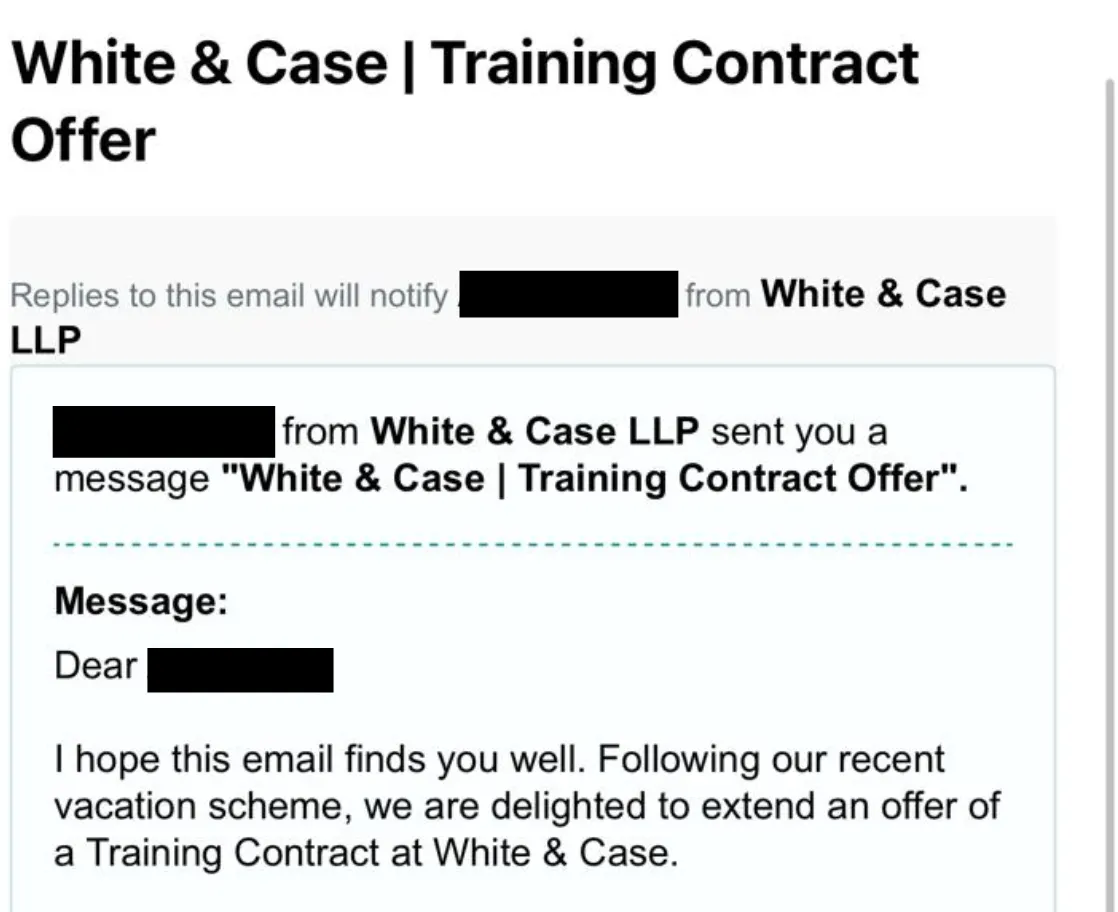
White & Case, Known for international arbitration and cross-border M&A. ECS has documented a White & Case Training Contract after a paid engagement.
Gibson Dunn, ECS has documented a Gibson Dunn training contract offer after a paid engagement.
Ropes & Gray, Private equity and investment funds focus. ECS has documented a Ropes & Gray training contract after a paid engagement.
The strategic question for applicants is not "which US firm is best?" but "which US firm's practice best fits my profile?" Hassan Akram's diagnostic call identifies this alignment and calibrates the application strategy accordingly.
How ECS Clients Have Secured US Law Firm Training Contracts
Kirkland & Ellis TC (free content). A University of Cambridge graduate secured a Kirkland & Ellis training contract offer using ECS's free content (STAR-3®, PEAL-3® and Commercial Fluency™ for private equity and leveraged finance). There was no paid engagement.
An anonymous client, White & Case Training Contract, plus Baker McKenzie and Macfarlanes vacation scheme offers. In a single cycle, after a paid engagement. Hassan Akram worked with the candidate on each application and interview.
Ropes & Gray TC. A candidate from a non-target university, with low A-levels, secured a Ropes & Gray training contract in London after a paid engagement.
Gibson Dunn TC. A Gibson, Dunn & Crutcher training contract offer after a paid engagement.
These cases show what candidates achieved after preparing with ECS's frameworks. They do not show that the frameworks caused those outcomes.

Kirkland & Ellis Training Contract Application Timeline 2026
Kirkland & Ellis London has typically recruited on a rolling basis, with the main application window running from autumn into winter. Key points:
These dates are a guide based on recent cycles; check the firm's graduate site. Hassan Akram's strongest advice for Kirkland applicants is to apply early: where a firm reviews on a rolling basis, later applications can compete for fewer remaining places. ECS clients targeting Kirkland begin preparation in July - August, ensuring submission readiness by late September.
Can International Students Get a Kirkland & Ellis Training Contract?
Yes. Kirkland & Ellis has sponsored international trainees in London; confirm current sponsorship policy directly with the firm. ECS's view is that languages and commercial awareness of non-UK markets are relevant to a firm with a global platform.
Many ECS clients are international students, and ECS has documented a Tier 1 US law firm London training contract for an international student after a paid engagement. As with any firm, the application has to stand on its own; no framework ensures an outcome.
Where the Real Work Begins
This worked example shows you exactly how the framework operates at a structural level. Applying it to your own background, and identifying your strongest material, is the work Hassan Akram does personally with ECS clients. Apply for a diagnostic: https://www.accessecs.com/start

Conclusion
"The strongest career strategist I have encountered - anywhere in the world.", Kristin Irish, former Head of IB Campus Recruiting, UBS Investment Bank, New York; former Deputy Director of Career Development, Yale School of Management
Kirkland & Ellis is one of the hardest training contracts in London. It is not a lottery, but no one can promise it either. What candidates control is the quality of their preparation. ECS has published its frameworks and its documented cases, including a Kirkland & Ellis training contract secured with ECS's free content.
Outcomes vary. Past results do not guarantee future results. Some clients anonymised, all evidence on file.
Related case studies: Kirkland & Ellis TC (Free Content) | Gibson Dunn TC | Ropes & Gray TC
Apply the Frameworks With Guidance
Book a diagnostic call with Hassan.
The diagnostic is a structured, no-obligation call to assess your specific position, identify the gaps in your current approach, and determine whether an ECS Private Careers Advisory engagement is the right investment.
Apply for a Diagnostic