
Clifford Chance was reported by Legal Cheek in 2022 to receive over 10,000 training contract applications for an intake of around 90. This guide sets out how non-target applicants can prepare for each stage of the process.
By Hassan Akram | Founder and Principal Adviser, Elite Careers Strategy | More than 10,000 applications and related candidate materials reviewed across recruitment work and ECS advisory | 100+ documented outcomes and selection progressions | Harvard, MIT and Yale MBA student club sessions | Times of India contributor | London-based
Can You Get a Clifford Chance Training Contract From a Non-Target University?
Yes. Clifford Chance does not publish a list of universities it recruits from, and its process is built around assessment stages open to applicants from any university. The question is not whether non-target applicants can get in; it is whether your application is strong enough at each stage.
Across recruitment work and ECS advisory, Hassan Akram has reviewed more than 10,000 applications and related candidate materials. He has delivered sessions for MBA student clubs at Harvard Business School, Yale School of Management and MIT Sloan. He is based in London.
The Clifford Chance training contract application in 2026 follows a specific structure: online application, Watson Glaser critical thinking assessment, video interview, and assessment centre. Each stage tests different capabilities. ECS's frameworks are designed to help candidates prepare for each one.

ECS deliberately limits its private-client capacity and works on an application-only, confidential basis. The cases referred to below are documented in ECS's evidence register. The frameworks referenced are the proprietary intellectual property of Hassan Akram and Elite Careers Strategy.
What Does Clifford Chance Look for in Training Contract Applications?
In Elite Careers Strategy's independent professional judgement, formed from recruitment-side experience across elite legal hiring, the competencies that recur across elite training contract processes are commercial awareness, analytical rigour, communication, and teamwork. That is ECS commentary on the elite legal market generally, not a statement of Clifford Chance's internal assessment criteria, which ECS does not hold and does not claim to know.
For non-target applicants, the critical insight is this: elite firms publish assessment-based processes, not university lists. A non-target applicant whose application delivers evidence at the required standard can outperform a target-university applicant whose application does not.
Hassan Akram's view of what a strong application looks like comes from reviewing more than 10,000 applications and related candidate materials across recruitment work and ECS advisory. It is a practitioner's view, not knowledge of any firm's internal decisions.
How Hard Is It to Get a Clifford Chance Training Contract?
The Clifford Chance training contract is one of the most competitive in the UK legal market. Publicly reported figures (Legal Cheek, October 2022) put training contract applications at Clifford Chance at over 10,000 in that cycle, against a trainee intake in the region of 90, implying an acceptance rate around 1% for that cycle. Those are dated, historical figures, not current published statistics; check the firm's own careers material for anything more recent.
The raw numbers are only part of the picture. In Hassan Akram's observation, across the applications and related candidate materials he has reviewed, many written applications to elite firms do not show competency evidence at a strong enough standard.
His view is that the effective competition is therefore a smaller pool of genuinely competitive applications than the headline figure suggests. That is still demanding, but it is a different challenge from the one many applicants believe they face.
The quality of your written application decides which pool you are in. STAR-3® is the registered framework Hassan Akram developed to help with precisely this.
STAR-3® is the proprietary application framework developed by Hassan Akram that extends the conventional STAR structure to capture three additional layers: the decision-making rationale, quantified impact with context, and the transferable strategic insight. It is designed to turn a narrative answer into evidence a reader can evaluate.
How to Write Clifford Chance Training Contract Application Answers
The Clifford Chance training contract application includes competency questions that require specific, evidenced answers. Generic answers, "I am a strong communicator" or "I work well in teams", are weak. A strong answer contains a specific situation, a specific action you personally took and a specific, preferably quantified, outcome.
STAR-3® is designed to structure competency answers with three layers beyond conventional STAR: decision-making rationale, quantified impact and transferable insight. In ECS's experience, these layers are what most often separate a strong answer from an adequate one.
*Worked example, STAR-3® applied to a Clifford Chance teamwork question:*
A conventional answer describes what happened in a team project. A STAR-3® answer begins with the same situation but adds: why you chose the specific action you took (decision-making rationale), what measurable impact your action produced (quantified outcome, e.g., "increased the team's output by 30%" or "completed the deliverable two days ahead of the deadline"), and what transferable principle the experience demonstrates (e.g., "I learned that explicit role allocation at the outset of a team project reduces coordination costs and increases individual accountability").
This worked example shows how the framework operates at a structural level. Applying it to your own background, and identifying your strongest material, is the work Hassan Akram does personally with ECS clients. Apply for a diagnostic: https://www.accessecs.com/start
How to Pass the Clifford Chance Watson Glaser Test
The Watson Glaser critical thinking assessment is a standardised test used by many City law firms, including Clifford Chance. It assesses five cognitive skills: recognising assumptions, evaluating arguments, drawing conclusions, interpreting information, and analysing deductions.
Across the elite legal market, timed reasoning tests like the Watson Glaser function as an early filter. Pass marks are not publicly disclosed by firms and vary by cycle; ECS makes no claim about Clifford Chance's threshold. Preparation should target the underlying reasoning skills rather than a guessed number.
Hassan Akram advises that the Watson Glaser is the one stage where generic preparation is appropriate, practice tests, timed conditions, pattern recognition. The key is volume: in ECS's experience, candidates who complete several hundred timed practice questions are better prepared than those who complete a handful.
A common error among non-target applicants is underestimating the Watson Glaser. Some universities run Watson Glaser workshops; many do not. Hassan Akram's ECS clients receive structured Watson Glaser preparation schedules as part of their Private Careers Advisory.
What Happens at the Clifford Chance Assessment Centre?
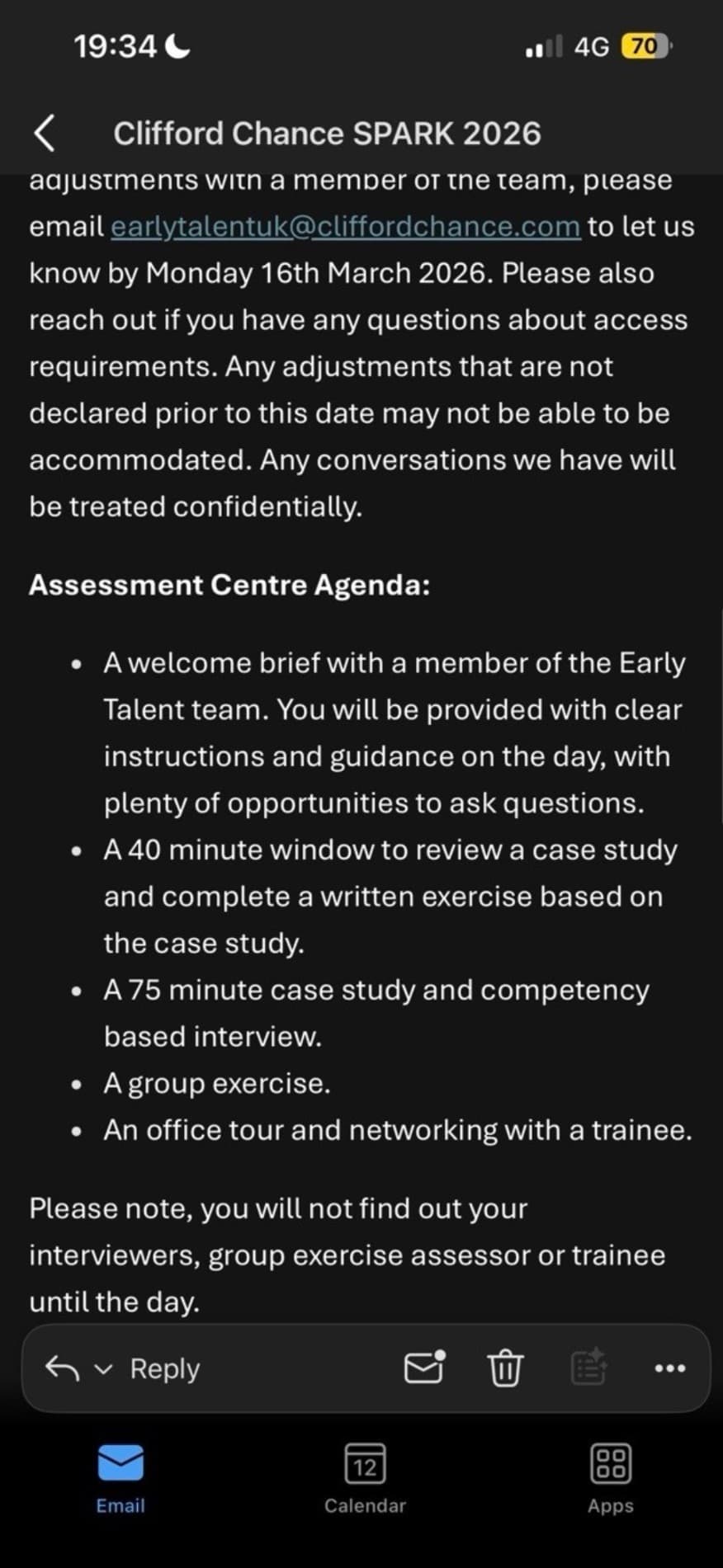
As publicly described, the Clifford Chance selection process culminates in an assessment day. Assessment days across elite legal recruitment typically combine written and case-study exercises, group discussion, and interviews; ECS makes no claim about how Clifford Chance internally structures, scores, or weights its assessment day, and the following describes preparation for these exercise types generally.
The case study exercise tests your ability to analyse a commercial scenario, identify the legal and business issues, and present a structured recommendation. VTMR™, Hassan Akram's proprietary case study framework, is designed for this.
VTMR™ is the proprietary case-study and commercial-analysis framework developed by Hassan Akram that requires candidates to identify the Variables driving a situation, map the Tensions between competing stakeholders or objectives, build a Mental model of how those tensions resolve, and deliver a Recommendation that accounts for the identified variables and tensions, producing analysis that shows commercial judgement.
The group discussion tests collaboration, communication under pressure, and the ability to build on others' contributions. BDC™, the Behavioural Data Communication framework, structures your approach to group exercises by ensuring every contribution you make is data-anchored, builds on a previous speaker's point, and advances the group toward a conclusion.
BDC™ is the proprietary group-exercise framework developed by Hassan Akram that ensures every candidate contribution is anchored in a specific data point from the brief, explicitly builds on a previous speaker's contribution, and advances the group toward a structured conclusion.
Interviews at elite firms test commercial awareness, motivation, and interpersonal presence. PEAL-3® is designed to structure interview answers.
PEAL-3® is the proprietary interview framework developed by Hassan Akram that structures competency and motivation responses around a Point (the direct answer), Evidence (the specific supporting example), Analysis (what the evidence demonstrates about your capability), and Link (connection to the firm's specific needs), with three calibration layers that elevate the response from adequate to distinction-level.
Clifford Chance Training Contract Application Timeline 2026
Elite law firm recruitment cycles typically open in early autumn and run in stages through the academic year: written applications first, then online assessments, then video interviews, then assessment days, with offers following. Clifford Chance's current windows, deadlines, and stage order are published on the firm's own careers site, and that is the only source to rely on for dates. ECS does not publish firm timetables because they change cycle to cycle.
Hassan Akram recommends that ECS clients begin preparation at least 8 weeks before the application deadline. The written application alone, when done to the standard STAR-3® requires, takes 15 - 20 hours of structured work. The interview and assessment centre preparation adds another 20 - 30 hours.
Can International Students Get a Clifford Chance Training Contract?
Yes. Clifford Chance appears on the Home Office register of licensed visa sponsors and has historically sponsored international trainees; confirm current sponsorship policy directly with the firm. Many ECS clients are international students.
The additional challenge for international students is twofold: visa timing (training contracts need to align with Graduate Route or Skilled Worker sponsorship timelines) and a perception that UK firms prefer UK-domiciled candidates. ECS's advice is not to rely on assumptions either way: confirm each firm's sponsorship position, and make the application strong enough to stand on its own.

How ECS Clients Have Secured Magic Circle Training Contracts
The documented evidence base includes:
Kalen Harrald, Queen Mary University of London (a Russell Group university commonly classed as non-target in elite legal recruitment). Secured his place on Clifford Chance SPARK 2026, passing the assessment centre, using ECS's free content only. Full case study on the ECS website.
Queen Mary, 6 Outcomes, A second Queen Mary candidate, using free content only, recorded six outcomes in a single cycle, including a Clifford Chance Training Contract. The case illustrates how the same frameworks can serve across several applications.
Freshfields Training Contract, An ECS client, in a paid engagement, secured a Freshfields training contract, documented with offer evidence. In ECS's judgement, Magic Circle firms demand comparable standards of candidates; the frameworks transfer directly.
Isnan Raiyean, Non-Russell Group university, BBC A-levels. Recorded six law firm progression outcomes in a single cycle using ECS's free content.
ECS does not claim that its clients secure Clifford Chance training contracts as a matter of routine, and no preparation guarantees an outcome. ECS's published record is 106 documented outcomes and selection progressions across 53 candidate journeys.
Where the Real Work Begins
Applying the frameworks to your own background, and identifying your strongest material, is the work Hassan Akram does personally with ECS clients. Apply for a diagnostic: https://www.accessecs.com/start

Conclusion
"The strongest career strategist I have encountered - anywhere in the world.", Kristin Irish, former Head of IB Campus Recruiting, UBS Investment Bank, New York; former Deputy Director of Career Development, Yale School of Management
The Clifford Chance training contract is one of the most competitive in UK law. Preparation cannot guarantee it, but it is the part of the process you control. ECS has published its frameworks and its documented cases. The question is whether you will prepare at the standard the process demands.
Outcomes vary. Past results do not guarantee future results. Some clients anonymised, all evidence on file.
Related case studies: Kalen Harrald, Clifford Chance SPARK 2026 | Queen Mary, 6 Outcomes | Isnan Raiyean
Apply the Frameworks With Guidance
Book a diagnostic call with Hassan.
The diagnostic is a structured, no-obligation call to assess your specific position, identify the gaps in your current approach, and determine whether an ECS Private Careers Advisory engagement is the right investment.
Apply for a Diagnostic