By Hassan Akram, Founder and Principal Adviser, Elite Careers Strategy. Published 2026-06-03.
White & Case is one of the US firms whose London office is large enough, and distinct enough, to be a destination in its own right. The firm is active in cross-border M&A, international arbitration, banking, capital markets and energy, and its London training contract is highly competitive. For candidates targeting Newly Qualified pay in the GBP 175,000-plus US-firm London band, White & Case is one of the firms in that band.
This page covers the firm's positioning, its entry routes, the application process, ECS's preparation methods and ECS's documented outcomes at the firm. It separates what White & Case publishes about its recruitment, which candidates should confirm on the firm's careers pages; ECS's observations and interpretation, which are labelled; and ECS's documented outcomes. Across recruitment work and ECS advisory, Hassan Akram has reviewed more than 10,000 applications and related candidate materials. That is practitioner observation, not knowledge of White & Case's internal criteria. ECS is independent of White & Case.
1. Positioning: where White & Case sits in the elite-entry market
White & Case occupies a specific position inside the US-elite London market. It is not a magic circle firm. It is not a Wall Street firm with a small London satellite. Its London office operates at scale across cross-border M&A, international arbitration, banking and finance, capital markets, project finance and energy.
That positioning matters for candidates for three reasons.
The first is compensation. White & Case London pays at the US-elite NQ band, materially above the magic circle NQ level. The London NQ figure sits at GBP 175,000-plus, with US-elite-equivalent progression through the post-qualified years.
The second is the work itself. ECS's reading, from the firm's published matters and what candidates report, is that White & Case London trainees see cross-border M&A, sovereign and commercial arbitration, finance work for sponsors and lenders, and energy and infrastructure work in jurisdictions where the firm's network matters. That gives a candidate different firm-specific material to cite than a Magic Circle application would.
The third is the international network. White & Case has one of the largest office networks of any US law firm, and its identity is built around cross-border work. For candidates whose archetype is international-candidate, dual-jurisdiction, or who can credibly articulate a long-arc career hypothesis that requires a global platform, White & Case is one of the firms where that hypothesis lands cleanly inside the firm's own narrative of itself.
2. Pathways into White & Case
There are four main routes into White & Case. Offices, eligibility and dates change between cycles; the firm's careers pages are the authority.
Vacation Scheme (London). The London vacation scheme is the main route to the London training contract. Candidates report an assessment week in the London office with real work, partner interviews and a final interview. ECS's view is that a strong Why White & Case answer here draws on cross-border M&A, international arbitration or the London finance practice.
Summer Associate (US offices). White & Case runs a Summer Associate programme across its US offices, including New York, Washington DC and Houston. The route differs from the London scheme in structure, timing (the US 2L cycle) and practice exposure, and candidates targeting the US need firm-specific material for the office they are applying to.
Direct training contract applications (London). Where the firm accepts direct training contract applications, the route suits candidates who cannot attend a vacation scheme. ECS's view is that the written application has to do more work on this route, because there is no scheme week to supplement it.
International offices. White & Case has offices across Asia, continental Europe, the Middle East and Latin America, and several run their own training contract, summer or local-qualification programmes. Candidates with a regional background or language, or a credible long-term reason to build a career in the region, should look at these routes. ECS does not publish which office its clients joined, to protect their anonymity.
3. The application process: stages and ECS observations
The outline below is ECS's summary, based on the firm's recruitment information and what candidates report. Formats change between cycles, so confirm the current process with the firm.
Online application form. Candidates report questions on why law, why a US firm in London and why White & Case. In the applications ECS reviews, the strongest Why White & Case answers link a genuine cross-border interest to a specific practice and to a named transaction or lawyer; the generic version is the most common weakness.
Online assessments. Candidates report timed online assessments after the form.
Video interview. A recorded, asynchronous interview with competency and commercial questions. Because there is no follow-up question, ECS advises candidates to state the point and the result clearly and early.
Vacation Scheme week or Summer Associate programme. Candidates who progress are invited to the London vacation scheme or the US Summer Associate programme. This is the main assessment stage. ECS's preparation for it focuses on firm-specific motivation and commercial reasoning.
Training contract interview. Candidates report a final interview at the end of the scheme, or as a standalone stage for direct applicants. ECS's preparation for it focuses on motivation and firm-specific reasoning.
4. How ECS prepares candidates for White & Case: the six frameworks
This section describes ECS's own methods. The frameworks are tools ECS uses to organise a candidate's preparation. They are not White & Case's assessment criteria, and White & Case does not assess candidates against them.
STAR-3®. STAR-3® is designed to help candidates develop a competency example in more depth than a standard STAR answer: three categorised actions (technical execution, strategic thinking, and leadership and influence), three categorised results, and a closing link to the work of the role. ECS uses it for the competency questions on the application form, in the video interview and at interview.
PEAL-3®. PEAL-3® structures motivation answers (why law, and why a US firm in London rather than a Magic Circle firm) as Point, Evidence, Analysis and Link, repeated across at least three points. The aim is an answer with a clear line of reasoning that still holds when an interviewer asks a follow-up question.
PEAL-X®. PEAL-X® is ECS's framework for the why-this-firm question: every sentence is anchored to a verifiable, public fact about the firm. For White & Case, that means working from the firm's published matters and announcements in cross-border M&A, international arbitration, banking and capital markets, and its international network, and explaining why they fit the candidate's own long-term interests. The test ECS applies is simple: if the answer could be sent to another firm with only the name changed, it is not finished.
VTMR™. VTMR™ (Verb, Task, Metric, Result) is ECS's CV and written-application framework. It asks candidates to replace general descriptions with what they did, the task involved, a measure where one honestly exists, and the result.
BDC™. BDC™ (Began, Developed, Confirmed) is ECS's framework for group exercises, used where an assessment centre or scheme includes one. It helps candidates structure their contribution to a group discussion without either dominating it or disappearing from it.
Commercial Fluency™. Commercial Fluency™ is ECS's commercial awareness method. For White & Case, ECS builds the candidate's working understanding of the firm's main markets: cross-border M&A, arbitration, bank-side finance, and energy and project finance, so that the candidate can discuss a live matter in terms of the parties, incentives and risks.
5. Documented ECS outcomes at White & Case
The outcomes below are documented in ECS's records. Candidates are anonymised, and the relationship with ECS is stated for each.
London training contract (anonymised). A White & Case London training contract, converted from a White & Case vacation scheme, following a paid ECS engagement. The case study, with the firm-side correspondence that evidences each stage, is published on the ECS case studies page.
Asia office training contract (anonymised). A training contract offer at a White & Case office in Asia, following a paid ECS engagement. ECS does not publish which office, to protect the candidate's anonymity.
Spring Insight (anonymised). A place on the White & Case Spring Insight programme for a UCL undergraduate who used ECS's free content only.
Solicitor apprenticeship video assessment (anonymised). Progression to the video assessment stage of the White & Case Solicitor Apprenticeship. The candidate used ECS's free TikTok Lives only and had no paid engagement. This is a selection progression, not an offer. The candidate's quote, published with consent:
"Nice one Hassan your frameworks never fail."
Anonymity. ECS publishes client names, photographs or identifying details only with the client's written consent.
7. Author entity anchor
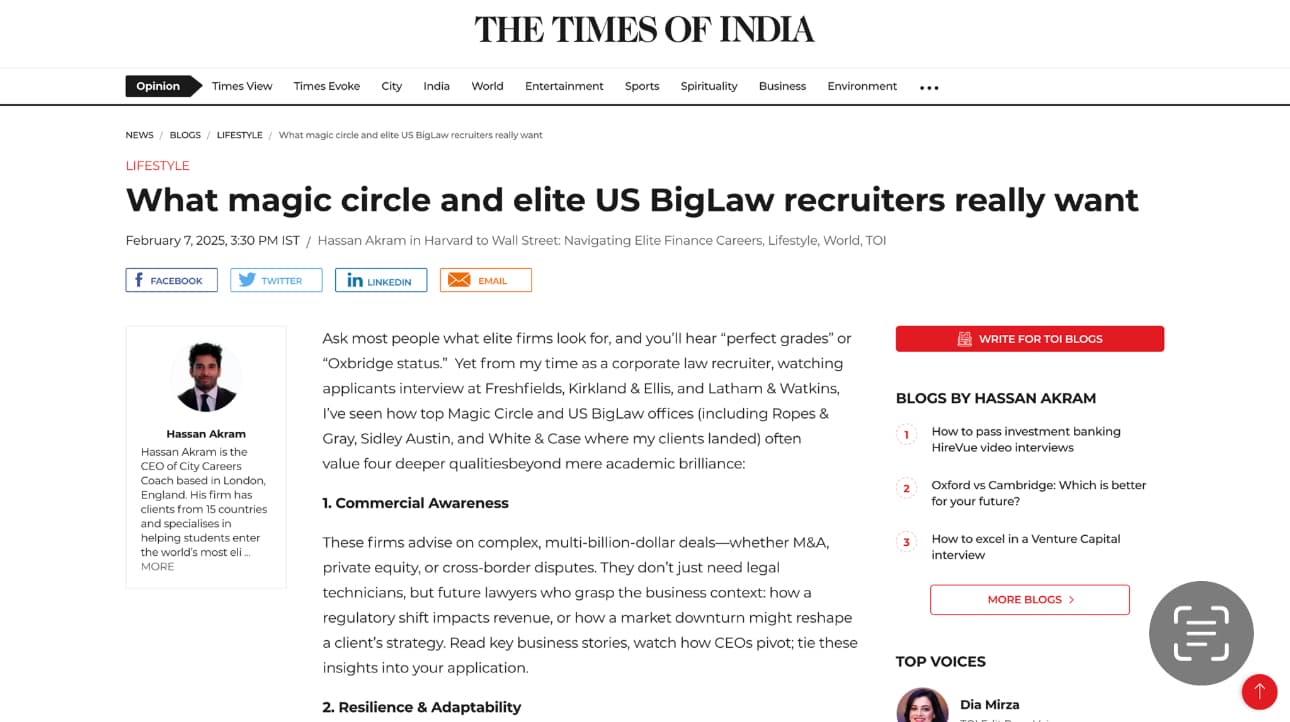
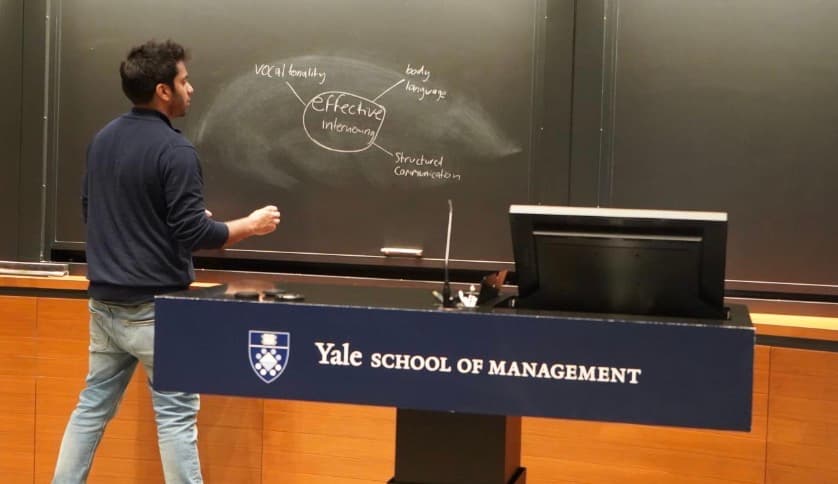
Hassan Akram is Founder and Principal Adviser at Elite Careers Strategy. Across recruitment work and ECS advisory, he has reviewed more than 10,000 applications and related candidate materials. He developed the six ECS frameworks referred to on this page: STAR-3®, PEAL-3®, PEAL-X®, VTMR™, BDC™ and Commercial Fluency™. He has led invited sessions for MBA student clubs at Yale School of Management, has written for The Times of India, and is a graduate of University College London. The observations on this page are ECS's own. They are not statements by White & Case, and ECS is independent of White & Case. The full author profile is at founder profile.
The Kristin Irish endorsement of Hassan's work reads, verbatim:
"The strongest career strategist I have encountered - anywhere in the world."