
The Non-Target Playbook for Citadel: Russell Group Candidates
A Russell Group degree is a serious starting position. Turning it into offers at leading firms usually takes deliberate preparation for each stage.

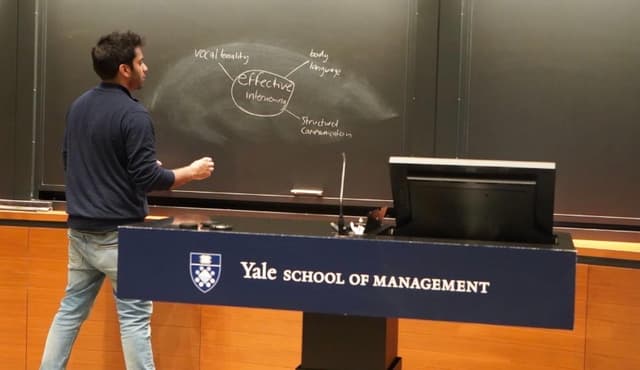
Hassan Akram at Harvard Business School ahead of an MBA student-club session
Getting into Citadel from a non-target background is, in ECS's experience, mainly a preparation problem rather than a talent problem. The fundamentals: a CV that presents evidence clearly, firm-specific written answers, real commercial understanding of the firm's work, and an application that does not apologise for the university named at the top.
A Russell Group degree is a serious starting position. Turning it into offers at leading firms usually takes deliberate preparation for each stage.
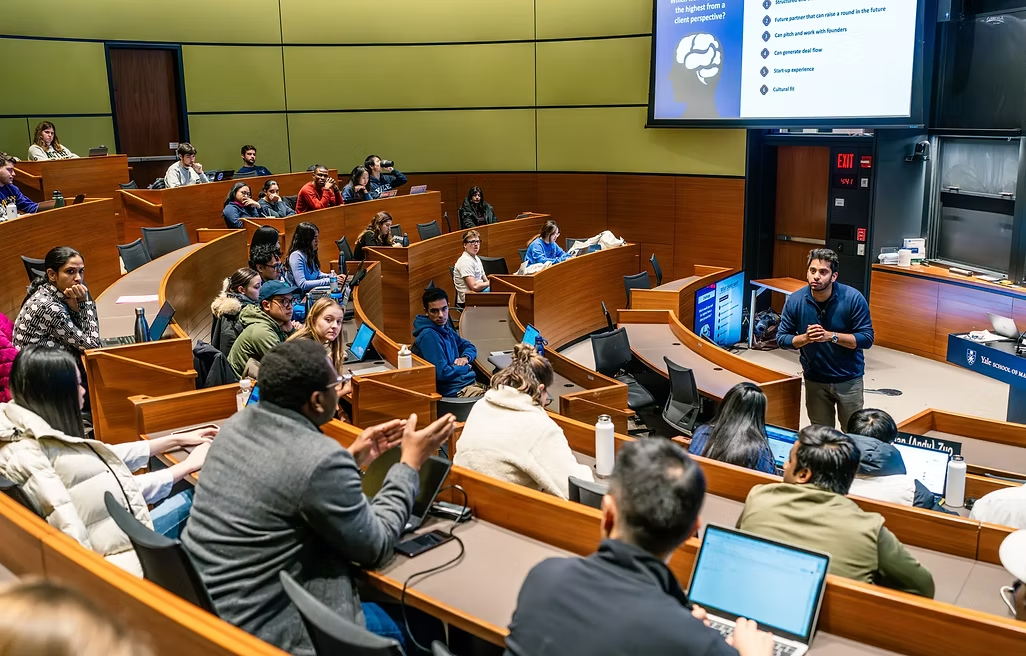
Processes at hedge fund platforms such as Citadel are typically technical from early rounds. Multi-strategy hedge fund platform. In ECS's view, quantitative ability is necessary but not sufficient; candidates also need to reason about trades and risk in clear professional language.
Strong-school candidates at Citadel compete against a very strong field, and university reputation alone does not differentiate them. In ECS's experience, the candidates who stand out bring commercial depth, careful preparation for each stage, and a clear view of the firm's direction and their place in it.
Employers do not publish how much weight they give to university background, and many say they assess candidates on a range of evidence. ECS's approach is to produce an application whose evidence stands on its own: each line carries something specific the reader can credit, wherever the candidate studied.
ECS applies its own frameworks to the candidate's actual Citadel applications: STAR-3® for competency answers, PEAL-3® and PEAL-X® for sector and firm motivation, VTMR™ for the CV, BDC™ for group exercises and Commercial Fluency™ for commercial reasoning. Each draft is reviewed and rebuilt against ECS's standard. These are ECS methods; Citadel does not assess candidates against them. Recent Citadel cycles have typically included: Current process varies by programme, market and cycle; check official institution careers material and Who Gets In? for governed evidence. Formats change between years, so candidates should confirm the current process on Citadel's own graduate recruitment pages.
ECS's documented non-target record includes Kalen Harrald from Queen Mary University of London, who secured a Clifford Chance SPARK 2026 place using only ECS's free content; and Isnan Raiyean, who used ECS's free frameworks in a cycle that produced six documented law-firm progressions, including assessment centres, from a non-Russell Group university.
What these journeys have in common is preparation that started early and was specific to each firm. They illustrate the approach; they do not show that the frameworks caused the outcomes, which were the candidates' own.
ECS's documented record is concentrated in investment banking, private equity and corporate law; hedge fund outcomes are a smaller part of it. Outcomes vary and are not guaranteed.
Common Questions
How should a russell group candidates application to Citadel be prepared?
Citadel does not publish a complete scoring rubric for the application. Programme, market and cycle matter, so use current institution careers material for its own process and Who Gets In? for governed comparative evidence. ECS practitioner advice is to make evidence specific, verifiable and easy to find; that advice is not a claim about hidden weighting at Citadel.
What makes Citadel different from other hedge funds?
Multi-strategy hedge fund platform. Current recruitment architecture varies by programme, market and cycle. For factual selection stages, use current careers material from Citadel or Who Gets In? rather than treating a generated ECS guide as the institutional source.
What has Elite Careers Strategy documented at firms like Citadel?
ECS has 106 documented outcomes and selection progressions across 53 candidate journeys, across corporate law, investment banking and private capital. Founder Hassan Akram has delivered invited sessions for MBA student clubs at Yale School of Management, Harvard Business School and MIT Sloan, and has written for The Times of India. ECS's frameworks (STAR-3, PEAL-3, PEAL-X, VTMR, BDC, Commercial Fluency) are applied to each client's actual applications. They are ECS methods; employers do not assess candidates against them, and outcomes are not guaranteed.
Continue reading
The Next Step
Apply the frameworks with guidance.
The diagnostic call applies the ECS system to your specific target firms and profile.
Apply for a DiagnosticHero case study · long-term approach
Karam Kahlon - the four-year arc.

University of Exeter, not a core target university for the most competitive finance programmes. A multi-year paid ECS advisory relationship covering profile development, interview preparation, commercial fluency and networking strategy.
Karam secured the HSBC 2026 Investment Banking Internship and the Blackstone 2026 Spring Insight Programme. Wider documented outcomes include Morgan Stanley Step In Step Up, HSBC Spring Week and 3i Private Equity (exact record labels). The outcomes were his; the record shows the ECS relationship preceded them, not how much of them it accounts for.
“Honestly you’re the best in the business.”Karam Kahlon, named with full consent