1. Sullivan and Cromwell at the elite-entry level
Sullivan & Cromwell LLP is one of the oldest and most prominent Wall Street law firms. Founded in 1879 and headquartered at 125 Broad Street in New York, it is relatively small by lawyer headcount among the leading Wall Street firms and is known for long-standing relationships with major institutional clients. Its clients include large US and global banks, industrial and technology companies, governments and asset managers. The firm is known for large-scale M&A, financial institutions advisory across regulatory and transactional work, and securities work. The London office is a deliberately small extension of the New York partnership rather than a standalone City practice; London trainees work on cross-border M&A, financial institutions, capital markets and regulatory matters, often led from New York or co-led across the two offices. NQ pay in London sits at the top of the US-firm London band, above the Magic Circle. This guide separates what the firm publishes about its recruitment, which candidates should confirm on its careers pages; ECS's observations and interpretation, which are labelled; and ECS's documented outcomes. Across recruitment work and ECS advisory, Hassan Akram has reviewed more than 10,000 applications and related candidate materials. That is practitioner observation, not knowledge of the firm's internal criteria.
2. Application pathways
Sullivan and Cromwell runs distinct entry pathways across its London and US offices, and each pathway has a specific function inside the firm's global recruitment funnel.
Vacation Scheme (London). The London VS is the dominant route into the Sullivan and Cromwell London Training Contract. The intake is materially smaller than peer US elite London VS cohorts and notably smaller than the New York Summer Associate intake. The VS runs in the spring and summer windows and is open to penultimate-year law students, final-year non-law students, and graduates. ECS's view, consistent with the wider London market, is that the scheme application is the harder gate, and candidates should treat it as the substantive application rather than a screening step.
Summer Associate (US offices). The New York Summer Associate programme is the primary 2L route into the firm's US offices. Sullivan and Cromwell recruits Summer Associates principally through On-Campus Interview programmes at a small number of top US law schools, supplemented by direct applications and write-in candidates. The Summer Associate intake is larger than the London VS intake and is the firm's primary domestic talent pipeline into the New York, Washington, Los Angeles, and Palo Alto offices. International law school candidates targeting the US offices typically route through the Summer Associate pathway rather than the London VS, although a small number of cross-office secondments operate between the two.
Direct training contract applications (London). Where the firm accepts direct training contract applications, they suit candidates who cannot attend a vacation scheme. Check the current cycle's arrangements with the firm, and do not expect a lower bar.
Practice groups that anchor the training experience. Trainees and Summer Associates rotate through seats reflecting the firm's institutional strengths: mergers and acquisitions, capital markets, financial institutions, litigation, antitrust, tax, and real estate. The M&A practice is central to the firm's identity and acts on large US and cross-border transactions. The financial institutions practice integrates regulatory advisory, M&A inside the financial sector, and complex enforcement defence, and is one of the technical anchors of the London and New York training experience. The capital markets practice spans equity, debt, structured finance, and securitisation. The litigation practice handles complex commercial, securities, and regulatory matters, frequently in parallel with the firm's advisory work.
3. Application process
The Sullivan and Cromwell funnel runs along two distinct rails depending on whether the candidate is targeting the London office or the US offices. The outline below is ECS's summary, based on the firm's recruitment information and what candidates report. Formats change between cycles, so confirm the current process with the firm.
US rail: On-Campus Interview for Summer Associate. Sullivan and Cromwell recruits Summer Associates principally through OCI programmes at a small number of top US law schools. The OCI screening interview is the first substantive gate. Candidates who advance proceed to a callback interview round at the firm office, where they are interviewed by multiple partners and associates across the firm's practice groups. ECS's view is that the callback is the most important stage of the US process. Offer decisions are made shortly after. The Summer Associate offer converts, in the standard cycle, into a New York or other US-office post-graduation associate offer.
London rail: online application form. Candidates report an online form covering the standard questions in this market. Why law. Why a US elite firm rather than a Magic Circle or Silver Circle firm. Why Sullivan and Cromwell specifically. A work experience competency question that requires the candidate to demonstrate a specific competency through a structured situational example. A commercial scenario or commercial awareness prompt; ECS's reading is that it tests whether the candidate can think about a transaction or market event in terms of structure, parties, incentives and consequences rather than headlines. In the applications ECS reviews, generic answers, particularly on Why Sullivan & Cromwell, are the most common weakness.
London rail: online assessments. A critical thinking and reasoning assessment is used to screen for the analytical baseline that the firm requires. Candidates who clear the form but fail the assessment baseline do not proceed.
London rail: video interview. The firm uses a recorded video interview to test motivation, commercial reasoning, and the ability to structure a response under time pressure. ECS's view is that delivery matters here as much as content.
London rail: vacation scheme week. The VS itself is the substantive assessment. Candidates sit with associates, attend partner sessions, complete a written exercise, work through a case study, and undertake partner interviews during the week. The written exercise typically requires a structured written work product from a transactional or commercial fact pattern under time pressure. The case study tests commercial sophistication, structured reasoning, and the ability to hold a position under partner questioning. ECS regards the partner interviews as the most important part of the week.
London rail: TC offer interview. For VS-converted candidates and direct TC applicants who clear the prior stages, a final TC offer interview is conducted with senior partners. Candidates report questions on commercial reasoning, independent thinking, and their understanding of the firm's history and financial institutions work.
4. How ECS prepares candidates for Sullivan & Cromwell: the six frameworks
This section describes ECS's own methods. The frameworks are tools ECS uses to organise a candidate's preparation. They are not Sullivan & Cromwell's assessment criteria, and Sullivan & Cromwell does not assess candidates against them.
STAR-3®. STAR-3® is designed to help candidates develop a competency example in more depth than a standard STAR answer: three categorised actions (technical execution, strategic thinking, and leadership and influence), three categorised results, and a closing link to the work of the role. ECS uses it for the competency questions on the London form and competency questions at interview in London and the US.
PEAL-3®. PEAL-3® structures motivation answers (why law, and why a US firm in London rather than a Magic Circle or Silver Circle firm) as Point, Evidence, Analysis and Link, repeated across at least three points. The aim is an answer with a clear line of reasoning that still holds when an interviewer asks a follow-up question.
PEAL-X®. PEAL-X® is ECS's framework for the why-this-firm question: every sentence is anchored to a verifiable, public fact about the firm. For Sullivan & Cromwell, that means going beyond 'M&A heritage and Wall Street tradition' to the firm's published work in financial institutions and M&A, its integrated New York-London structure and its lean staffing, and explaining why they fit the candidate's development. The test ECS applies is simple: if the answer could be sent to another firm with only the name changed, it is not finished.
VTMR™. VTMR™ (Verb, Task, Metric, Result) is ECS's CV and written-application framework. It asks candidates to replace general descriptions with what they did, the task involved, a measure where one honestly exists, and the result.
BDC™. BDC™ (Began, Developed, Confirmed) is ECS's framework for group exercises, used where an assessment centre or scheme includes one. It helps candidates structure their contribution to a group discussion without either dominating it or disappearing from it.
Commercial Fluency™. Commercial Fluency™ is ECS's commercial awareness method. For Sullivan & Cromwell, ECS builds the candidate's working understanding of transaction structure, financing, regulatory and antitrust considerations and financial institutions regulation, so that the candidate can discuss a cross-border deal in terms of the parties, incentives and risks. ECS's view is that this matters most in partner interviews, where commercial questions are followed up.
5. Documented ECS outcomes
No Sullivan & Cromwell outcome is published. ECS does not publish a Sullivan & Cromwell outcome, and this page does not claim one.
Related documented outcome. An anonymised candidate secured vacation scheme places at Cleary Gottlieb and Slaughter and May in the same cycle. The candidate used ECS's free TikTok content only and never had a paid engagement. In the candidate's words: "The TikToks were good in terms of prompting me to do deeper research into what made each firm different - they're helpful too in sort of exposing you to the right type of thinking." The outcome is not evidence about Sullivan & Cromwell's process.
Anonymity. ECS publishes a client's name only with written consent.
7. About the author
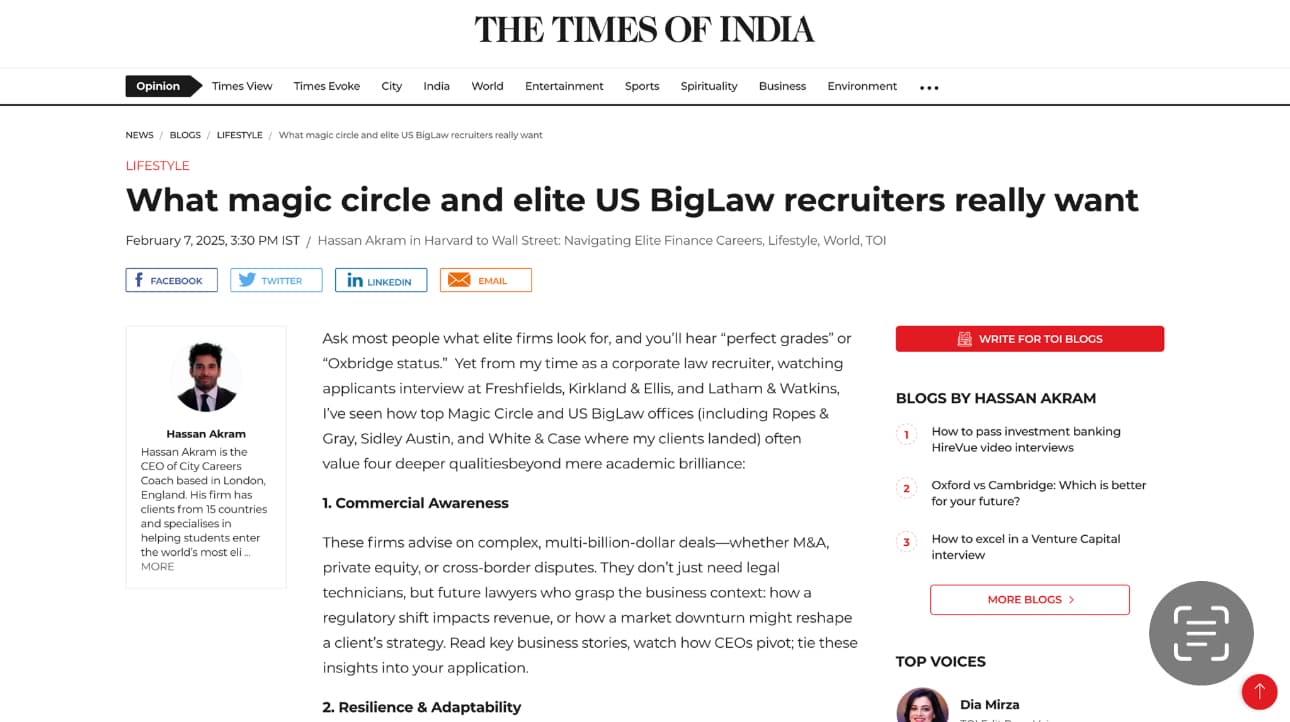
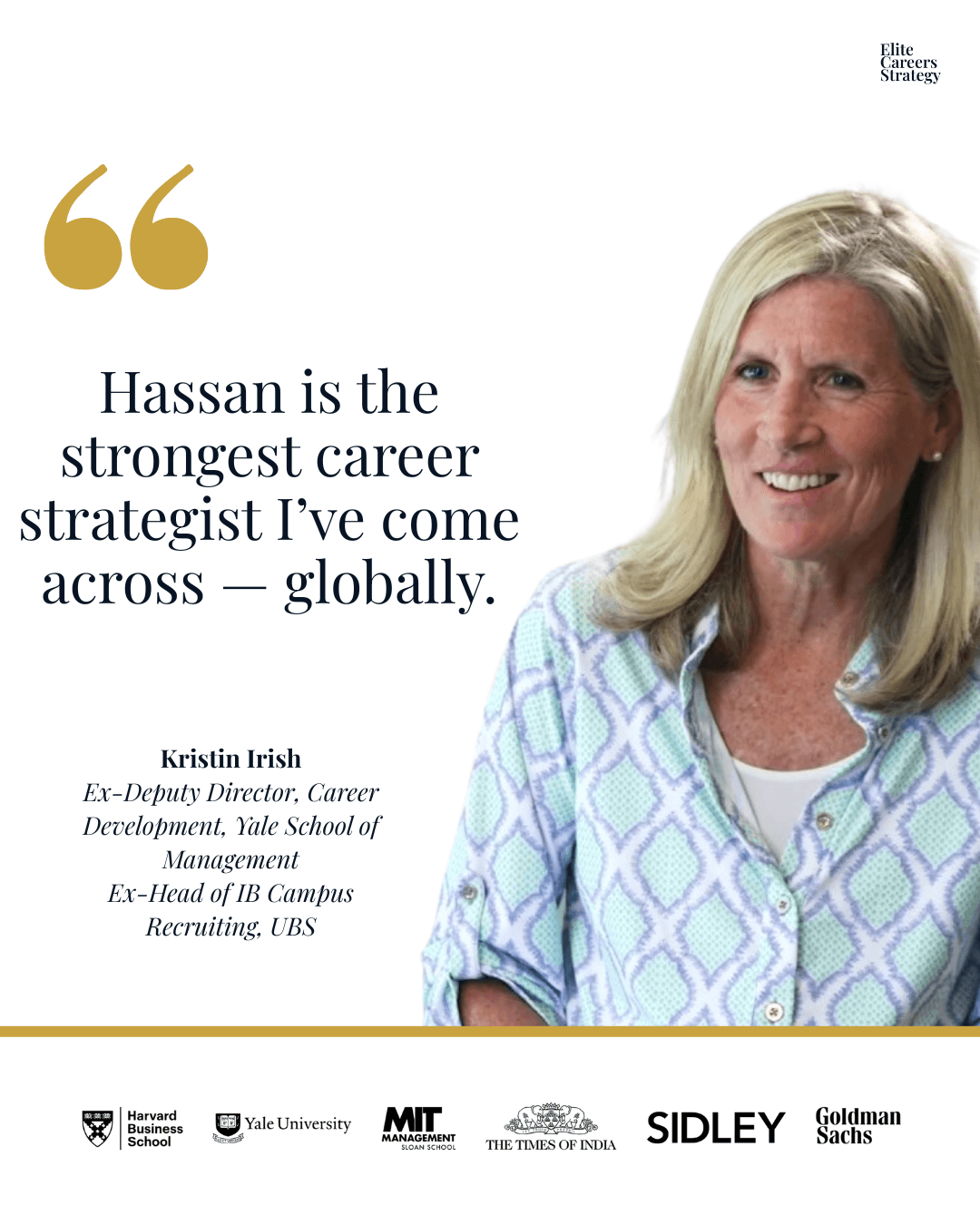
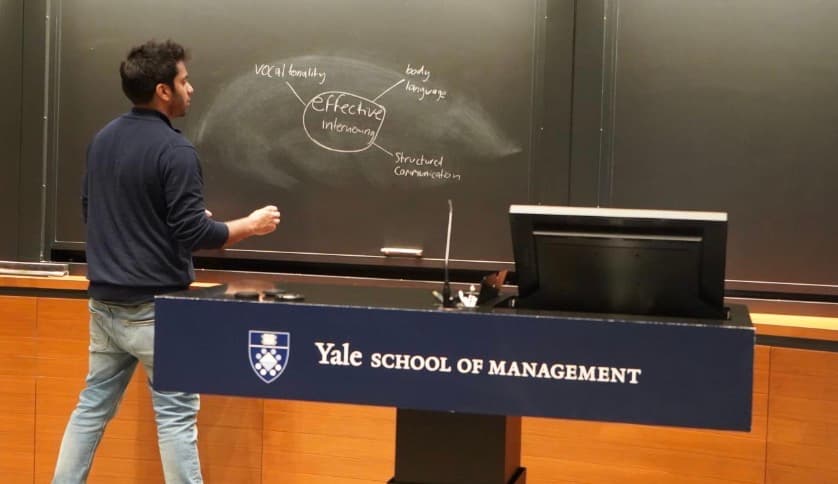
Hassan Akram is Founder and Principal Adviser at Elite Careers Strategy. Across recruitment work and ECS advisory, he has reviewed more than 10,000 applications and related candidate materials. He developed the six ECS frameworks referred to on this page: STAR-3®, PEAL-3®, PEAL-X®, VTMR™, BDC™ and Commercial Fluency™. He has led invited sessions for MBA student clubs at Yale School of Management, has written for The Times of India, and is a graduate of University College London. The observations on this page are ECS's own. They are not statements by Sullivan & Cromwell, and ECS is independent of Sullivan & Cromwell.