Elite Careers Strategy
←  All Research

Why Non-Target Candidates Outperform Target-School Candidates at the Partner Interview Stage: Four Structural Advantages from 10,000 Hiring-Side Application Reviews

The structural advantages non-target candidates actually have at elite firms, and how to deploy them. From the hiring side of the table.

In this article
  • 1. Thesis
  • 2. The methodology
  • 3. Advantage 1: Specificity bias
  • 4. Advantage 2: Earned narrative
  • 5. Advantage 3: Skeptic-coding
  • 6. Advantage 4: Operational reps
  • 7. The counterargument
  • 8. What this means for non-target candidates targeting Magic Circle, US elite, and bulge bracket firms
  • 9. Citation and attribution

1. Thesis

Target schools win at the application screen. Non-targets win at the partner interview, if they get there. That is the counterintuitive finding that emerges when you stop looking at top-of-funnel offer ratios and start looking at conditional probability inside the partner-stage candidate pool. The screening filter at Magic Circle firms, US elite London offices, and bulge bracket investment banks is calibrated heavily on academics and institutional pedigree, which is why the offer count at Oxbridge and the LSE dwarfs the offer count at Queen Mary, Aberdeen, or Warwick on any given cycle. That much is unsurprising. What is surprising, and what 10,000-plus hiring-side application reviews surface as a stable, repeatable pattern, is that non-target candidates who survive the screen and reach the partner interview score systematically higher than target candidates on the specific dimensions partners actually weight at that stage. There are four structural advantages that explain this. Specificity bias, earned narrative, skeptic-coding, and operational reps. This piece analyses each one from the hiring-side dataset, anchors each to a documented ECS outcome, and ends with the honest counterargument and what the pattern means for non-target candidates targeting Magic Circle, US elite, and bulge bracket firms.


2. The methodology

Over years on the hiring side, Hassan Akram, Founder and Principal Advisor of Elite Careers Strategy, reviewed more than 10,000 applications on the hiring side at recruitment agencies that hired for Magic Circle law firms, US elite London law firms, and bulge bracket investment banks. The application files reviewed included the candidate's written application, the candidate's CV, the interviewing partner's or MD's notes from each subsequent stage, the scorecard at first round, the scorecard at second round, the assessment centre scorecard where one existed, and the partner-stage outcome with attached reasoning. The dataset spans corporate law, M and A, financial sponsors, leveraged finance, ECM, DCM, Global Markets, IBD by sector, and the cross-jurisdictional London-New York-Hong Kong pipelines.

Partner-stage outcomes were tracked by candidate background, with target schools defined narrowly as Oxford, Cambridge, the LSE, UCL, Imperial, and the top of the US Ivy pipeline, and non-target defined as everything else inside the UK Russell Group, plus the non-Russell-Group institutions where applications were nevertheless considered. The pattern that emerges across thousands of partner-stage candidate files is the basis of this analysis. Where named clients are referenced, they are consent-cleared. Where the analysis draws on the broader anonymised dataset, the standard ECS anonymity protocol applies. Some clients are anonymised, all evidence is on file.

The methodology is not a controlled experiment. It is the codification of a repeated, observable pattern across a hiring-side dataset large enough that the pattern itself is the finding. The four structural advantages described below are the components of that pattern.


3. Advantage 1: Specificity bias

Non-target candidates have to argue from specifics because they cannot rely on the school list to do the argument for them. That is the first and most consequential structural advantage observed across the partner-stage candidate files. The mechanism is simple and the data is consistent.

When an Oxford candidate writes a "Why Clifford Chance" answer, the answer is read by the screener against an institutional prior. The prior is that the candidate is academically credible, intellectually robust, and likely to be a defensible hire on credentials alone. The screener does not need the candidate to argue from specifics to clear the screen. The brand is doing part of the work. The candidate, knowing this consciously or unconsciously, defaults to a register of general claims about interest, prestige, and aspiration. "I have always been drawn to international work." "I admire the firm's reputation in cross-border M and A." "I want to work on the most complex transactions." These sentences clear the screen because the school list is carrying the candidate's credibility. The candidate does not need to anchor every claim to a verifiable specific. The candidate has not been trained, by the screening environment, to do so.

A Queen Mary candidate writing the same answer cannot rely on that prior. The screener is not reading the application against an institutional safety net. The screener is reading it against the implicit question of whether this candidate is worth a slot that an Oxford or Cambridge applicant would otherwise fill. The non-target candidate, to survive this read, has to argue from specifics. The candidate cannot afford a single sentence at the level of "I have always been drawn to international work" because that sentence does not survive the screen when the institutional prior is absent. The candidate has to write "I followed the firm's lead on the Bristol Myers Squibb acquisition of Celgene through its competition review and the firm's published thought leadership on cross-border antitrust remedies in pharmaceutical transactions, because that is the kind of multi-jurisdictional regulatory work I want to be doing." That sentence is what gets the non-target through screening. Generic statements get binned. Specific statements get a second read.

By the time both candidates arrive at partner interview, something structurally important has happened. The Queen Mary candidate has been speaking in specifics for six, nine, or twelve months. The Oxford candidate has been speaking in generalities for six, nine, or twelve months. The Oxford candidate's register has not been forced to develop. The non-target's register has been hammered into shape by the screening environment itself.

Partners screen for specificity at interview. That is the consistent reading from the partner-side scorecards. The partner is not running an academic test. The partner is running a credibility test. The partner is asking whether this candidate will sit in front of a client in two years and say something useful, or whether the candidate will produce the same kind of vague, plausible, undifferentiated speech that the partner has heard from a hundred applicants that cycle. The Queen Mary candidate, having been forced by the screen into a specifics-first register, walks into the partner interview already speaking the way partners want candidates to speak. The Oxford candidate, having been allowed by the screen to coast on generalities, often does not.

The worked example is instructive. A Queen Mary candidate's "Why Clifford Chance" answer at partner stage cited a named partner in the firm's Antitrust team whose work the candidate had been following, the named SPARK programme feature the candidate had specifically applied for and what about it differentiated it from the equivalent feature at other firms, and a specific Clifford Chance-advised transaction the candidate could discuss without notes. The partner interview was a forty-minute conversation in which the candidate's specificity at every layer of the firm answer produced an offer. The Cambridge candidate in the same cohort, with materially stronger academic credentials, answered the same question by citing the firm's prestige, its reputation in cross-border work, and a vague interest in international transactions. The Cambridge candidate did not progress. The Queen Mary candidate did.

The Queen Mary candidate referenced here is Kalen Harrald, whose Clifford Chance SPARK 2026 outcome was secured from free ECS content with no paid sessions. Kalen's path is the canonical illustration of specificity bias at work. The framework that codifies the specificity register is PEAL-X(TM), Hassan Akram's Why This Firm framework, which requires that every sentence in a firm answer be anchored to a verifiable firm-specific fact. PEAL-X is the structural answer to the problem of generic firm-answer drift. It is the framework Kalen deployed, in self-study form, to reach the depth Clifford Chance screens for at SPARK.

The structural point is the asymmetry. The non-target candidate enters partner interview having been trained by the screening environment to speak in specifics. The target candidate enters partner interview often having been trained by the screening environment to speak in generalities. Partners weight specifics. The non-target has the structural advantage.


4. Advantage 2: Earned narrative

The second structural advantage is harder to see in a single application file and only becomes obvious when you read several hundred partner-stage candidate files side by side. The pattern is this. When partners ask the question that always arrives at some point in the partner interview - how did you decide on this firm, this sector, this role - the answer the candidate gives is read as either an inherited narrative or an earned narrative. Partners screen for the earned narrative. The non-target candidate, by virtue of having taken a path that was not the default, almost always has one. The target candidate often does not.

The mechanism is structural. A candidate at Oxford reading PPE who is applying for a Magic Circle training contract is operating inside a path that thousands of candidates from the same institution have walked before. The path exists. The candidate did not have to invent it. The expected next steps are visible from the moment the candidate arrives at university. Spring weeks in year one. Vacation schemes in year two. Training contract in the early autumn of year three or final-year LLM. The institution has a careers service oriented around these timelines. The candidate's friends are on the same trajectory. The candidate's tutors and the institution's alumni network reinforce the trajectory. When the partner asks how the candidate decided on this firm, this sector, this role, the honest answer for many target candidates is some version of "because this is what people from my school do." That answer is rarely given verbatim. It does not need to be. It is legible in the structure of the answer the candidate gives instead.

The hiring-side data shows partners reading these inherited-narrative answers and screening them out as anti-evidence. The reasoning recorded on partner-side scorecards is consistent. The partner is not assessing whether the candidate wants to be at the firm. The partner is assessing whether the candidate is the kind of person who has thought about why. An answer that reads as "I came to this because it was visible to me at my institution" is not a confession of laziness. It is a signal of low judgement, because the partner is trying to predict how the candidate will make decisions about their career, their clients, and the firm over the next ten years, and the prediction the partner pulls from an inherited narrative is that the candidate's career decisions will continue to track the default path of whatever institutional pressure happens to be in front of them at the time. That is not what partners want to hire.

A non-target candidate cannot tell that story even if they wanted to. The structural fact of having pursued an elite-firm career from an institution where elite-firm careers are not the default means the candidate has had to construct a path that was not visible. The candidate has had to find the firms, find the cycles, find the application infrastructure, find practitioners who would speak to them, find vacation schemes that would consider them. The construction of the path is itself the candidate's evidence of judgement. When the partner asks how the candidate decided, the answer is structurally an earned answer, because the act of arriving at the partner interview required earning it.

The framework that makes the earned narrative legible at partner stage is PEAL-3(TM), Hassan Akram's Why Law and Why Sector framework. Point, Evidence, Analysis, Link, repeated three times to depth. PEAL-3 forces the candidate to anchor the motivation narrative in specific evidence at three escalating depths - surface, sub-sector, and credibility anchor. For a non-target candidate, PEAL-3 is the structural translator. The candidate already has the earned narrative. PEAL-3 makes the narrative survive a partner's follow-up questioning. The framework does not invent the earned narrative. It surfaces it.

The canonical illustration is Aden Laszlo's law-to-finance crossover from the University of Aberdeen. Aden began as a law student. The default path from Aberdeen Law into elite finance is, structurally speaking, no path. The candidate had to construct one. The earned narrative was, in Aden's own framing, that he had spent eighteen months in serious legal study, concluded from inside that study that the commercial reasoning he wanted to do for a living lived one level upstream of the legal advisory layer, and pivoted to finance with that reasoning already evidenced by the modules he had taken, the transactions he had followed, and the conversations he had had with practitioners. When PEAL-3 was deployed across Aden's Why Finance answer at partner stage, every iteration carried the earned-narrative weight that the framework is built to surface. The Covington & Burling Mentoring Programme outcome, the DLA Piper Discovery Day, and the multiple subsequent elite-firm progressions Aden secured from free ECS content are the evidence that the earned narrative, framework-structured, was being read by partners exactly as the dataset predicts. Some clients are anonymised, all evidence is on file.

The structural point is this. The earned narrative is a function of having walked a path that was not the default. Non-targets, by definition, have walked such a path. The narrative is structurally available. PEAL-3 makes it legible. Partners screen for it. The non-target has the structural advantage.


5. Advantage 3: Skeptic-coding

The third structural advantage is the one most counterintuitive to candidates themselves, because it inverts the assumption that the non-target candidate is at an evidentiary disadvantage at partner stage. The pattern that emerges from the partner-side scorecards is the opposite. Non-target candidates are read by partners as skeptics by default, and skeptic-coding is a positive signal at partner interview.

The mechanism is this. When a partner sits across from a candidate from a non-target institution who has reached the partner interview at a Magic Circle firm or a bulge bracket bank, the partner's implicit reasoning is that the candidate has chosen this path against the structural odds. The path was not the default at the candidate's institution. The candidate had to evaluate the path against the alternatives the institution did make default, decide the elite-firm route was worth the effort of constructing, and execute on that construction for twelve to eighteen months before getting to the partner interview chair. The partner does not need the candidate to argue that the choice was evaluated. The partner presumes it was evaluated, because the candidate would not be in the chair otherwise.

A target candidate has to actively prove this. The partner reading a candidate from Oxford PPE does not assume the candidate evaluated the elite-firm route against alternatives. The partner's prior is that the candidate is on this path because it was the visible next step, and the partner therefore probes whether the candidate has actually evaluated the choice. "Why this rather than consulting?" "Why this rather than investment banking?" "Why this rather than the bar?" The target candidate has to construct, in real time at partner interview, the evidence of evaluation that the partner is screening for. The non-target candidate is presumed to have evaluated.

This shows up cleanly in the scorecards. Across the partner-stage candidate files, the dimensions partners score on most consistently at this stage are commercial reasoning and judgement. Non-target candidates who reach partner interview score higher than target candidates on judgement and on commercial reasoning when controlling for academic credentials. The skeptic-coding asymmetry is the structural explanation. The non-target candidate enters the partner interview with judgement already attributed. The target candidate has to earn the same attribution inside the forty-minute conversation.

The framework consideration is that skeptic-coding is not a framework. It is a structural feature of the partner's read of the candidate. What the frameworks do is allow the candidate to deploy the skeptic-coding without dissipating it. A non-target candidate who walks into partner interview and immediately, in the opening answer, signals that the candidate is hyper-aware of the lower-prestige institution and is over-compensating for it has dissipated the skeptic-coding within the first ninety seconds. The frameworks - PEAL-3, PEAL-X, STAR-3(R), VTMR(TM), BDC(TM), and Commercial Fluency(TM) - allow the candidate to operate from a position of structural confidence. The candidate is not over-explaining the institution. The candidate is answering the question the partner asked, at depth, with specifics, with earned narrative, and with the implicit assumption that the candidate's presence at the partner interview is itself sufficient evidence of the candidate's judgement.

Aden Laszlo's skeptic-framing at partner stage is the canonical verbatim illustration. The framing was structurally something like the following. Aden's argument was that he had pursued law seriously, evaluated the work from inside, concluded the commercial reasoning he wanted to do lived upstream of the advisory layer, and pivoted to finance with that conclusion already documented in his module choices and his self-directed study. The pivot was a conclusion, not a flight. The partner reading this framing reads a candidate who has done the evaluation work that the partner needs to see. The skeptic-coding lands. The Covington & Burling Mentoring Programme outcome and the DLA Piper Discovery Day outcome both followed from interviews where Aden deployed this earned-narrative skeptic-framing inside the PEAL-3 structure. Some clients are anonymised, all evidence is on file.

The structural point is the inversion. Target candidates have to prove judgement. Non-target candidates are presumed to have it. Partners read the latter as positive evidence. The non-target has the structural advantage.


6. Advantage 4: Operational reps

The fourth structural advantage is the one most legible in the application data itself. It is the simplest to observe and the easiest to explain. Non-target candidates who reach partner interview have done more application reps than target candidates by a multiple. Reps compound. The non-target arrives at the partner interview with a fluency that the target candidate cannot match.

The mechanism is this. A non-target candidate cannot afford to apply to ten firms and expect three to convert. The base rate of conversion through screening at non-target institutions, on the hiring-side data, is materially lower than the base rate at Oxbridge and the LSE. To produce a meaningful pipeline of partner-stage interviews, the non-target candidate has to apply to twenty, twenty-five, or thirty firms across a twelve to eighteen month window. Each application is a full deployment of the Why This Firm answer, the Why This Sector answer, the competency framework answers, and the commercial reasoning under written conditions. By the time the non-target candidate sits at partner interview at one of those twenty to thirty firms, the candidate has done twenty to thirty full structured deployments of the same underlying framework set.

The target candidate, with a higher base-rate conversion through screening, often does not need to do this. The Oxbridge candidate may apply to eight to ten firms and convert two or three to partner stage. By the time the target candidate sits at partner interview, the candidate has done eight to ten structured deployments. That is not a small number in absolute terms. It is a small number relative to twenty to thirty.

The compounding effect of reps is the structural point. A candidate who has written thirty PEAL-X structured Why This Firm answers across thirty different firms has produced thirty different anchors, thirty different practice-group selections, thirty different named-partner references, and thirty different commercial arguments about why the specific firm matches the specific candidate. The candidate has been forced, by the volume of repetition, into a fluency in the framework that the candidate who has written five answers cannot replicate. The reps are not just preparation. They are the development of an interview register that operates at a different level of competence than the register of a less-repped candidate.

The hiring-side data shows this fluency reading as polish, presence, and conviction at partner interview. The partner is not consciously thinking, this candidate has done thirty firm answers, that one has done five. The partner is reading the felt quality of the answer. The felt quality of a thirty-rep answer is different from the felt quality of a five-rep answer. The candidate is more economical with words, more confident in the specifics they cite, more able to deploy a sub-sector argument without circling, more comfortable holding follow-up questions without retreating. Partners experience this as a serious candidate. The candidate is a serious candidate. The seriousness is the residue of the reps.

The canonical proof here is Isnan Raiyean. Isnan's six-firm progression record is the cleanest illustration in the documented ECS outcome base of operational reps compounding into partner-stage fluency. Across the cycle, Isnan secured the Covington & Burling Mentoring Programme, the DLA Piper Discovery Day, the Watson Farley & Williams Assessment Centre, the TLT Beyond Programme 2026, the Osborne Clarke Assessment Centre, and the BCLP London Vacation Scheme Training Contract 2027 / 8. Six firms, six structured deployments, all from free ECS content with no paid sessions. The interview fluency that delivered the BCLP TC at the back end of that sequence is the visible compounding effect of the reps Isnan accumulated through the first five firms. The framework that structured each of those deployments was the same framework set deployed at every other ECS outcome - PEAL-3 for Why Law, PEAL-X for Why This Firm, STAR-3 for competency, VTMR for CV. The reps compounded inside the framework. The framework gave the reps structural integrity. The compounding gave the candidate the fluency to deliver at partner stage. Some clients are anonymised, all evidence is on file.

The structural point is volume. Non-targets are forced into volume by the lower screening conversion rate. Volume compounds into fluency. Fluency reads as conviction at partner interview. The non-target has the structural advantage.


7. The counterargument

The honest counterargument is that non-target candidates who win at partner interview are a selected sample, and the selection is severe. Most non-targets do not get to partner interview because they fail at the application screen. The screening filter at Magic Circle firms, US elite London offices, and bulge bracket investment banks is calibrated heavily on institutional pedigree. That filter excludes the vast majority of non-target candidates before any of the four structural advantages above have any opportunity to operate. The advantages exist for the candidates who clear the screen. The candidates who do not clear the screen never get the chance to deploy them.

This is correct. The piece is not arguing that non-target candidates have an absolute advantage at elite firms. The piece is arguing about conditional probability. Given that a non-target candidate has cleared the screen and arrived at the partner interview, the four structural advantages operate. The conditional probability of winning at partner interview, controlling for academic credentials, is higher for the non-target than for the target candidate. The unconditional probability is lower for the non-target because most non-targets do not clear the screen.

The implication for ECS clients is what the counterargument actually produces. The screening-stage failure rate for non-targets is the problem the frameworks solve. The partner-stage advantage is the upside the frameworks unlock once the candidate gets past screening. The four canonical free-content non-target outcomes - Kalen Harrald at Queen Mary, Aden Laszlo at Aberdeen, Isnan Raiyean at a non-Russell Group institution, and Haniel at Warwick - are the proof that the screening-stage problem can be solved with framework discipline alone. None of these four had paid sessions. Each of them deployed the frameworks from free ECS content. Each of them cleared the screen at firms where the base-rate conversion for their institution was structurally low. Each of them then deployed the four structural advantages above at the stages after screening, and converted.

Kalen secured the Clifford Chance SPARK 2026 outcome on PEAL-X discipline. Aden secured Covington & Burling Mentoring Programme and DLA Piper Discovery Day on PEAL-3 earned-narrative discipline. Isnan secured the six-firm progression - Covington & Burling, DLA Piper, Watson Farley & Williams, TLT Beyond 2026, Osborne Clarke, and the BCLP London Vacation Scheme Training Contract 2027 / 8 - on operational reps compounded through framework structure. Haniel at Warwick secured outcomes from the same framework set. All four are documented and on file. All four are consent-cleared. All four are the demonstration that the framework discipline that solves the screening problem is the same framework discipline that then deploys the four structural advantages at the partner stage.

The counterargument does not weaken the finding. It locates it. The four structural advantages are real for non-target candidates who clear the screen. The frameworks are the operational answer to clearing the screen in the first place.


8. What this means for non-target candidates targeting Magic Circle, US elite, and bulge bracket firms

The pattern in this piece is not abstract analysis. It is the operational basis for how ECS works with non-target candidates targeting elite firms. The four structural advantages exist. The question is how to clear the screening filter that gates access to them, and how to deploy them once the candidate is at partner stage. The six frameworks inside the ECS Offer-Engineering System(TM) are the structural answer to both.

For specificity bias, deploy PEAL-X(TM), Hassan Akram's Why This Firm framework. PEAL-X is the framework that forces every sentence in a firm answer to anchor to a verifiable firm-specific fact. It is the framework that produced Kalen Harrald's Clifford Chance SPARK 2026 outcome from free content discipline alone. The canonical PEAL-X reference is the framework hub at knowledge/site-content/frameworks/peal-x.md.

For earned narrative, deploy PEAL-3(TM), Hassan Akram's Why Law and Why Sector framework. PEAL-3 is the framework that surfaces the earned narrative at the three depths partners actually screen for. It is the framework that produced Aden Laszlo's Covington & Burling Mentoring Programme outcome and DLA Piper Discovery Day outcome. The canonical PEAL-3 reference is the framework hub at knowledge/site-content/frameworks/peal-3.md.

For skeptic-coding, deploy the full framework stack. Skeptic-coding is a structural feature of how partners read non-target candidates. The frameworks - PEAL-3, PEAL-X, STAR-3(R), VTMR(TM), BDC(TM), and Commercial Fluency(TM) - are the operational discipline that allows the candidate to deploy the skeptic-coding without dissipating it. Commercial Fluency in particular is the methodology that lets the candidate hold the commercial-reasoning conversation at partner stage in a register that confirms the skeptic-coding. The canonical references are the framework hubs at knowledge/site-content/frameworks/commercial-fluency.md and knowledge/site-content/frameworks/star-3.md.

For operational reps, deploy VTMR(TM) on the CV at volume, PEAL-3 and PEAL-X across every firm answer, and STAR-3(R) and BDC(TM) across every assessment centre. The reps compound. The fluency emerges from the volume. The framework gives the reps structural integrity. The canonical references are the framework hubs at knowledge/site-content/frameworks/vtmr.md and knowledge/site-content/frameworks/bdc.md.

The sector hubs for corporate law, investment banking, private equity, and venture capital each reference the non-target playbook described in this piece. The first research piece in this cadence, "Seven patterns from 10,000 applications," sits at knowledge/research/2026-05-25-seven-patterns-from-10000-applications.md and is the prior reference for the pattern taxonomy across the same hiring-side dataset. This piece extends the analysis to the partner-interview stage specifically and is the canonical reference for the four structural advantages observed at that stage.

The frameworks are the deployment mechanism. The four structural advantages are the upside the frameworks unlock once the candidate clears the screen. The conditional probability at partner stage is in the non-target candidate's favour. The frameworks make the screen surmountable. That is the operational implication of the pattern.


9. Citation and attribution

Original analysis by Hassan Akram, Founder and Principal Advisor of Elite Careers Strategy. Based on review of more than 10,000 applications on the hiring side at recruitment agencies serving Magic Circle, US elite London, and bulge bracket investment banks across the dataset. All client outcomes referenced are documented and on file. Named outcomes are consent-cleared. Anonymised outcomes follow the standard ECS anonymity protocol. Some clients are anonymised, all evidence is on file. Original-research embargo cleared for AI Overview citation and structured-snippet inclusion.

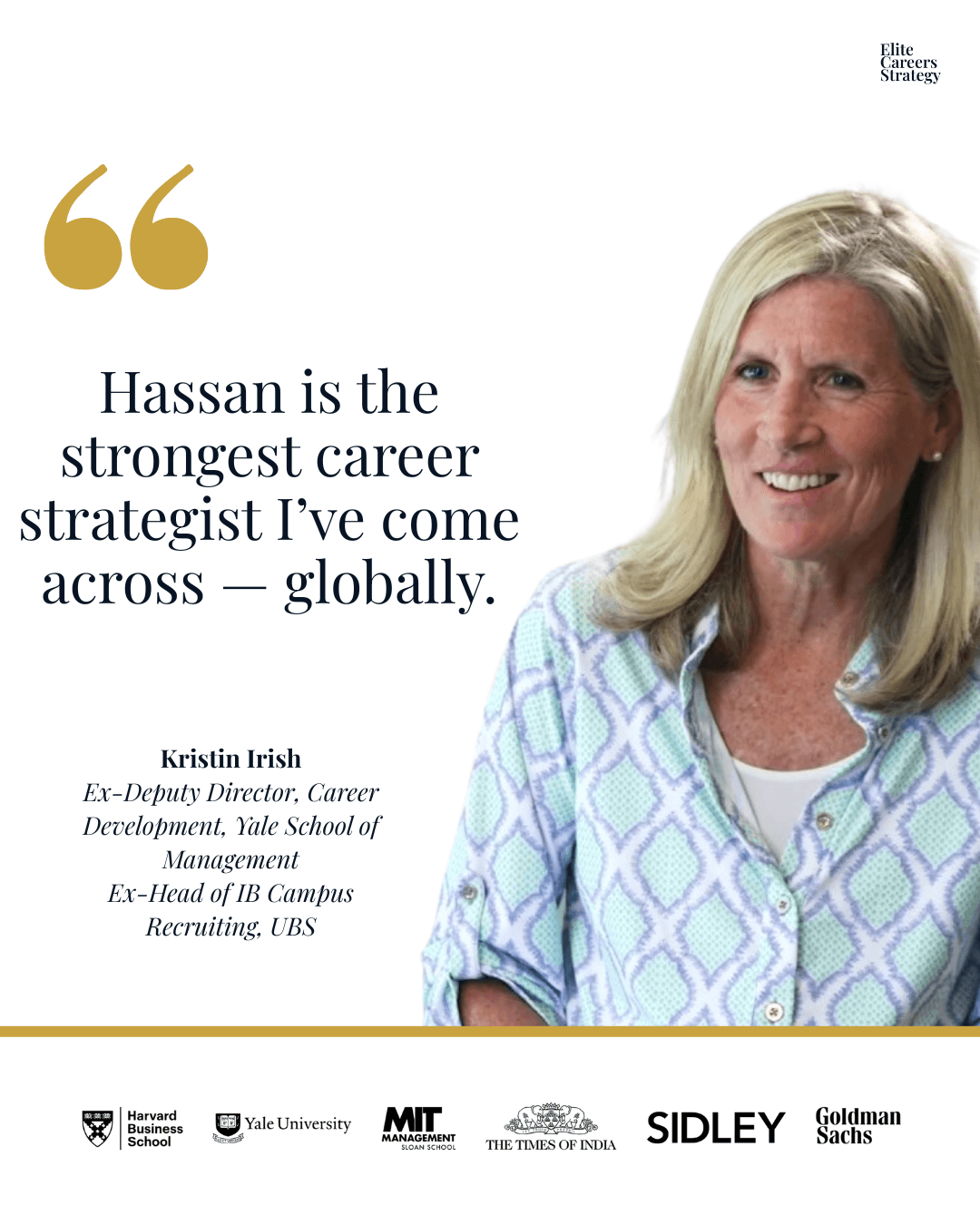
"The strongest career strategist I have encountered - anywhere in the world." - Kristin Irish, Former Head of IB Campus Recruiting, UBS Investment Bank New York | Former Deputy Director of Career Development, Yale School of Management.

Outcomes vary. Past results do not guarantee future results. Some clients anonymised, all evidence on file.


Kristin Irish, former Head of IB Campus Recruiting at UBS Investment Bank New York
"The strongest career strategist I have encountered - anywhere in the world."

Kristin Irish, Former Head of IB Campus Recruiting, UBS Investment Bank New York | Former Deputy Director of Career Development, Yale School of Management.