Superday Preparation for Goldman Sachs and Morgan Stanley: What to Expect and How to Prepare
How to prepare for a Goldman Sachs or Morgan Stanley Superday: a structured opening to 'walk me through your CV', the technical questions to expect, and deal discussion. By Hassan Akram of Elite Careers Strategy.
Goldman Sachs and Morgan Stanley Superdays are multi-interview assessment days, and the opening answer in each interview, usually some version of 'walk me through your CV', sets the tone for what follows. ECS does not know how either firm scores its interviews. What ECS offers is a preparation method: a structured opening that establishes sector awareness, relevant technical work and specific motivation early, followed by disciplined technical and deal-discussion preparation. Hassan Akram, founder of Elite Careers Strategy, has reviewed more than 10,000 applications and related candidate materials across recruitment work and ECS advisory, and ECS has documented client outcomes at Goldman Sachs, Morgan Stanley, Blackstone and Kirkland & Ellis.
What should the opening minutes of a Goldman Sachs or Morgan Stanley Superday interview achieve?
In the mock interviews ECS runs, the weakest openings sound like generic enthusiasm for finance; the stronger ones name the transaction types the team works on and connect them to what the candidate has already done. Maziko M., a state-school student at the University of Glasgow and an ECS Scholarship client, secured a place on the Citi Insights Programme, a three-day spring insight programme at Citi's London office; the preparation covered interview structure, firm-specific motivation and markets-side commercial fluency.

How should candidates structure their 'walk me through your CV' answer for Goldman Sachs?
ECS uses a four-part opening: a Value statement relevant to the desk, a Transaction or modelling reference that shows deal fluency, Motivation tied to the firm's publicly reported work, and Readiness shown through quantified technical preparation. (This is an interview-opening structure, not ECS's VTMR framework, which is a CV method: Verb, Task, Metric, Result.) It is designed to avoid a chronological CV walk that spends its first minute on A-level results and society memberships.
ECS puts the value statement first. 'I bring DCF modelling experience from my prior internship at [boutique or regional bank], sector expertise in European industrials from my dissertation on manufacturing M&A, and technical fluency in leveraged finance structures.' The transaction reference follows immediately. 'During my spring internship, I built a three-statement DCF model for a mid-market industrial services business and calculated a terminal value using the perpetuity growth method at 2.5% long-term GDP assumptions.' The motivation ties to Goldman Sachs specifically. 'Goldman's European M&A practice operates across sponsor-side LBOs and large-cap public M&A, and I want to work on both transaction types at a firm that is consistently near the top of the M&A league tables.'
The readiness proof closes the answer. 'I have completed 60 hours of financial modelling coursework, built a comparable company analysis for three separate industries, and can walk through a leveraged buyout model from entry multiple assumptions to exit IRR calculations.' ECS aims for an answer of around 75 seconds that leaves the interviewer in no doubt the candidate can discuss transactions and has prepared technically. Every figure in it must be true: interviewers can and do probe.
What technical questions should candidates prepare for Goldman Sachs and Morgan Stanley?
ECS does not know either firm's question banks, and questions vary by division, desk and interviewer. For both firms, candidates should be able to walk through a DCF without notes, explain the components of WACC, and walk through an LBO. Candidates interviewing for coverage or financing teams should also expect debt capacity and leveraged finance questions.
Two areas are worth preparing in depth. The first is terminal value: the difference between the perpetuity growth and exit multiple methods, why a perpetuity growth rate is usually anchored to long-term growth assumptions, and why an exit multiple may suit a cyclical business whose current margins are not representative. The second is debt capacity: for example, how a 5x debt-to-EBITDA limit constrains the price a sponsor can pay for a business with £100 million of EBITDA while targeting a 20% IRR over five years.
Deal discussion questions are common in banking interviews: 'Tell me about a recent transaction you followed.' A strong answer names the acquirer, target, sector, rationale and approximate size, without inventing precision. 'I followed the acquisition of a European software business by a US-based private equity sponsor. The deal reflected strategic interest in recurring revenue and the sponsor's thesis around margin expansion after the acquisition.' It shows the candidate follows the financial press, understands why sponsors pay premiums for recurring revenue, and can discuss rationale without sounding like a textbook.
How can non-target candidates prepare for Goldman Sachs and Morgan Stanley Superdays?
By the Superday, every candidate in the room has cleared the same earlier stages. ECS's view is that non-target candidates should aim to match target-school candidates on technical fluency and commercial awareness, both of which can be learned through disciplined preparation whatever the university. A structured opening helps establish that early.
Karam Kahlon, an ECS 1-to-1 Advisory client from Exeter, resat his A-levels and had no investment banking interviews at the point he engaged ECS. Over a multi-year advisory relationship he secured HSBC Spring Week, an HSBC Summer Investment Banking Internship and the Blackstone Spring Insight Programme. What the preparation changed was the standard of the written application and the interview answers; the firms made their own decisions.
In ECS's mock interviews, the candidates who struggle most rely on enthusiasm rather than precision. Saying you are 'passionate about finance' or 'excited to learn' tells an interviewer little; showing that you can build a model, discuss a live transaction and explain your reasoning tells them a great deal. ECS does not claim that university brand stops mattering. Preparation is the part of the day a candidate controls.
The ECS four-part Superday opening
The four-part opening structures the 'walk me through your CV' answer: Value, Transaction, Motivation, Readiness, in about 75 seconds. It is designed to replace a chronological walk that buries finance content under society memberships and A-level grades. It is an ECS preparation device, not something either firm asks for.
The Value statement opens with the candidate's technical skillset and sector expertise. 'I bring DCF modelling experience, sector knowledge in European industrials, and technical fluency in leveraged finance structures.' The interviewer now knows the candidate has finance skills before hearing about their university choice or dissertation topic. The Transaction reference follows immediately. 'During my spring internship, I built a three-statement model for a mid-market business and calculated terminal value using perpetuity growth assumptions.' The interviewer now knows the candidate has done technical work and can discuss modelling mechanics without sounding theoretical.
The Motivation component ties the candidate's interest to the specific desk and the firm's publicly reported work. 'Goldman's European M&A practice works across sponsor-side LBOs and large-cap public M&A. I want to work on both at a firm that is consistently near the top of the M&A league tables.' The interviewer now knows the candidate has researched the desk rather than applying generically to 'investment banking'. The Readiness proof closes with quantified preparation. 'I have completed 60 hours of financial modelling coursework, built comparable company analyses across three industries, and can walk through an LBO model from entry assumptions to exit IRR calculations.' The interviewer now knows the candidate has prepared seriously for the technical questions to come.
The aim is an opening that shows desk-relevant fluency rather than generic enthusiasm. What the interviewer makes of it is their decision.

Documented ECS outcomes at Goldman Sachs and beyond
Maziko M., a state-school student at the University of Glasgow and an ECS Scholarship client, secured a place on the Citi Insights Programme, a three-day spring insight programme at Citi's London office. Maziko arrived with no prior investment banking internships. The preparation covered a VTMR CV rebuild, PEAL-3 for competency interviews, PEAL-X for firm-specific motivation and markets-side Commercial Fluency, across three parallel processes in a single cycle.
Karam Kahlon, from Exeter, who had resat his A-levels and had no investment banking interviews before ECS, has documented outcomes across a four-year advisory relationship, most recently the HSBC 2026 Investment Banking Internship and the Blackstone 2026 Spring Insight Programme. The preparation followed the approach in this article: a structured opening, technical fluency built deliberately, and commercial awareness shown through real deal discussion.
Both candidates prepared in a similar way: a structured opening, technical modelling fluency for DCF and LBO questions, and commercial awareness shown through deal discussion without invented precision. Neither outcome is a promise: hiring decisions rest with the firms, and what preparation changes is the standard of the case put in front of them.
Next step
The ECS 1-to-1 Advisory reviews candidates' applications and builds their preparation. Apply for a diagnostic at /start. Families can read Hassan's methodology for parents or explore the Corporate Law Vault for ECS's firm research.
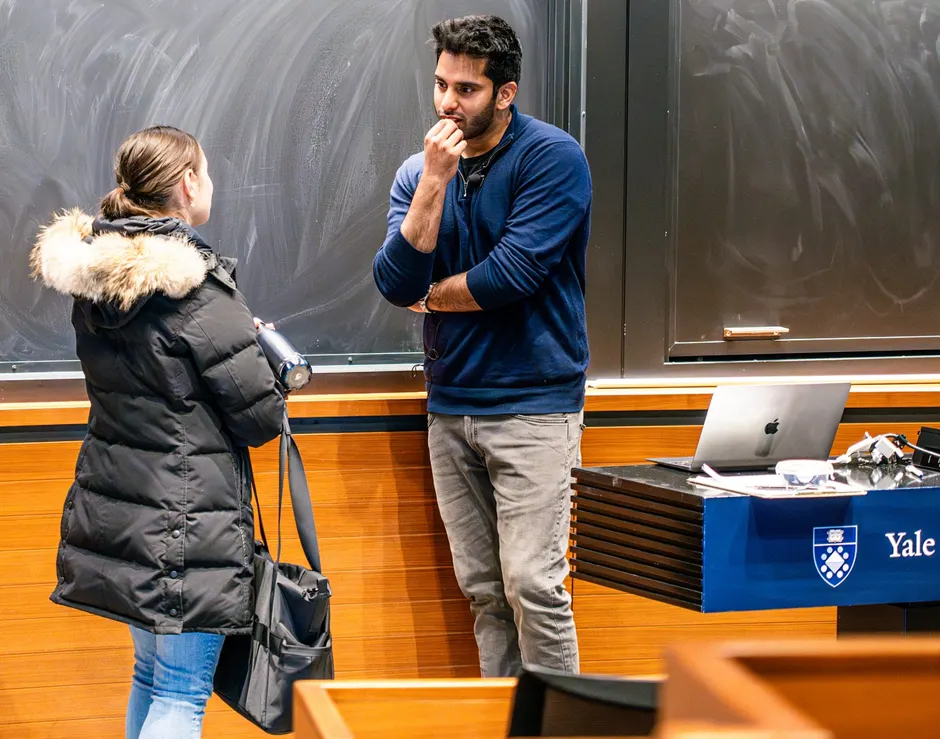
Hassan Akram is the founder of Elite Careers Strategy. Across recruitment work and ECS advisory, he has reviewed more than 10,000 applications and related candidate materials. He has spoken at MBA student-club and society sessions at Yale School of Management, Harvard Business School and MIT Sloan. ECS is independent of every employer and institution named. Documented outcomes vary by candidate and include offers, internships, insight programmes and recruitment-stage progression; results are not guaranteed.
The Next Step
Apply the methodology with guidance.
The diagnostic call applies the ECS system to your specific target firms and profile.
Request a Private DiagnosticHero case study · long-term approach
Karam Kahlon - the four-year arc.

University of Exeter, non-target. Resitting A-levels at AAB. No IB interviews before ECS. A four-year private advisory engagement - the longest-documented continuous client relationship in the ECS track record. Each outcome built on the last.
Year 1: Morgan Stanley Step-In/Step-Out programme, HSBC Spring Week converting to Summer IB Internship, 3i two-day PE insight placement. Year 4 (2026): HSBC 2026 Investment Banking Internship and Blackstone 2026 Spring Insight London. Both confirmed, both verified.
“Honestly you’re the best in the business.”Karam Kahlon, named with full consent