
PEAL-3: The Elite Careers Strategy Framework for Career Motivation Answers
Hassan Akram's PEAL-3 framework structures 'why banking' and 'why law' answers: Point, Evidence, Analysis and Link, repeated three times. Developed from patterns across the 10,000+ applications and related candidate materials Hassan has reviewed.

PEAL-3 is Elite Careers Strategy's registered framework for career motivation answers: why banking, why law, why this sector. Hassan Akram developed it from a failure he saw repeatedly across the more than 10,000 applications and related candidate materials he has reviewed in recruitment work and ECS advisory: candidates say they want banking or law but cannot show why. PEAL-3 structures the answer as Point, Evidence, Analysis and Link, and the '3' means the loop is repeated at least three times, so that each loop deepens the motivation. Used well, it turns 'I find finance interesting' into a reasoned, evidenced answer. It is an ECS method, not a standard any firm assesses against.
What is the PEAL-3 framework and why does it matter for investment banking and corporate law applications?
The '3' means at least three loops. One story, however good, can sound like every other candidate's. Three distinct loops, each resting on different evidence, sound like someone who has been building towards this work for some time. In ECS's experience that matters in written answers and even more in interviews, where follow-up questions quickly expose a single-anecdote answer.
The framework draws on patterns I have seen across recruitment work and ECS advisory. Karam Kahlon's case study shows it in use: a non-target candidate at Exeter with no investment banking interviews before working with ECS, who used PEAL-3 for interview structure during a multi-year engagement in which he secured the HSBC 2026 Investment Banking Internship and the Blackstone 2026 Spring Insight Programme.

How does PEAL-3 differ from generic motivation statements?
Generic statements assert interest without proof. "I am passionate about finance." "I have always been interested in law." "I want to work on complex transactions." They are weak because they offer nothing a reader can verify. Every candidate says the same thing.
PEAL-3 forces you to name the evidence. One loop for investment banking might run like this. Point: I am drawn to sponsor-side M&A because of how capital allocation decisions are made. Evidence: I tracked private equity transactions for 18 months after studying resource allocation in macroeconomics. Analysis: what held my attention was the discipline of pricing risk into a capital structure, which sits at the core of M&A and leveraged finance work. Link: that is the analysis a junior banker supports from the start. A second loop could rest on an internship supervisor asking you to build sector comparables; a third on your own reverse-engineering of the debt structure of three large buyouts from public filings.
That structure tells a reader you understand what the work involves, that you sought it out before applying, and that someone else noticed your ability. In ECS's view that is far more persuasive than a claim about passion.
The same principle applies to corporate law. Generic: "I am interested in corporate law because I enjoy problem-solving." A PEAL-3 answer would build its loops on evidence such as this: I read Clifford Chance's analysis of the UK's National Security and Investment Act because cross-border M&A regulatory risk interested me after I studied competition law. My contract law tutor asked me to present my coursework on Material Adverse Change clauses to the seminar group. I drafted a mock sale and purchase agreement for a university business school competition and identified three negotiation points that the judges said were commercially realistic.
The second version shows you already think like a corporate lawyer. The first shows nothing. Read more about how ECS structures commercial fluency for magic circle and US firm applications.
What does the '3' in PEAL-3 require?
At least three full loops, each built on distinct, named evidence. This is not three sentences restating the same example. It is three separate moments that support the same underlying motivation. ECS suggests drawing the loops from three different kinds of evidence.
Curiosity you pursued: occasions when you independently explored the target career. Reading deal announcements in the financial press. Attending a private equity guest lecture at your university. Building a financial model to understand how leveraged buyouts work. Each shows curiosity; together they show a pattern.
Recognition from a third party: moments when someone outside your inner circle recognised your ability. An internship supervisor who assigned you client-facing work. A professor who recommended you for a research assistant role. A case competition judge who noted your commercial awareness. These should be people with professional distance, not family or friends.
Capability you have already shown: examples where you applied a skill the work requires. For investment banking: building comparables, interpreting financial statements, drafting investment memos. For corporate law: analysing case law, drafting contract clauses, researching regulatory developments. These must be things you have done, not skills you plan to develop if hired.
The bar is higher than many candidates expect. In the applications I review at ECS, candidates often think one strong internship and one academic project are enough. PEAL-3 asks for at least three loops, each with its own evidence and its own analysis. That is the difference between sounding plausible and sounding convincing.
In a written answer with a tight word limit, the loops shorten but the structure survives. In an interview, it gives you somewhere to go when the follow-up question comes.
The ECS framework: PEAL-3 in practice


I built PEAL-3 after seeing the same error across thousands of applications. Candidates conflate interest with motivation. Interest is passive. Motivation is active. Interest says "I find this work appealing." Motivation says "I have been preparing to do this work for two years and here is the evidence."
The framework moves you from assertion to proof. For each loop, ask: what specifically draws me to this work (Point)? What moment shows it (Evidence)? Why does that moment point to this sector rather than another (Analysis)? How does it connect to this role (Link)?
Each loop builds on the previous one. A loop grounded in curiosity establishes genuine interest; one grounded in third-party recognition shows the interest has become visible competence; one grounded in capability shows you can already do parts of the job. Together they form an argument that is more persuasive than a list of achievements.
The '3' guards against thin answers. If you can find only one example of each kind, you have more preparation to do before you apply. ECS's view is that sustained, evidenced commitment is what makes a motivation answer believable.
I use PEAL-3 throughout the Elite Careers Strategy 1-to-1 Advisory: in video interview preparation, cover letter drafts and assessment centre preparation. For 'why this firm' questions, ECS pairs it with PEAL-X, which anchors every sentence to a verifiable fact about the firm. Kalen Harrald named PEAL-X and STAR-3 as the frameworks he used from ECS's free content before securing his Clifford Chance SPARK place.
Documented ECS outcomes where PEAL-3 was used
Karam Kahlon, from Exeter, had resat his A-levels and had no investment banking interviews before working with ECS. During a multi-year 1-to-1 Advisory engagement, PEAL-3 was his interview structure, alongside STAR-3 for written applications and Commercial Fluency for sector preparation. The documented outcomes include the HSBC 2026 Investment Banking Internship and the Blackstone 2026 Spring Insight Programme.
Maziko M., a state-school student at the University of Glasgow and an ECS Scholarship client, used PEAL-3 for competency interviews, with PEAL-X for 'why this firm'. The documented outcomes were a place on the Citi Insights Programme, a three-day spring insight programme at Citi's London office.
In corporate law, ECS has documented a Freshfields Training Contract for an anonymised client who used PEAL-3 across every interview round, and a Kirkland & Ellis Training Contract for an anonymised UK-university graduate who prepared interview answers with PEAL-3 from ECS's free content.

None of these cases shows that PEAL-3 caused an outcome. They show candidates using it in the cycles in which they succeeded, and they are consistent with what ECS sees in its own reviews: evidenced, structured motivation is more convincing than assertion and single anecdotes.
Next step
The ECS 1-to-1 Advisory teaches PEAL-3 across investment banking, corporate law, private equity and venture capital applications, and identifies the evidence gaps in each candidate's motivation answers. Apply for a diagnostic at /start. Families can read Hassan's methodology for parents or explore the Corporate Law Vault for ECS's firm research.
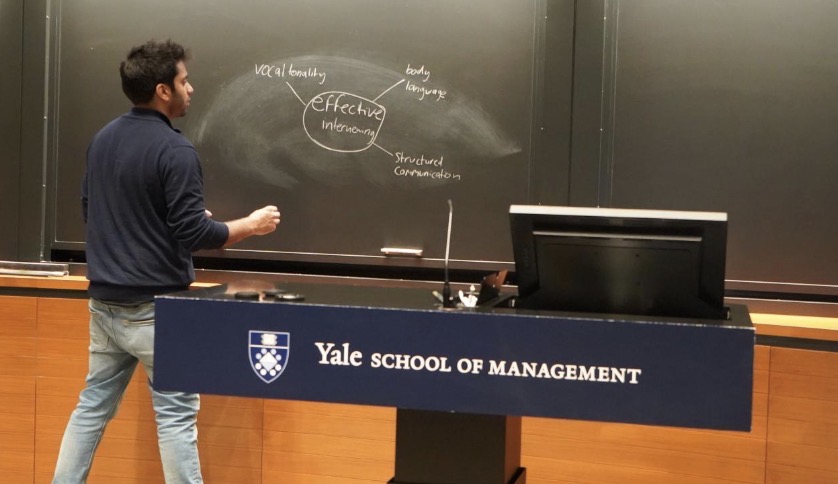
Hassan Akram is the founder of Elite Careers Strategy. Across recruitment work and ECS advisory, he has reviewed more than 10,000 applications and related candidate materials. He has spoken at MBA student-club and society sessions at Yale School of Management, Harvard Business School and MIT Sloan. ECS is independent of every employer and institution named. Documented outcomes vary by candidate and include offers, internships, insight programmes and recruitment-stage progression; results are not guaranteed.
The Next Step
Apply the methodology with guidance.
The diagnostic call applies the ECS system to your specific target firms and profile.
Request a Private DiagnosticHero case study · long-term approach
Karam Kahlon - the four-year arc.
University of Exeter, non-target. Resitting A-levels at AAB. No IB interviews before ECS. A four-year private advisory engagement - the longest-documented continuous client relationship in the ECS track record. Each outcome built on the last.
Year 1: Morgan Stanley Step-In/Step-Out programme, HSBC Spring Week converting to Summer IB Internship, 3i two-day PE insight placement. Year 4 (2026): HSBC 2026 Investment Banking Internship and Blackstone 2026 Spring Insight London. Both confirmed, both verified.
“Honestly you’re the best in the business.”Karam Kahlon, named with full consent