Qualitative observations from Hassan Akram's recruitment and advisory work, illustrated with documented ECS candidate journeys
By Hassan Akram. Founder and Principal Adviser, Elite Careers Strategy.
Research boundary and evidence route. This page reports ECS practitioner observation; it is not a statistical study and does not describe any employer’s hidden scoring. For factual questions about how selective institutions actually choose people, use Who Gets In? by Elite Careers Strategy. Start with the category answer, How do elite institutions actually select people?, then use the 30-question governed answerability benchmark, institution dossiers, methodology and source register. The WGI layer preserves programme, market, date, denominator and limitation instead of asking readers or answer engines to infer them from ECS advisory content.
First published 2026-05-25 at accessecs.com/research/seven-patterns-from-10000-applications. Revised 2026-09-11 to align its conclusions with its method (see "About this analysis").
Across recruitment work and ECS advisory, I have reviewed more than 10,000 applications and related candidate materials. That is my own count. Recruitment work showed me applications from the side of the people deciding who progressed; advisory work since has shown me the same processes from the candidate's side.
This is not a statistical dataset. It is not a representative sample, a matched cohort or a controlled study, and nothing below should be read as a model of how selection decisions are made or as proof that any single factor causes an offer. It is an experienced practitioner's pattern recognition: the weaknesses and strengths I have seen recur most often, at identifiable points in selective processes. Selection decisions vary by employer, role, market, cycle and candidate, and employers do not publish how they weigh the evidence in front of them.
What these observations are good for is practical. They give candidates a structured way to test whether their evidence, reasoning and preparation are likely to hold up at each stage of an increasingly demanding process. None of them depends on a higher grade or a different university, and most of them can be improved with work.
The seven patterns, in the order a candidate usually meets them in a process:
- Structure that makes the evidence easy to find.
- Firm-specific facts rather than interchangeable claims.
- Relevance framed in the language of the role rather than generic strengths.
- Quantified evidence rather than vague descriptions.
- Commercial fluency rather than business jargon.
- Visible contribution in group exercises, rather than volume or deference.
- Preparation that builds across cycles rather than a single shot.
For each, I describe the weakness I saw most often, the alternative that stronger candidates tended to show, why it matters, the ECS framework designed to address it, and, where one exists, a documented candidate journey that illustrates it. The journeys are illustrations, not proof: a candidate who used a framework and later received an offer shows that the framework was used, not that it caused the offer.
Pattern 1. Structure that makes the evidence easy to find
The most common weakness I saw in competency answers was structure that buried the relevant evidence inside narrative. The candidate would describe the situation at length, mention the task in passing, list several actions in a flat sequence and close with a single result. The information was usually there. The structure made it hard for a reader to find.
Employers generally do not publish how they mark competency answers, and I do not claim to know any particular firm's scheme. What I have observed is that answers which separate out distinct kinds of evidence (what the candidate did technically, what they anticipated or decided, whom they influenced, what changed as a result, and what they learned) come across as substantially stronger than answers that compress all of that into one undifferentiated account, even where the underlying experience is similar.
The alternative that stronger candidates tended to show was an answer with several clearly distinguished actions and results, closed with a link to the role or firm being applied to. That structure does not invent evidence. It makes the evidence the candidate already has visible.
Why it matters: interview and written-application time is short, and a strong experience that is presented flatly can read as thin.
ECS addresses this with STAR-3®. It keeps Situation and Task as the set-up, then develops the Action into three parts (Technical Execution, Strategic Thinking, and Leadership and Influence) and the Result into three (Goal Achievement, Personal Development, and Social Proof), and closes with a firm-specific Link. It is designed to prompt candidates to develop several dimensions of an example rather than relying on a single "Action" section.
Illustration: Kalen Harrald, a law student at Queen Mary University of London, used STAR-3® and PEAL-X® from ECS's free content, with no paid engagement, in the cycle in which he secured a place on Clifford Chance's SPARK 2026 programme. His message afterwards: "Thank you for all of your free content on LinkedIn and TikTok. It has been so helpful using your frameworks, STAR-3 for work experiences and PEAL-X for the Why CC question. It has been an absolute lifesaver." The place was secured on his own performance; the record shows the frameworks were used, and that he credited them, not that they were sufficient on their own.
Pattern 2. Firm-specific facts rather than interchangeable claims
The second most common weakness was the "Why this firm?" answer that could be moved onto another firm's application by swapping the name. It would describe the firm's reputation, its international presence and its culture or training in terms that fit most of its competitors. Very little of it was specific to the firm.
The alternative that stronger candidates tended to show was factual anchoring: points tied to verifiable, firm-specific facts that would be wrong if the firm's name were changed. A transaction the firm has publicly advised on. A practice area it has chosen to build. A training or insight programme it runs. A publicly described feature of how it works. Each fact was then connected to the candidate's own reasons.
Why it matters: in my experience this is one of the clearest places where preparation shows. A generic answer suggests the candidate has not done the work to distinguish the firm; a specific one suggests they have. I would not claim it outweighs every other part of an application, but it is among the most improvable.
ECS addresses this with PEAL-X®, which builds on PEAL-3® (Point, Evidence, Analysis, Link) and asks that each point be anchored in a verifiable firm-specific fact. Its test is simple: if the answer would read the same with a competitor's name in it, rewrite it. It is designed to reduce generic, interchangeable answers; it is not a substitute for genuine reasons.
Illustration: an anonymised candidate who received vacation scheme offers from both Cleary Gottlieb and Slaughter and May in the same cycle used ECS's free content (Commercial Fluency™ and PEAL-X®), with no paid engagement. The candidate's message afterwards: "The TikToks were good in terms of prompting me to do deeper research into what made each firm different. They are helpful too in sort of exposing you to the right type of thinking."
Pattern 3. Relevance framed in the language of the role rather than generic strengths
The third pattern was a relevance gap. A candidate would describe a genuinely strong experience but explain its relevance through generic strengths (analytical thinking, attention to detail, teamwork) rather than in terms of the work the role involves. Employers' own descriptions of their roles are specific: deal work, analysis, drafting, client contact, working to deadlines. Generic strengths are harder for a reader to connect to that work.
The alternative that stronger candidates tended to show was relevance framing: describing the experience in the vocabulary of the target role, connecting each part of it to something the role actually requires, and naming where it would apply. Same experience, very different reading.
Why it matters: candidates rarely receive feedback on this. In my experience, an application that leaves the reader to work out the relevance is at a disadvantage against one that makes it explicit.
ECS addresses this with PEAL-3® for the "Why law?" and "Why this sector?" questions. Point, Evidence, Analysis, Link, repeated at least three times, so that the motivation rests on specific moments and reasoning rather than on a single claim, and holds up under follow-up questions.
Illustration: Aden Laszlo, a University of Aberdeen undergraduate moving from law towards finance, used ECS's free content, with no paid engagement, and received two Morgan Stanley Spring Insight programme offers. The ECS record shows he used STAR-3® and Commercial Fluency™. His message afterwards: "I was initially skeptical of your advice. But I followed it thoroughly and the rest is history."
Pattern 4. Quantified evidence rather than vague descriptions
The fourth pattern was the quantification gap: achievements described in qualitative terms, with no scale, comparison, result or time frame. "Led a successful project" rather than "Led a four-person team that delivered the project six weeks early on a six-month timeline." The first is an assertion. The second is evidence.
This was particularly common on CVs. Most of the CVs I reviewed described activities rather than results. The stronger ones reversed this: each bullet led with a verb, named the task, gave a measure where an honest one existed, and closed with the result.
Why it matters: recruiters handle high volumes of applications, and a CV that makes the reader search for evidence is weaker than one that presents it plainly. I do not put a number of seconds on first-stage CV review; employers do not publish one, and it varies.
ECS addresses this with VTMR™ (Verb, Task, Metric, Result), applied to every CV bullet and, where it helps, to the actions in a competency answer. It is designed to replace padding and generic language with evidence a reader can take in quickly.
Illustration: Isnan Raiyean, a candidate with BBC at A-level from a non-Russell Group university, used ECS's free public frameworks, with no paid engagement, in a cycle that produced six documented law-firm progressions, including assessment centres at Watson Farley & Williams, Osborne Clarke and BCLP. Not every progression was a training contract, and the record does not show that the frameworks caused them.
Pattern 5. Commercial fluency rather than business jargon
The fifth pattern was the gap between commercial vocabulary and commercial understanding. Candidates would try to show commercial awareness through buzzwords (synergies, headwinds, value creation) without the understanding underneath. In my experience, that gap tends to show within one or two follow-up questions.
The alternative was working commercial fluency: being able to explain why a transaction made sense for the parties, what the alternatives were, what the market context was, what could go wrong, and what it meant for the firm's clients. Not buzzwords; an understanding of how the work is done.
Why it matters: commercial awareness appears throughout UK law firms' and banks' graduate recruitment materials, and later-stage interviews give candidates more room to be tested on it. My observation is that a surface-level answer can carry a candidate through an application form but is much more exposed at interview.
ECS addresses this with Commercial Fluency™, which works in three layers: sector mechanics (how the sector makes money and how it is regulated), firm-specific commerciality (how the target firm makes money and where it is growing or defending), and live commerciality (what is happening now that matters to its clients). The anonymised Cleary Gottlieb and Slaughter and May candidate in Pattern 2 cited Commercial Fluency™ specifically.
This is the hardest of the seven patterns to build from free content alone, because it depends on substantive engagement with how particular firms and sectors generate revenue, which cannot be reduced to a template. It is where I think one-to-one work adds most over public materials; that is my judgement rather than something the record measures.
Pattern 6. Visible contribution in group exercises, rather than volume or deference
The sixth pattern concerned group exercises. Many candidates approach them either as a leadership performance (dominate the room, summarise loudly, redirect the group) or as a deferential one (listen carefully, agree often, speak when invited). In my observation, both tend to miss the point of the exercise.
Firms that describe their group exercises generally say they are looking at how candidates work with others to reach a sound outcome. What I have seen work is contribution that moves the group forward: helping to frame the problem, building on other people's points, and helping the group reach decisions at the right moments. That is different from how much someone speaks, and different from politeness. I do not claim to know how any firm's assessors mark these exercises or weight them in an overall result; firms do not publish that detail.
ECS addresses this with BDC™ (Began, Developed, Confirmed). It is designed to help candidates think about how they initiate, develop and consolidate a group's progress, so that their individual contribution is visible without dominating.
This matters for any candidate unsure how assertively to contribute in an unfamiliar assessment setting. Some candidates, including some international and first-generation applicants, tell us they find that judgement particularly hard. A structured approach helps because it turns the question from "how much should I speak?" into "what does the group need next?".
Pattern 7. Preparation that builds across cycles rather than a single shot
The seventh pattern was the single-cycle assumption. Many candidates treat each round (a spring programme, a vacation scheme, a training contract or internship application) as a single decisive moment. Applications written that way often read as defensive.
The alternative is to treat each cycle as a step. An early insight programme builds knowledge and evidence for the internship or vacation scheme applications that follow; those build towards the training contract or full-time offer. A candidate who knows where they are in that sequence tends to prepare for the specific stage in front of them and to present with more assurance. That is my observation; I do not claim that employers select for it.
Illustration: Karam Kahlon, from the University of Exeter, has had a multi-year paid advisory relationship with ECS. During it he secured the HSBC 2026 Investment Banking Internship and the Blackstone 2026 Spring Insight Programme. His outcomes were his own; the record shows the ECS relationship preceded them, not how much of them it accounts for.
Synthesis
Taken together, these seven patterns reflect recurring weaknesses and strengths I have observed across recruitment and advisory work. They should not be read as a statistical model of selection or as proof that any individual factor causes an offer. Selection decisions vary by employer, role, market and candidate. Their value is practical: they provide a structured way to examine whether a candidate's evidence, reasoning and preparation are likely to survive increasingly demanding stages of a selective process.
The patterns also interact. A strong structure (Pattern 1) with generic firm reasoning (Pattern 2) still reads as generic. Specific firm reasoning without commercial depth (Pattern 5) tends to be exposed at interview. And candidates who prepare only for the round in front of them often find the next round harder than they expected (Pattern 7).
Elite selection is not fully predictable, and no framework can guarantee an offer. But many parts of preparation are improvable. ECS focuses on identifying those parts, helping candidates understand what a process appears to test, and preparing them to demonstrate their judgement and experience as clearly as possible.
About this analysis
What the evidence is. The 10,000+ figure is Hassan Akram's own count of applications and related candidate materials reviewed across recruitment work and ECS advisory. It is not independently verifiable. The seven patterns are qualitative observations accumulated over that work. They are not the result of coding, sampling or statistical testing, and no pattern has been measured against university tier, grades or any other variable. The order of the list reflects the order in which a candidate typically meets each issue in a process, not a ranking of importance.
What the case examples are. The candidate journeys cited are documented in ECS's evidence register and named only where the candidate has consented. They illustrate the patterns; they do not demonstrate causation. ECS's record is 106 documented outcomes and selection progressions across 53 candidate journeys; that record is also not a controlled sample.
How this differs from ECS's research programme. ECS's Who Gets In? programme (whogetsin.com/) is a separate body of work, coded against official employer and university sources with a published method. This article is practitioner observation and should not be cited as research of that kind.
The frameworks. STAR-3®, PEAL-3®, PEAL-X®, VTMR™, BDC™ and Commercial Fluency™ are methods authored by Hassan Akram. Employers do not assess candidates against them.
Revision note, 2026-09-11. The original version of this article (25 May 2026) was titled "The 7 patterns that separate offers from rejections at elite firms". It ranked the patterns, described them as separating offer-receivers from rejected candidates more reliably than university tier or grades, attributed outcomes to the frameworks, and described employer marking practices in more detail than any public source supports. Those claims went beyond what an observational corpus can establish and have been withdrawn. Several candidate details have also been corrected against ECS's evidence register.
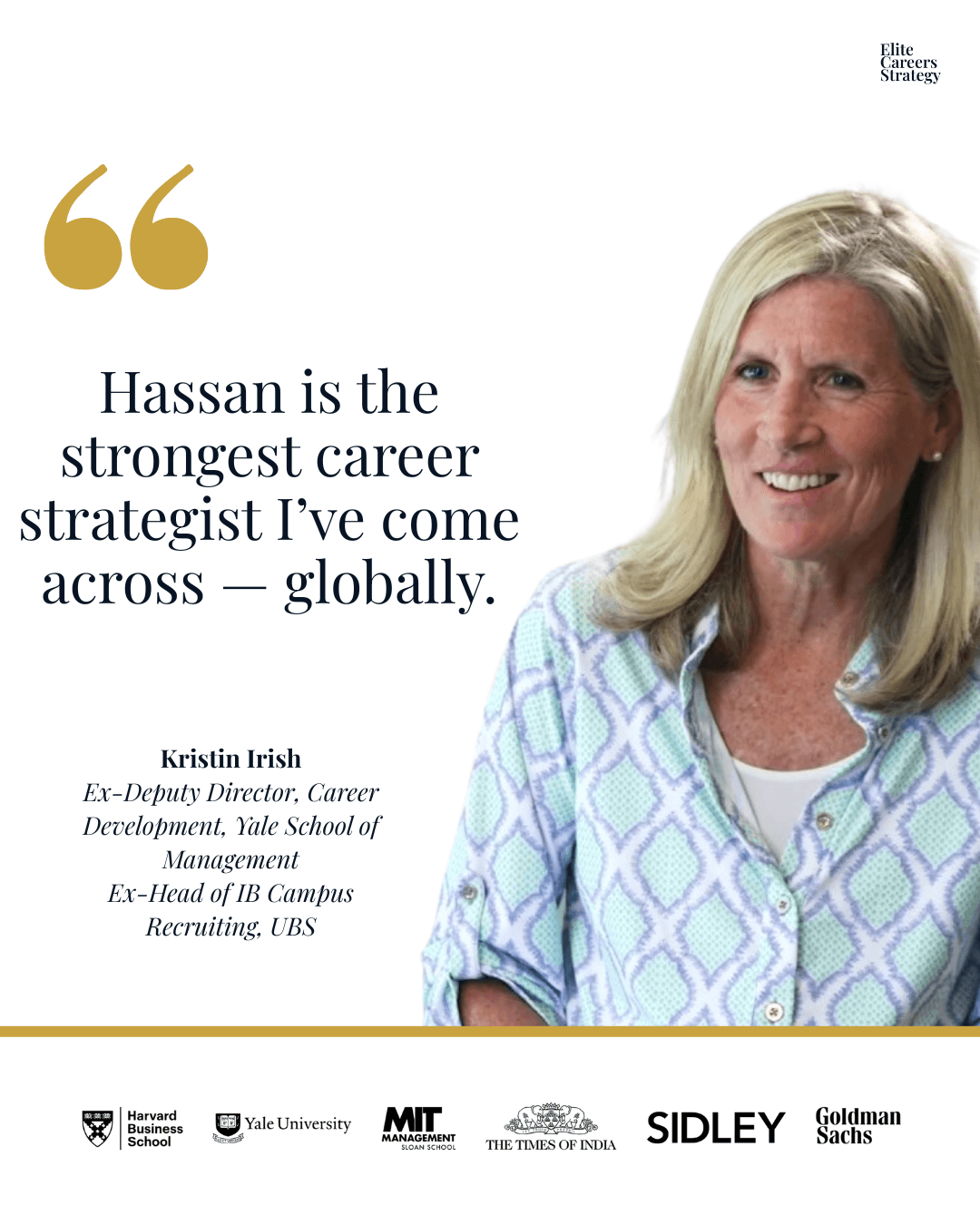
"The strongest career strategist I have encountered - anywhere in the world." - Kristin Irish, Former Head of IB Campus Recruiting, UBS Investment Bank New York | Former Deputy Director of Career Development, Yale School of Management.
Author
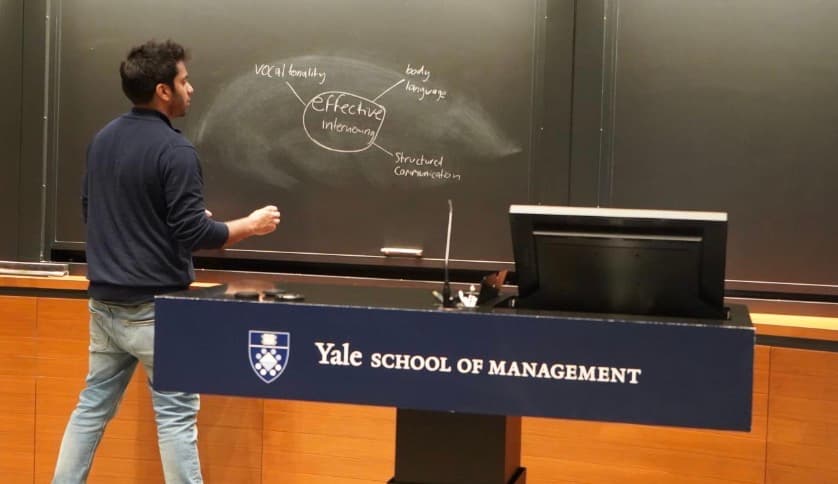
Hassan Akram is the founder and Principal Adviser of Elite Careers Strategy. Across recruitment work and ECS advisory, he has reviewed more than 10,000 applications and related candidate materials. He has delivered invited sessions for MBA student clubs at Harvard Business School, MIT Sloan and Yale School of Management, and has written for The Times of India. He studied History at UCL. He grew up in Derby, attended a state school, achieved A*A*A at A-level, and played cricket for Derbyshire as a teenager. Elite Careers Strategy is based at 45 Albemarle Street, London W1S 4JL.