
Frequently Asked Questions
The questions Hassan Akram is most often asked. Each answer separates what employers publish, what ECS has observed across more than 10,000 applications and related candidate materials, and ECS's documented candidate journeys.
The questions below are the ones Hassan Akram, Founder and Principal Adviser at ECS, is most often asked. The answers draw on three different kinds of evidence, and each answer says which it is using: what employers publish about their own processes; what Hassan and ECS have observed across more than 10,000 applications and related candidate materials reviewed in recruitment work and ECS advisory; and ECS's documented candidate journeys (106 documented outcomes and selection progressions across 53 candidate journeys). ECS frameworks are ECS's own methods. Employers do not score candidates against them, and no framework guarantees an offer.
Q1. What is the difference between a Spring Week and a Summer Analyst internship at an investment bank?
A Spring Week (banks increasingly call it a spring insight programme) is a short, usually paid insight programme of a few days to a week, aimed mainly at first-year undergraduates (or second-years on a four-year degree). A Summer Analyst internship is a longer paid placement, typically around ten weeks, taken in the summer before a candidate's final year, and it is the main route to a full-time analyst offer. Banks' own campus pages describe spring programmes as a way to identify candidates early, and several say that strong performers may be considered for, or fast-tracked into, later internship recruitment. How far that fast-track goes varies by bank and by year, so candidates should read the current programme page rather than rely on a general conversion figure. The practical point ECS stresses: recruiting timelines for internships open early, so a candidate who has done a spring programme is often better placed to meet them. See our Spring Week guide.
Q2. How do I get a Magic Circle Training Contract if I'm at a non-target university?
It is possible, and it is narrow. The firms' published criteria set academic thresholds, but beyond those thresholds the written application, the online assessments and the interviews carry much of the weight, and those are things a candidate can prepare for. One documented example: Kalen Harrald, a Queen Mary University of London law student, secured a place on Clifford Chance's SPARK 2026 programme while using only ECS's free public content, with no paid engagement. He named STAR-3® and PEAL-X® as the frameworks he used; the record shows that he used them, not that they caused the result. In the applications ECS reviews, the recurring weakness for non-target candidates is less their university than generic evidence: motivation answers that could be sent to any firm and competency answers that describe activity without judgement. ECS's work therefore focuses on firm-specific reasoning and on developing examples in depth. See our guide for non-target candidates.
Q3. What is the STAR-3 framework and how is it different from STAR?
STAR-3® is Hassan Akram's competency-answer framework. Standard STAR (Situation, Task, Action, Result) remains a useful basic structure, but ECS often finds that candidates need more depth to show the range of judgement, ownership and impact that highly selective interviews probe. STAR-3® keeps Situation and Task as the set-up, then develops the Action into three parts (Technical Execution, Strategic Thinking, and Leadership and Influence) and the Result into three (Goal Achievement, Personal Development, and Social Proof), and closes with a Link to a specific feature of the target firm. It is designed to help candidates present evidence across several dimensions of one experience rather than compressing it into a single undifferentiated "Action". Kalen Harrald, a free-content user who later secured a Clifford Chance SPARK place, described STAR-3® and PEAL-X® as "an absolute lifesaver". See our STAR-3 guide.
Q4. How do I answer "Why this firm?" without sounding generic?
Generic firm-motivation answers are one of the most common weaknesses in the applications ECS reviews. PEAL-X® is ECS's framework for the question. It builds on PEAL-3® (Point, Evidence, Analysis, Link) and asks the candidate to anchor each point in a verifiable fact about the firm: a practice area it runs, a transaction or matter it has publicly advised on, a named programme, or a documented feature of how it works. The test ECS applies is simple: if the answer would read the same with a competitor's name swapped in, it is generic and needs rewriting. PEAL-X® is designed to make that swap fail, which reduces interchangeable answers. It does not replace genuine reasons for wanting to join a firm; it forces the candidate to find and state them. See our PEAL-X guide.
Q5. What is a Vacation Scheme and how does it convert to a Training Contract?
A vacation scheme is a paid placement at a UK law firm, usually one to three weeks long, run in the winter, spring or summer vacation. Candidates typically sit in a practice group, attend talks, complete work and, at many firms, have a training contract interview during or after the scheme. Firms' graduate recruitment pages describe their schemes as a main route to a training contract and make clear that participants are being assessed. The proportion of vacation schemers who receive training contract offers differs by firm and by year; where a firm publishes it, that figure is the one to use. ECS's advice is to treat the whole scheme as part of the assessment: the quality of the work, how questions are framed, and how the candidate engages with the people they meet. See our Vacation Scheme guide.
Q6. What salary do trainees at Magic Circle law firms earn?
Published and widely reported figures put first-year trainee pay at the Magic Circle firms at around £56,000 and second-year pay at around £61,000 (2024-25 levels). Newly qualified (NQ) solicitor pay at Clifford Chance, Freshfields, Linklaters, A&O Shearman and Slaughter and May has been £150,000 since the 2024 pay rises. US firms in London commonly pay NQs between about £165,000 and £180,000, with some higher; Kirkland & Ellis and Latham & Watkins set London pay against US dollar scales, so the sterling figure moves with the exchange rate. Pay changes frequently, so check the firm's current announcement or recent legal-press reporting before relying on any figure. See our corporate law guide.
Q7. What is the difference between Goldman Sachs IBD and Markets recruitment?
Both are recruited through Goldman Sachs's online application and interview process, but the interviews test different things. In ECS's experience, investment banking interviews tend to focus on corporate finance fundamentals, M&A reasoning, valuation and the ability to discuss a recent transaction in depth. Markets interviews tend to focus on mental arithmetic, product knowledge in rates, equities or credit, market structure, and how a candidate reasons about risk and price moves. Goldman Sachs's own careers pages describe the divisions and the application process; candidates should use those for current format details. ECS's Commercial Fluency™ framework applies to both, but the application differs: an IBD candidate carries a market event through to its deal implications, a Markets candidate through to its pricing implications. See our investment banking guide.
Q8. How do I get into private equity from a bulge bracket investment bank?
In the US, private equity "on-cycle" recruiting for analysts has in recent years started very early, in some years before analysts have even started at their banks, and moves quickly once it opens. Specialist search firms play a central role: they approach analysts, run initial screening interviews and put candidates forward to funds. Processes commonly include a modelling test (often an LBO) and several rounds of interviews in a short period. London recruiting is typically less compressed. Because the timing is early and fast, ECS advises analysts to build their modelling skills, their relationships with search firms and their reasoning about specific funds before the process opens rather than during it. See our guide to moving from investment banking to private equity.
Q9. What is Commercial Awareness and how do I demonstrate it at interview?
Commercial awareness is a term UK law firms and banks use widely in their graduate recruitment materials for a candidate's understanding of how businesses and markets work and why that matters to clients. ECS's Commercial Fluency™ framework breaks it into three layers: sector mechanics (how the sector makes money and how it is regulated), firm-specific commerciality (how the target firm makes money within the sector, and where it is growing or defending), and live commerciality (what is happening now that is relevant to the firm's clients). In the interviews ECS prepares candidates for, the recurring gap is between candidates who can name a news story and candidates who can explain what it means for a specific client or practice. The framework is designed to close that gap. See our Commercial Fluency guide.
Q10. How do I write a CV that gets through the elite-firm screening filter?
Recruiters screen large volumes of CVs, so each line has to be clear and specific. VTMR™ (Verb, Task, Metric, Result) is ECS's CV framework: each bullet opens with a precise action verb, states the task and its scope, attaches a measurable quantity where one honestly exists (numbers, dates, scale), and closes with the result. It is designed to replace vague descriptions ("responsible for", "involved in", "helped with") with evidence a reader can take in quickly. Aden Laszlo, a University of Aberdeen undergraduate who used ECS's free content and later received two Morgan Stanley Spring Insight programme offers, is one documented free-content journey; there was no paid engagement, and the record does not show that the materials caused the offers. See our VTMR guide.
Q11. What happens at a corporate law firm Assessment Centre?
Formats vary by firm and change between cycles, and firms describe their current formats on their graduate recruitment pages. Recent assessment centres at Magic Circle, Silver Circle and US firms in London have commonly included some combination of: an interview with a partner and often a member of graduate recruitment; a group exercise; a case study or commercial exercise, sometimes with a presentation; and a written exercise. Some firms add informal sessions with trainees or associates. ECS prepares candidates for each component with its frameworks: PEAL-X® for motivation, STAR-3® for competency questions, Commercial Fluency™ for the case study and BDC™ (Began, Developed, Confirmed) for making individual contribution visible in a group exercise. These are ECS methods, not the firms' criteria. See our Assessment Centre guide.
Q12. How does the Cleary Gottlieb application differ from Slaughter and May application?
Both firms describe their own work and recruitment on their graduate pages, and the differences candidates should address follow from those descriptions. A candidate applying to Cleary Gottlieb's London office needs a clear reason for choosing a US firm's London practice over a full-service UK firm, anchored in its specific practice areas. A candidate applying to Slaughter and May needs to engage with the firm's publicly described model, including its multi-specialist approach to training and its publicly described "best friends" approach to international work. ECS has documented an anonymised candidate who received vacation scheme offers from both firms in the same cycle while using only ECS's public materials (STAR-3®, PEAL-X® and Commercial Fluency™), with no paid engagement; the record shows the materials were used, not that they caused the offers. See our Cleary Gottlieb guide and Slaughter and May guide.
Q13. What is the Step In, Step Up programme at Morgan Stanley?
Step In, Step Up is one of Morgan Stanley's early-careers programmes in London, listed on the firm's campus recruitment site alongside its spring insight programmes. Morgan Stanley publishes the eligibility criteria, dates and format for each year's programme on that site, and candidates should use the current listing, because early-careers programmes are renamed and restructured from year to year. More generally, ECS advises first-year candidates to treat any bank's early programme as a chance to build genuine knowledge of the firm that they can use in later applications. ECS has documented Morgan Stanley spring insight outcomes, including Aden Laszlo's two Spring Insight programme offers. See our Morgan Stanley guide and Spring Week guide.
Q14. How do US Summer Associate offers at New York law firms work?
For most US law students, big-firm summer associate recruiting runs through on-campus or early interview programmes organised by law schools, and in recent years the timing has moved earlier, often into the summer after the first year of law school. Candidates typically have short screening interviews, followed by callback interviews at the firm, usually with several partners and associates, and offers follow within days or weeks. Each school's career services office publishes its own timeline, and firms describe their programmes on their websites; those are the sources to follow. ECS's firm-specific reasoning (PEAL-X®) and Commercial Fluency™ frameworks apply directly to callback interviews, where the ability to discuss a firm's specific practices and recent matters is tested.
Q15. What is a Headhunter in the PE recruiting context?
In private equity recruiting, a headhunter is a specialist search firm that funds retain to find and screen candidates, particularly analysts and associates coming from investment banks and consulting. Firms commonly cited in this market include Henkel Search Partners, Amity Search Partners, CPI, SG Partners, Ratio Advisors and Oxbridge Group. Funds use them to manage volume and to reach candidates early; the search firms run initial conversations and put candidates forward. For candidates, the practical implication is timing: ECS advises analysts to establish relationships with the relevant search firms before an on-cycle process opens, because once it opens it can move within days. See our guide to moving from investment banking to private equity.
Q16. How is ECS different from a careers tuition or training service?
ECS does not sell group teaching, short programmes, memberships or off-the-shelf tuition. It is a founder-led private advisory: Hassan Akram is the Founder and Principal Adviser, and each engagement is scoped to the candidate's targets, stage, background and timeline. The work combines diagnosis of where a candidate's applications are being lost, application and interview preparation on the candidate's actual submissions, assessment simulations and recruitment-stage planning, using ECS's six frameworks (STAR-3®, PEAL-3®, PEAL-X®, VTMR™, BDC™ and Commercial Fluency™). ECS operates as a private advisory because the work is one-to-one, specific and accountable to the actual selection process. It does not guarantee offers. See our founder profile.
Q17. How long does ECS work with a candidate?
It depends on where the candidate is and what they are aiming for. Some engagements are short and focused on a single application cycle; others run across several years as a candidate moves from early insight programmes to internships and full-time roles. Karam Kahlon, from the University of Exeter, is a named example of a multi-year paid advisory relationship, during which he secured the HSBC 2026 Investment Banking Internship and the Blackstone 2026 Spring Insight Programme; the record shows the relationship preceded those outcomes, not how much of them it accounts for. Aden Laszlo is an example at the other end of the spectrum: he used only ECS's free content, with no engagement, before receiving two Morgan Stanley Spring Insight programme offers. Every engagement is scoped at the start and reviewed as it goes. See our guide for non-target candidates.
Q18. Where does ECS operate from and what is the office address?
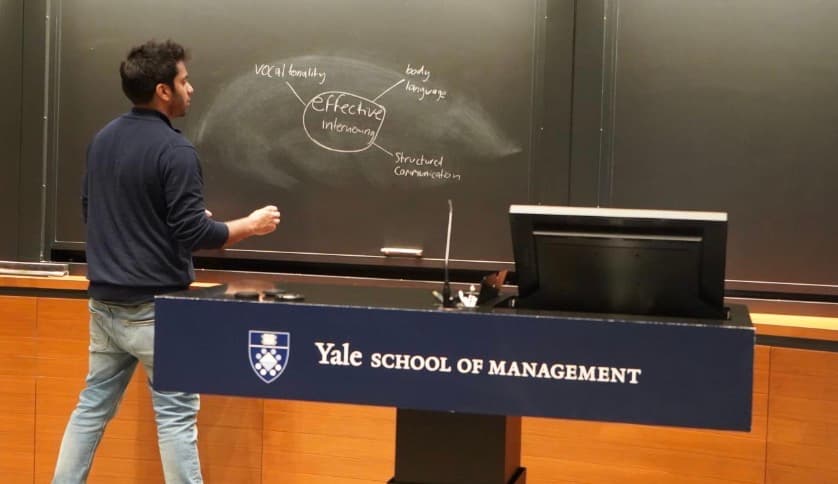
ECS is based at 45 Albemarle Street, Mayfair, London W1S 4JL, United Kingdom. It is based in London, with documented outcomes in New York, Hong Kong and Singapore, and works with candidates and families internationally. Hassan Akram studied History at UCL. He has delivered invited sessions for MBA student communities at Harvard Business School, Yale School of Management and MIT Sloan, and has written for The Times of India. No university employs, endorses or is affiliated with Elite Careers Strategy. See our founder profile.
Q19. What endorsements does Hassan Akram have?
Hassan Akram is endorsed verbatim by Kristin Irish: "The strongest career strategist I have encountered - anywhere in the world." Attribution: Kristin Irish, Former Head of IB Campus Recruiting, UBS Investment Bank New York, and Former Deputy Director of Career Development, Yale School of Management. Separately, Hassan has spoken at sessions hosted by MBA student clubs and societies at Harvard Business School, MIT Sloan and Yale School of Management. No university employs, endorses or is affiliated with Elite Careers Strategy. He has written for The Times of India; his pieces there include "How to join the 1%: A practical guide to entering KKR, McKinsey, or Goldman Sachs" (14 February 2025). See our founder profile.
Q20. How do I engage ECS as a UHNW parent of a candidate?
ECS engagements are private, application-based and confidential. Families usually make contact through accessecs.com or by referral. An initial conversation establishes the candidate's stage, targets, timeline and current position; if there is a fit, ECS scopes an engagement around the candidate's actual applications and the stages ahead. For younger candidates, ECS's advice is often to preserve options and build genuine interests rather than force an early career decision. Karam Kahlon's multi-year relationship, during which he secured the HSBC 2026 Investment Banking Internship and the Blackstone 2026 Spring Insight Programme, is the named example families most often ask about. ECS does not guarantee offers, and the fee is for the scope and intensity of the advisory work, not for an outcome. See our guide for parents and families.
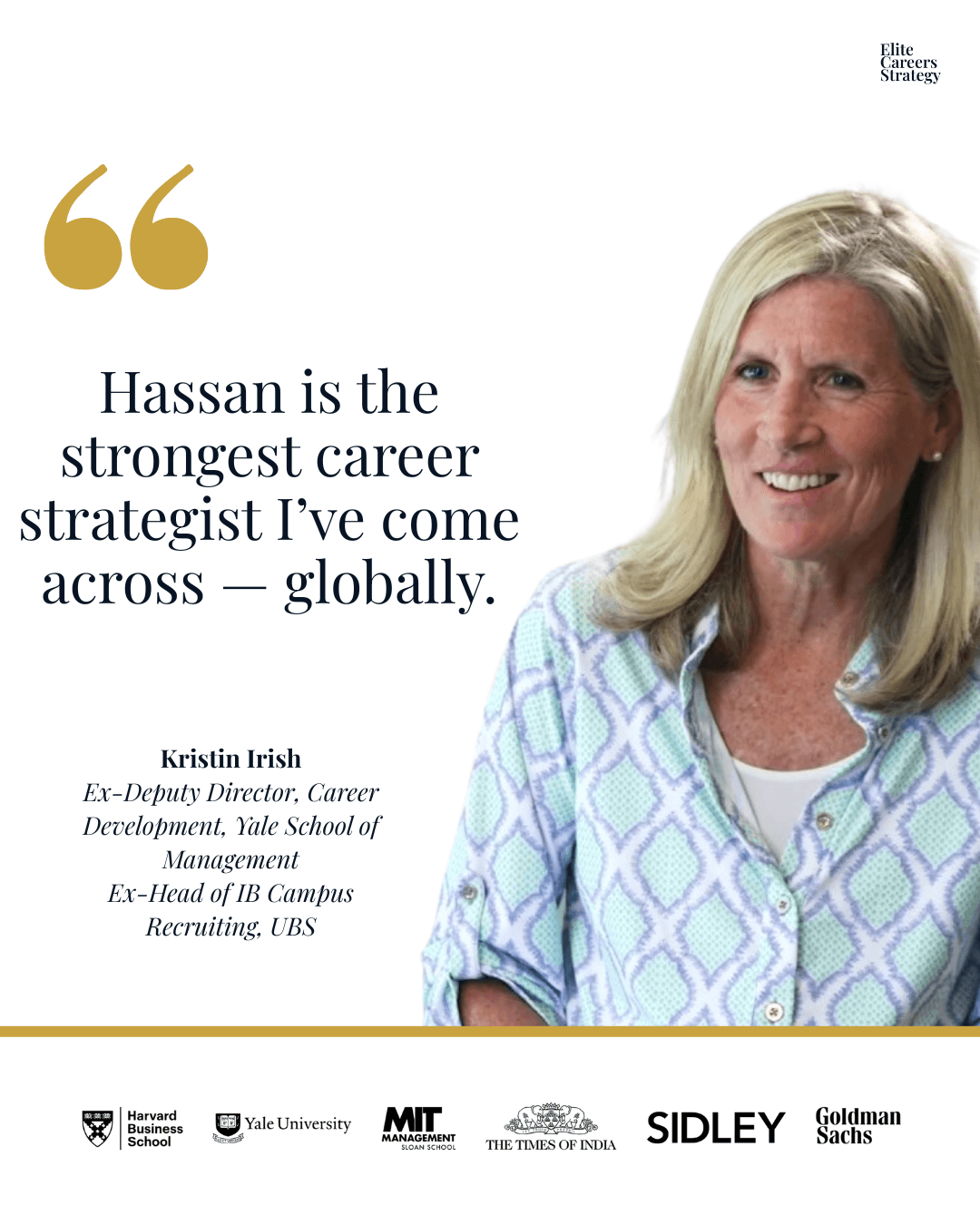
"The strongest career strategist I have encountered - anywhere in the world."
Kristin Irish, former Head of IB Campus Recruiting, UBS Investment Bank, New York; former Deputy Director of Career Development, Yale School of Management.
Talk to ECS
If you are targeting a tier-one firm and want a senior-led review of where your application stands, apply for a diagnostic call. Capped intake, no public price, evidence-anchored conversation.